
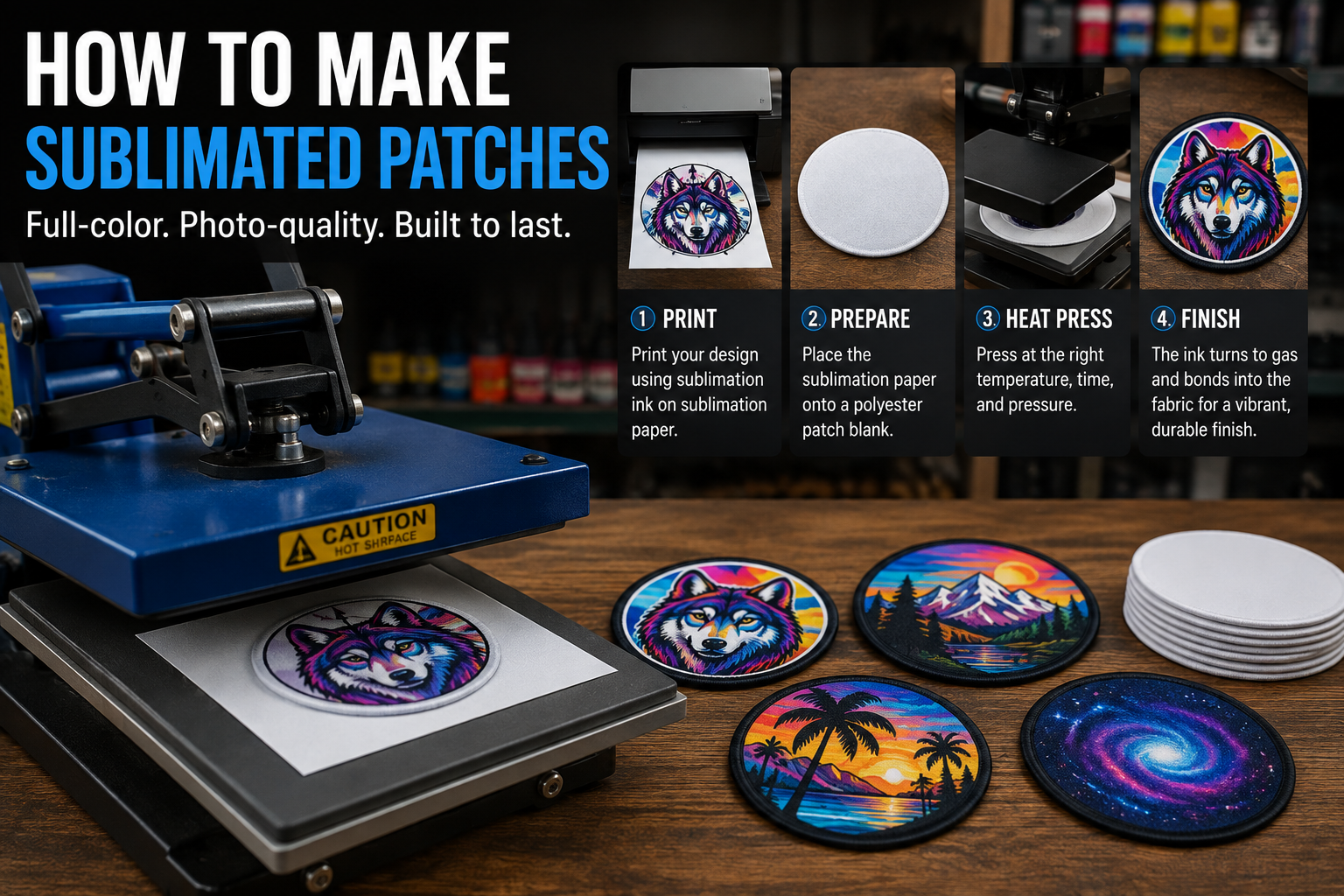
Making a sublimated patch comes down to a clear process: print your design on sublimation paper, press it onto a polyester blank at the right time and temperature, then finish it with the right backing. Using the correct material and settings determines whether your colors turn out sharp or faded. Whether you're producing patches yourself or ordering from a supplier, getting these steps right gives you a durable, full-color patch that lasts.
Introduction
Sublimated patches give you full-color, photo-quality designs without the limits of thread or ink layers. This guide walks through exactly how they’re made, what materials work best, and what backing to choose so your patches turn out sharp and durable.
Featured Snippet Answer
To make a sublimated patch, you print your design onto sublimation paper using sublimation ink, then press it onto a polyester patch blank using a heat press at the right time and temperature. The heat turns the ink into gas, which bonds permanently into the fabric fibers. This process produces vivid, full-color designs that won’t crack, peel, or fade.
Why This Matters
Sublimated patches look simple, but a few wrong settings ruin the color and finish.
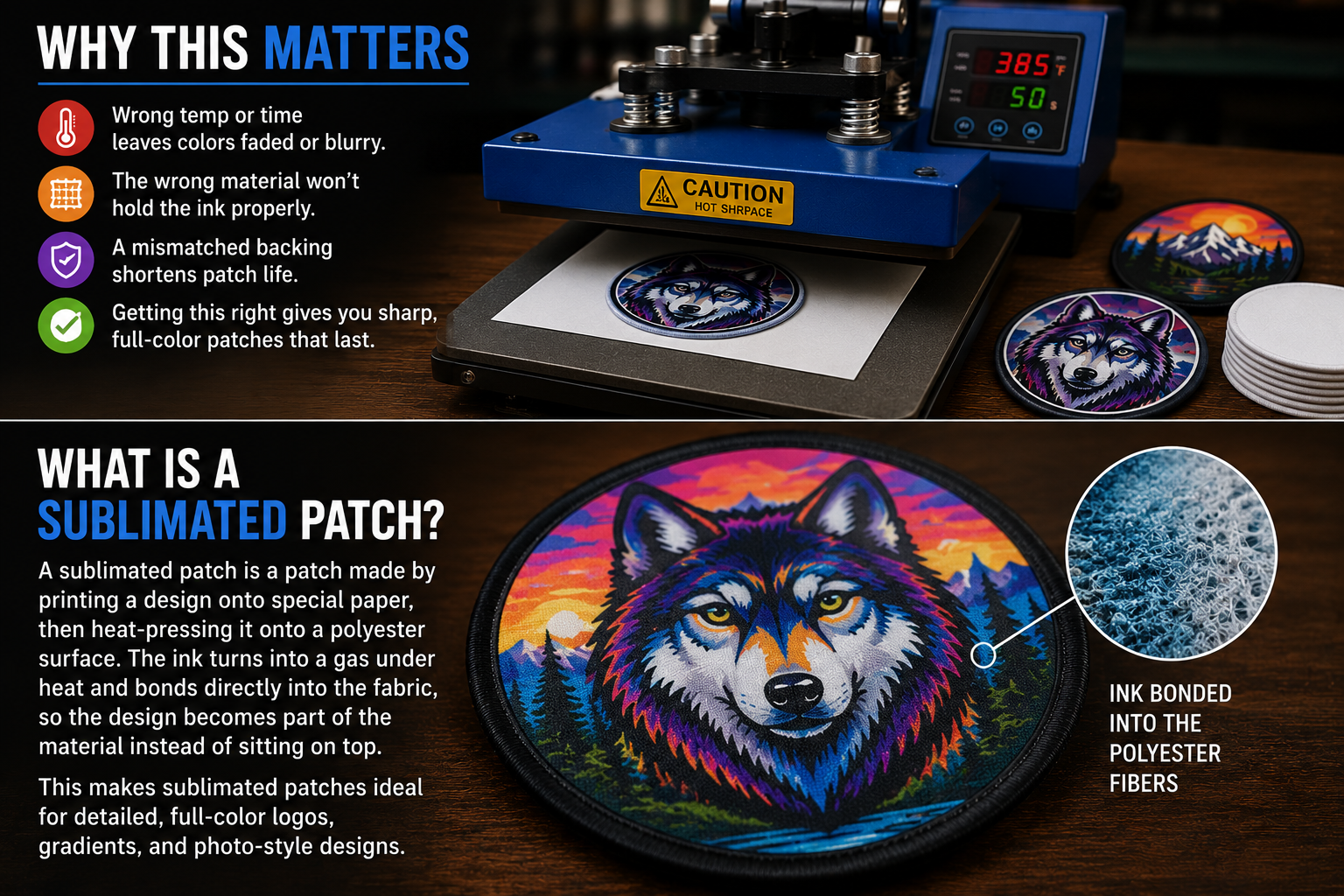
- Wrong temp or time leaves colors faded or blurry.
- The wrong material won’t hold the ink properly.
- A mismatched backing shortens how long the patch lasts on the garment.
- Getting this right gives you sharp, full-color patches that hold up over time.
What Is a Sublimated Patch
A sublimated patch is a patch made by printing a design onto special paper, then heat-pressing it onto a polyester surface. The ink turns into a gas under heat and bonds directly into the fabric, so the design becomes part of the material instead of sitting on top. This makes sublimated patches ideal for detailed, full-color logos, gradients, and photo-style designs.
How Do Sublimated Patches Work
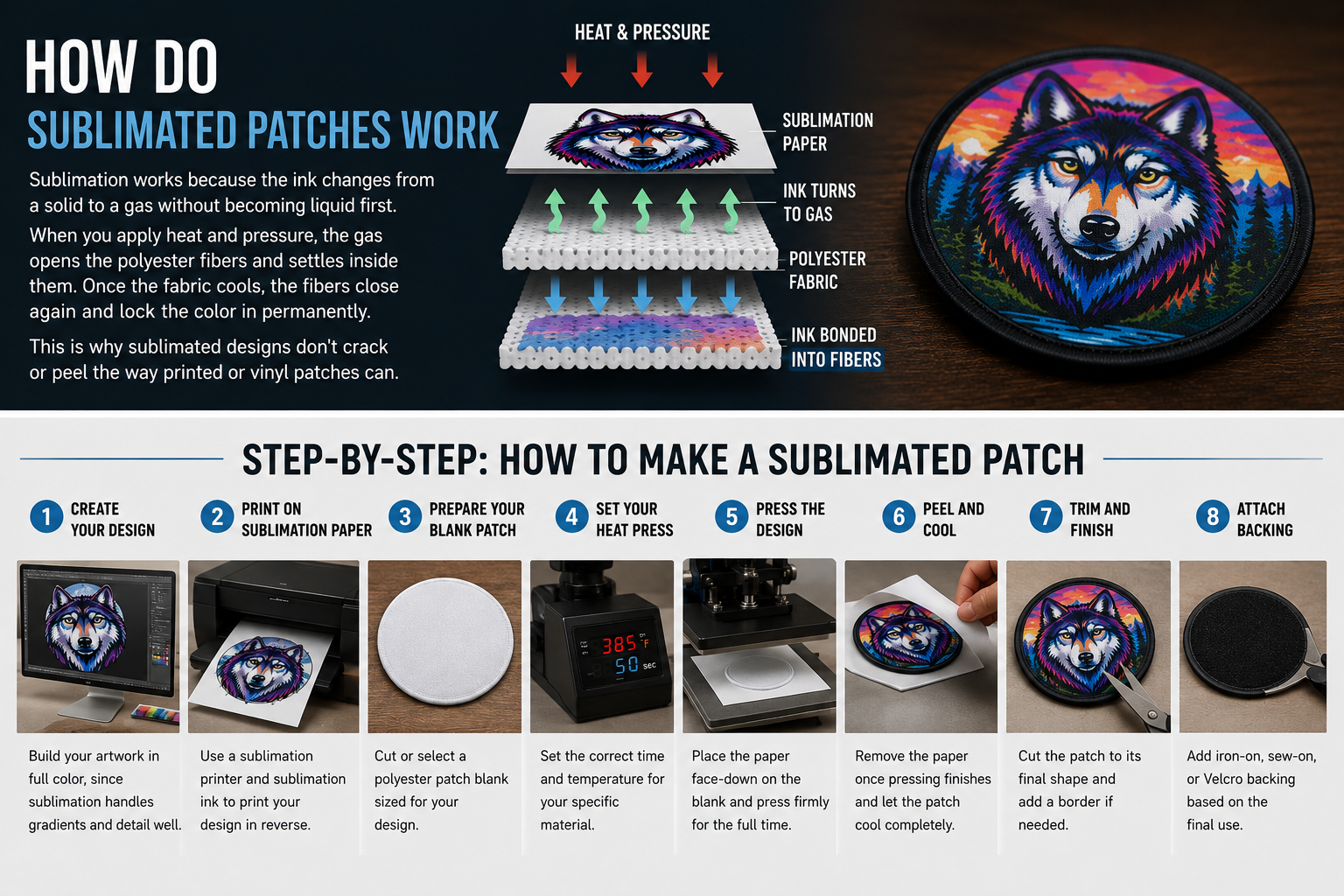
Sublimation works because the ink changes from a solid to a gas without becoming liquid first. When you apply heat and pressure, the gas opens the polyester fibers and settles inside them. Once the fabric cools, the fibers close again and lock the color in permanently. This is why sublimated designs don’t crack or peel the way printed or vinyl patches can.
Step-by-Step: How to Make a Sublimated Patch
Here’s the full process from design to finished patch.
- Step 1: Create your design. Build your artwork in full color, since sublimation handles gradients and detail well.
- Step 2: Print on sublimation paper. Use a sublimation printer and sublimation ink to print your design in reverse.
- Step 3: Prepare your blank patch. Cut or select a polyester patch blank sized for your design.
- Step 4: Set your heat press. Set the correct time and temperature for your specific material.
- Step 5: Press the design. Place the paper face-down on the blank and press firmly for the full time.
- Step 6: Peel and cool. Remove the paper once pressing finishes and let the patch cool completely.
- Step 7: Trim and finish. Cut the patch to its final shape and add a border if needed.
- Step 8: Attach backing. Add iron-on, sew-on, or Velcro backing based on the final use.
Time and Temp for Sublimation Patches
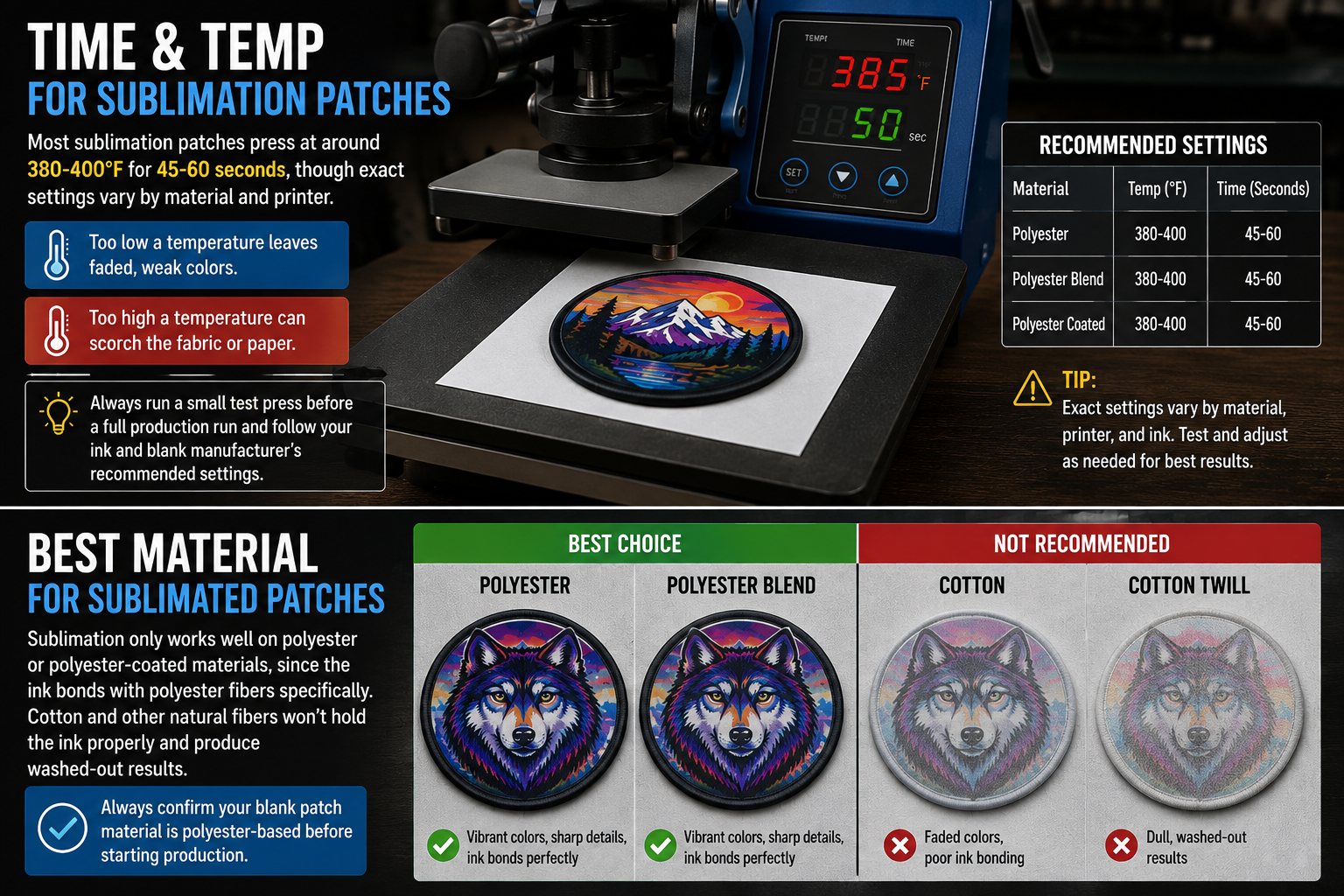
Most sublimation patches press at around 380-400°F for 45-60 seconds, though exact settings vary by material and printer. Too low a temperature leaves faded, weak colors, while too high can scorch the fabric or paper. A patch maker testing a new material batch, for example, should always run a small test press before a full production run. Always follow your specific ink and blank manufacturer’s recommended settings rather than a universal number.
Best Material for Sublimated Patches
Sublimation only works well on polyester or polyester-coated materials, since the ink bonds with polyester fibers specifically. Cotton and other natural fibers won’t hold the ink properly and produce washed-out results. A patch supplier switching from cotton twill to a polyester-blend blank, for instance, sees a sharp jump in color vibrancy. Always confirm your blank patch material is polyester-based before starting production.
Best Backing Option for Sublimated Patches
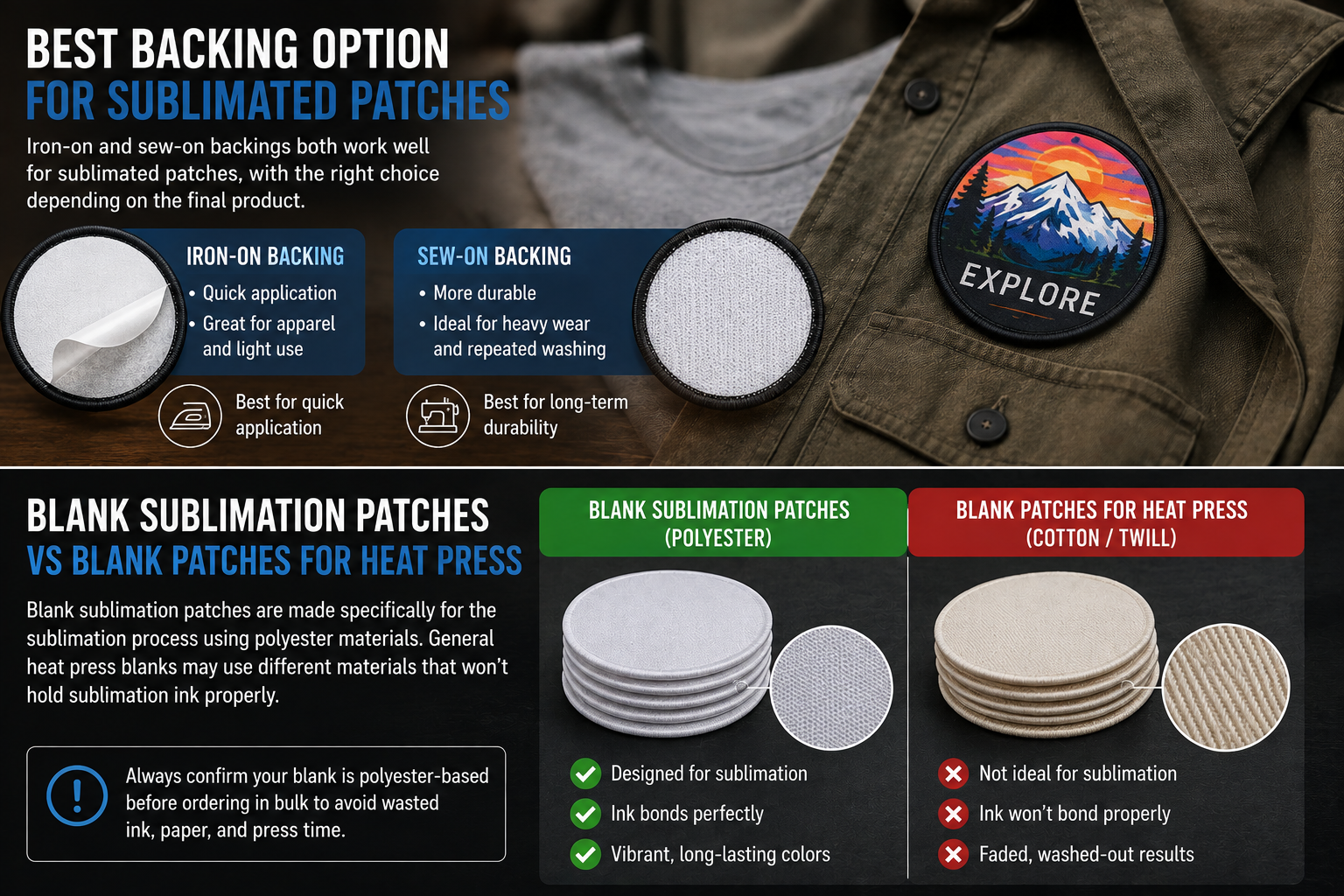
Iron-on and sew-on backings both work well for sublimated patches, with the right choice depending on the final product. Iron-on suits quick application on apparel, while sew-on holds up better for items that see heavy wear or repeated washing. A uniform supplier attaching patches to work jackets, for example, typically chooses sew-on for long-term durability. Match your backing choice to how much wear and washing the finished item will see.
Blank Sublimation Patches vs Blank Patches for Heat Press
Blank sublimation patches are pre-cut polyester pieces made specifically for the sublimation process, while general blank patches for heat press may use different materials suited to other transfer methods. Using the correct blank matters, since a non-polyester blank won’t hold sublimation ink properly regardless of your heat press settings. A business ordering in bulk should always confirm the blank type matches sublimation, not a generic heat-press blank. Checking this before a large order avoids wasted ink, paper, and press time.
Comparison Table Sublimated Patches vs Other Patch Types
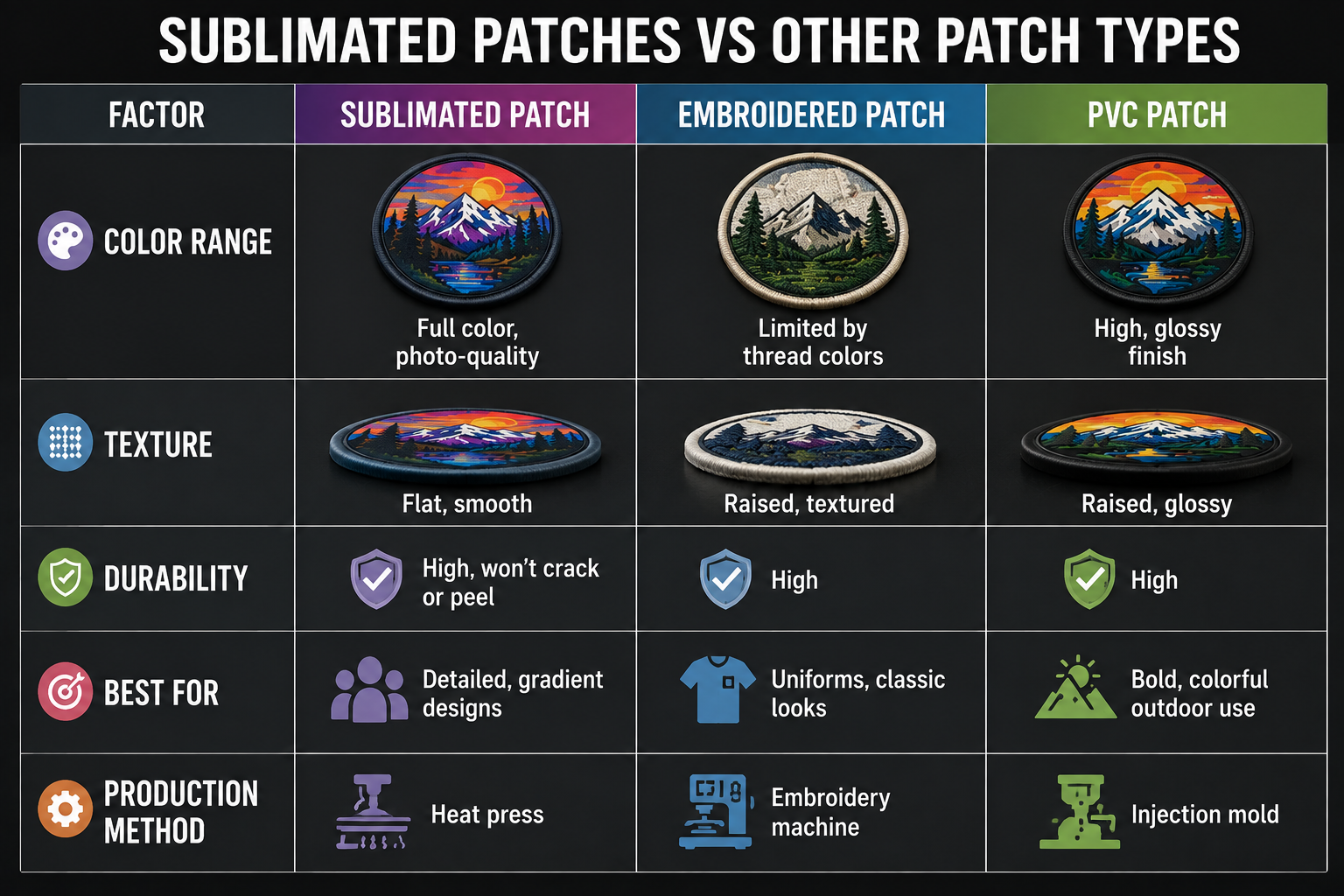
| Factor | Sublimated Patch | Embroidered Patch | PVC Patch |
|---|---|---|---|
| Color Range | Full color, photo-quality | Limited by thread colors | High, glossy finish |
| Texture | Flat, smooth | Raised, textured | Raised, glossy |
| Durability | High, won’t crack or peel | High | High |
| Best For | Detailed, gradient designs | Uniforms, classic looks | Bold, colorful outdoor use |
| Production Method | Heat press | Embroidery machine | Injection mold |
Common Mistakes
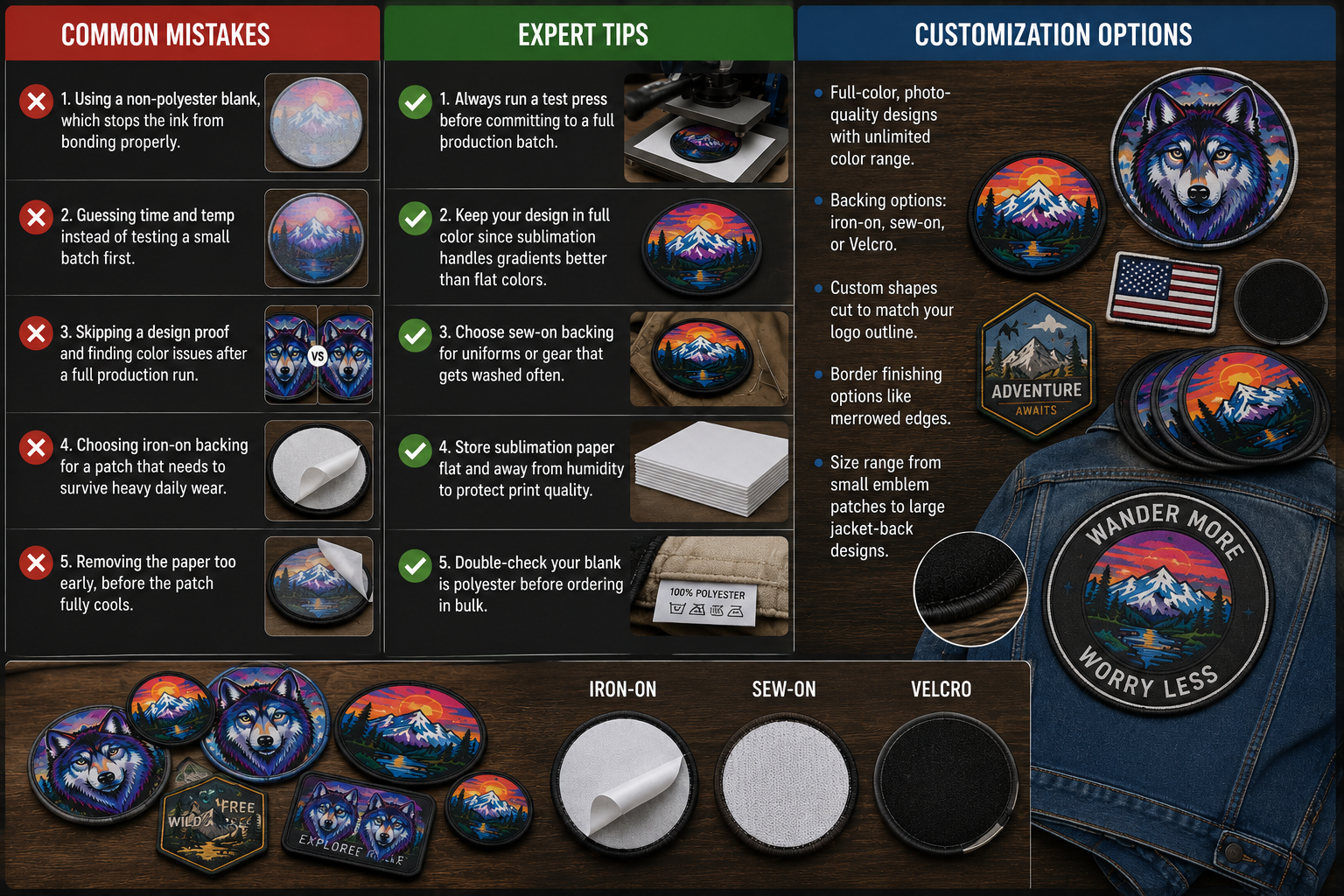
- Mistake 1: Using a non-polyester blank, which stops the ink from bonding properly.
- Mistake 2: Guessing time and temp instead of testing a small batch first.
- Mistake 3: Skipping a design proof and finding color issues after a full production run.
- Mistake 4: Choosing iron-on backing for a patch that needs to survive heavy daily wear.
- Mistake 5: Removing the paper too early, before the patch fully cools.
Expert Tips
- Tip 1: Always run a test press before committing to a full production batch.
- Tip 2: Keep your design in full color since sublimation handles gradients better than flat colors.
- Tip 3: Choose sew-on backing for uniforms or gear that gets washed often.
- Tip 4: Store sublimation paper flat and away from humidity to protect print quality.
- Tip 5: Double-check your blank is polyester before ordering in bulk.
Customization Options
Sublimated patches offer several customization choices beyond the design itself.
- Full-color, photo-quality designs with unlimited color range.
- Backing options: iron-on, sew-on, or Velcro.
- Custom shapes cut to match your logo outline.
- Border finishing options like merrowed edges.
- Size range from small emblem patches to large jacket-back designs.
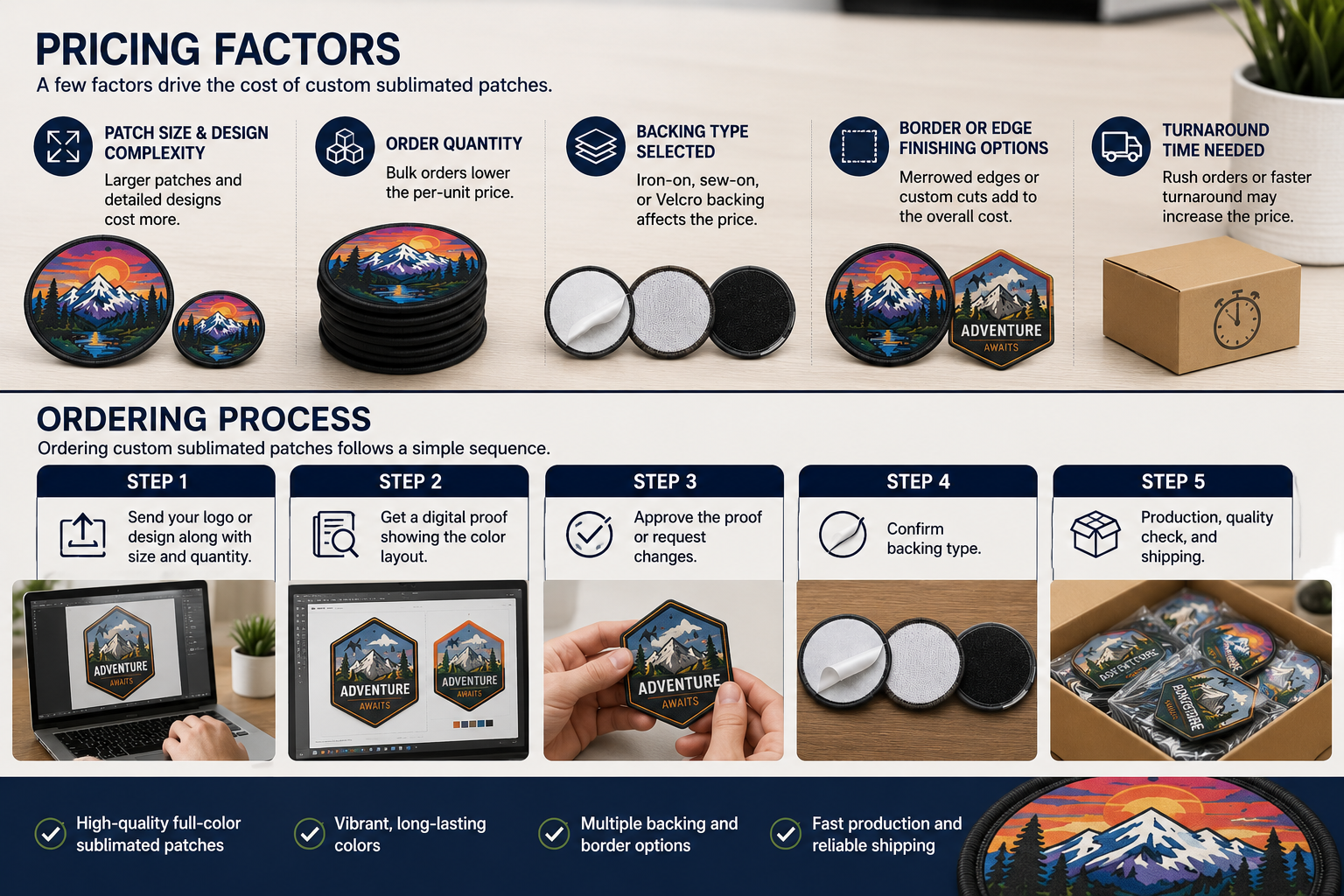
Pricing Factors
A few factors drive the cost of custom sublimated patches.
- Patch size and design complexity.
- Order quantity, since bulk orders lower the per-unit price.
- Backing type selected.
- Border or edge finishing options.
- Turnaround time needed.
Ordering Process
Ordering custom sublimated patches follows a simple sequence.
- Step 1: Send your logo or design along with size and quantity.
- Step 2: Get a digital proof showing the color layout.
- Step 3: Approve the proof or request changes.
- Step 4: Confirm backing type.
- Step 5: Production, quality check, and shipping.
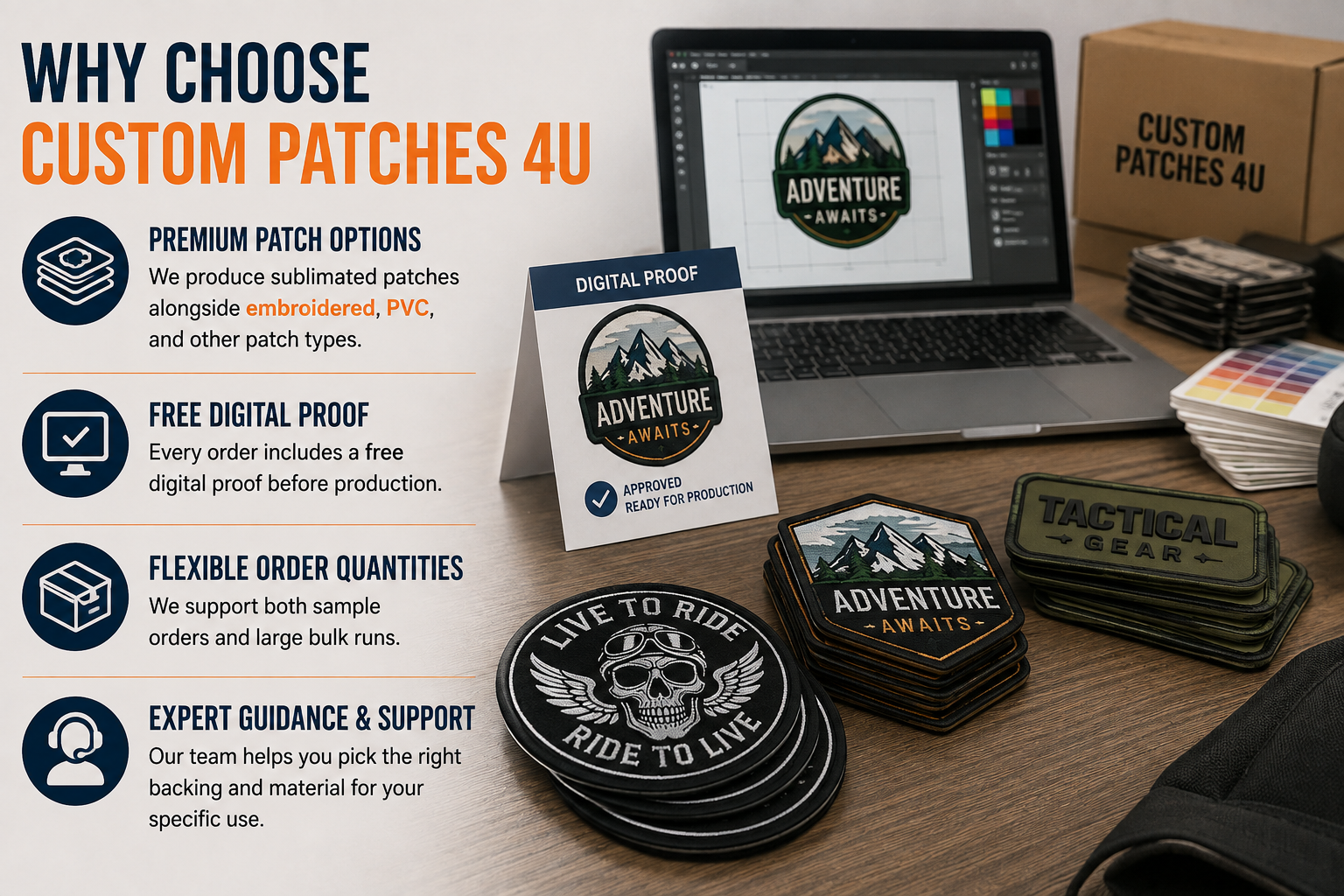
Why Choose Custom Patches 4U
- We produce sublimated patches alongside embroidered, PVC, and other patch types.
- Every order includes a free digital proof before production.
- We support both sample orders and large bulk runs.
- Our team helps you pick the right backing and material for your specific use.
FAQs
How do you make a sublimated patch?
You print your design onto sublimation paper, then heat-press it onto a polyester blank so the ink bonds into the fabric.
What is a sublimated patch?
It’s a patch made by transferring full-color ink into polyester fabric using heat, instead of stitching or molding the design.
How do sublimated patches work?
Heat turns the sublimation ink into a gas, which opens the polyester fibers and bonds the color inside before the fabric cools.
What’s the best time and temperature for sublimation patches?
Most patches press at around 380-400°F for 45-60 seconds, though exact settings vary by material and ink.
What material works best for sublimated patches?
Polyester or polyester-coated material works best, since sublimation ink bonds specifically with polyester fibers.
What’s the best backing for sublimated patches?
Iron-on suits quick apparel application, while sew-on holds up better for items that see heavy wear or frequent washing.
What’s the difference between blank sublimation patches and blank patches for heat press?
Blank sublimation patches are made specifically from polyester for sublimation ink, while general heat-press blanks may use different materials for other transfer methods.
Are sublimated patches durable?
Yes, since the ink bonds directly into the fabric fibers, sublimated patches resist cracking, peeling, and fading over time.
Can sublimated patches handle detailed, multi-color designs?
Yes, sublimation handles gradients and photo-quality detail better than embroidery or most other patch methods.
Can I get a sample before ordering sublimated patches in bulk?
Yes, ordering a sample first is recommended to check color accuracy before a full production run.
Get Your Custom Sublimated Patches Made
Ready to turn your design into a custom sublimated patch? Reach out to Custom Patches 4U for a free proof, sample request, or bulk pricing before you place your order.