
Choosing the right patch backing gets confusing fast when a business is ordering hundreds or thousands of units for uniforms, jackets, or gear. One question comes up again and again before a bulk order: are sew on patches more durable than iron on patches? The honest answer depends on how and where a business uses the patches.
This guide compares both backing types in detail. It covers durability, application methods, and which option fits different business use cases.
At Custom Patches 4U, we work with B2B buyers across industries who need patches that hold up to daily wear, frequent washing, and long term use. This comparison reflects the questions we hear most often before a business places an order.
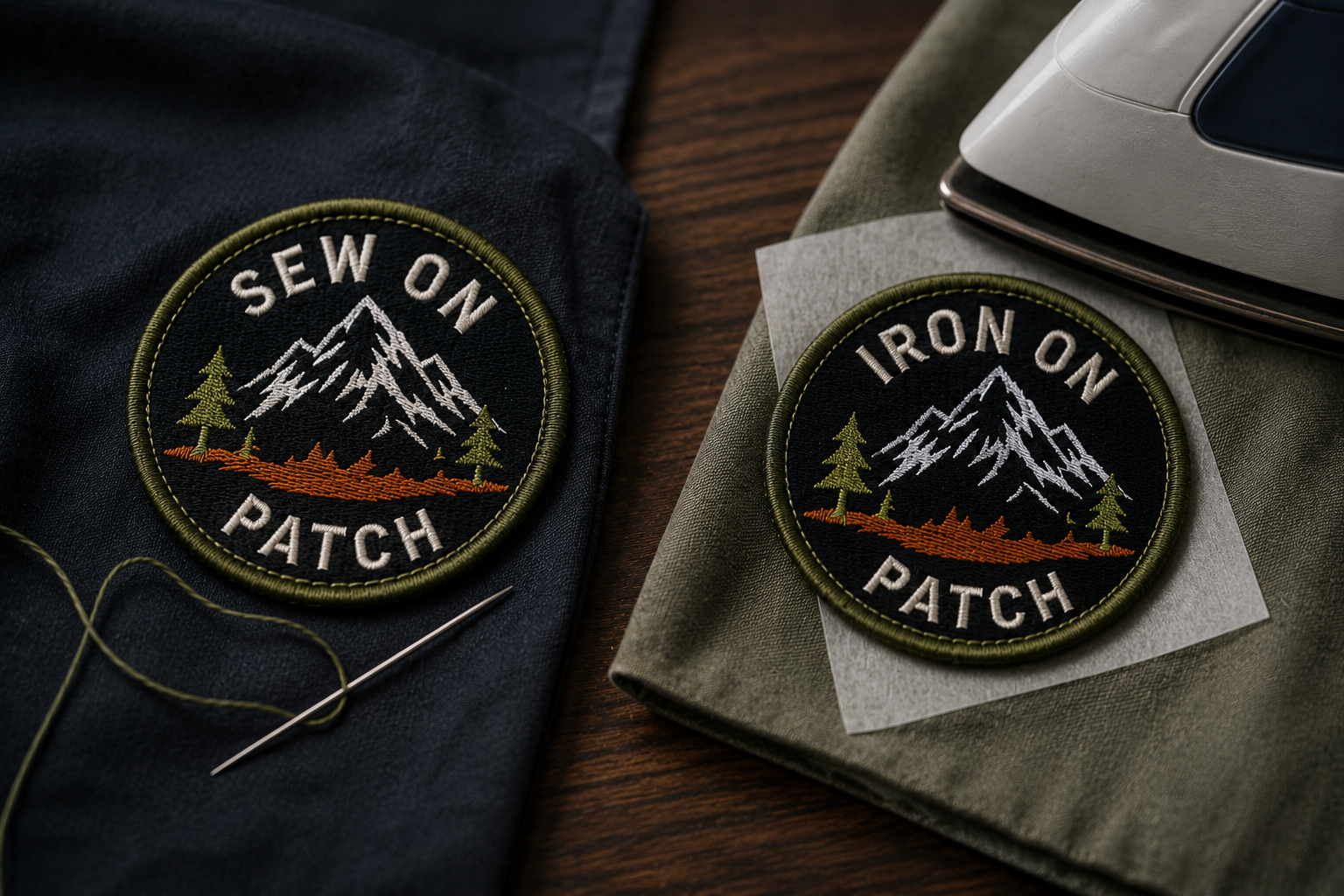
What Are Sew On and Iron On Patches?
- A sew on patch has no adhesive backing. It attaches to fabric using needle and thread, either by hand or machine.
- An iron on patch has a heat activated adhesive film on the back, applied during manufacturing. It bonds to fabric when a business applies heat and pressure.
- Both types can use the same embroidered, woven, or printed design. The difference is purely in how they attach to the garment.
- The backing type does not change the artwork or design quality. It only changes the method and strength of attachment.
Get Custom Pricing for either backing type based on your production needs.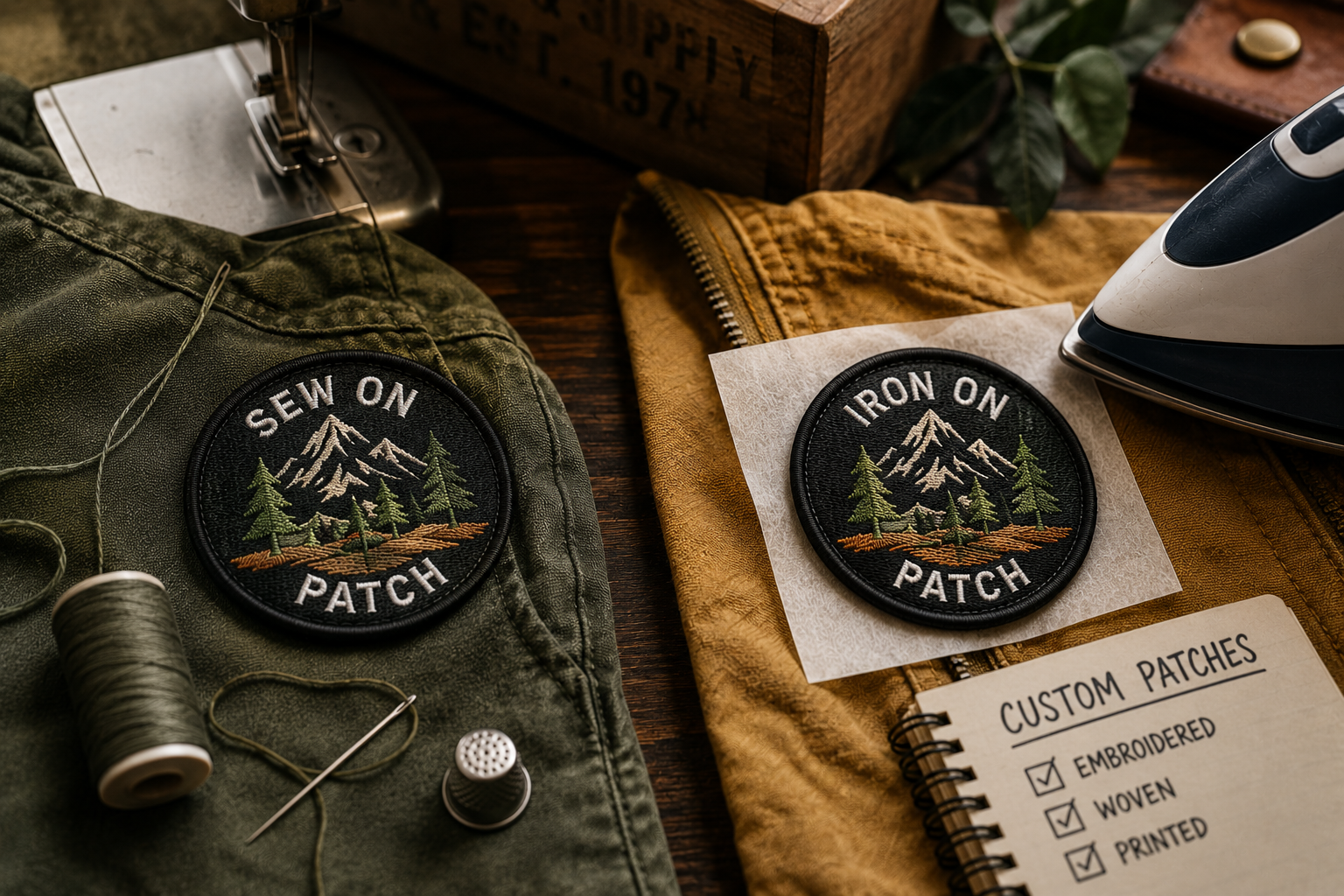
Are Sew On Patches More Durable Than Iron On Patches?
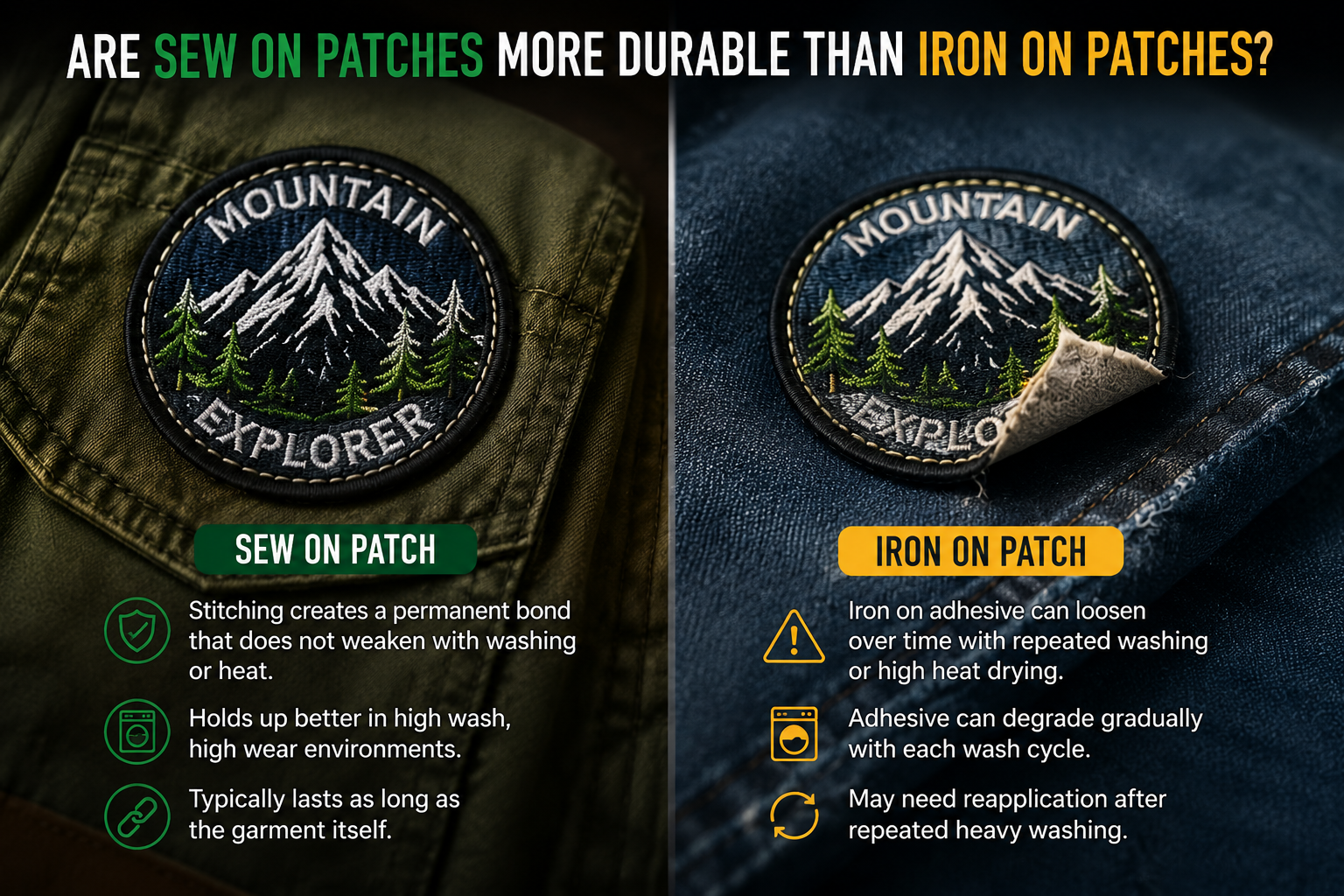
Are sew on patches more durable than iron on patches? Yes. Sew on patches generally last longer because stitching creates a permanent bond that does not weaken with washing or heat. Iron on adhesive can loosen over time with repeated washing or high heat drying, while stitched patches typically stay attached for the life of the garment.
- Stitching does not rely on heat sensitive adhesive, so it holds up better in high wash, high wear environments.
- Iron on adhesive can degrade gradually with each wash cycle, especially under high heat.
- Which patch lasts longer, sew on or iron on? Sew on patches typically last as long as the garment itself. Iron on patches may need reapplication after repeated heavy washing, particularly if the applicator did not apply them correctly the first time.
Why This Comparison Matters for Businesses
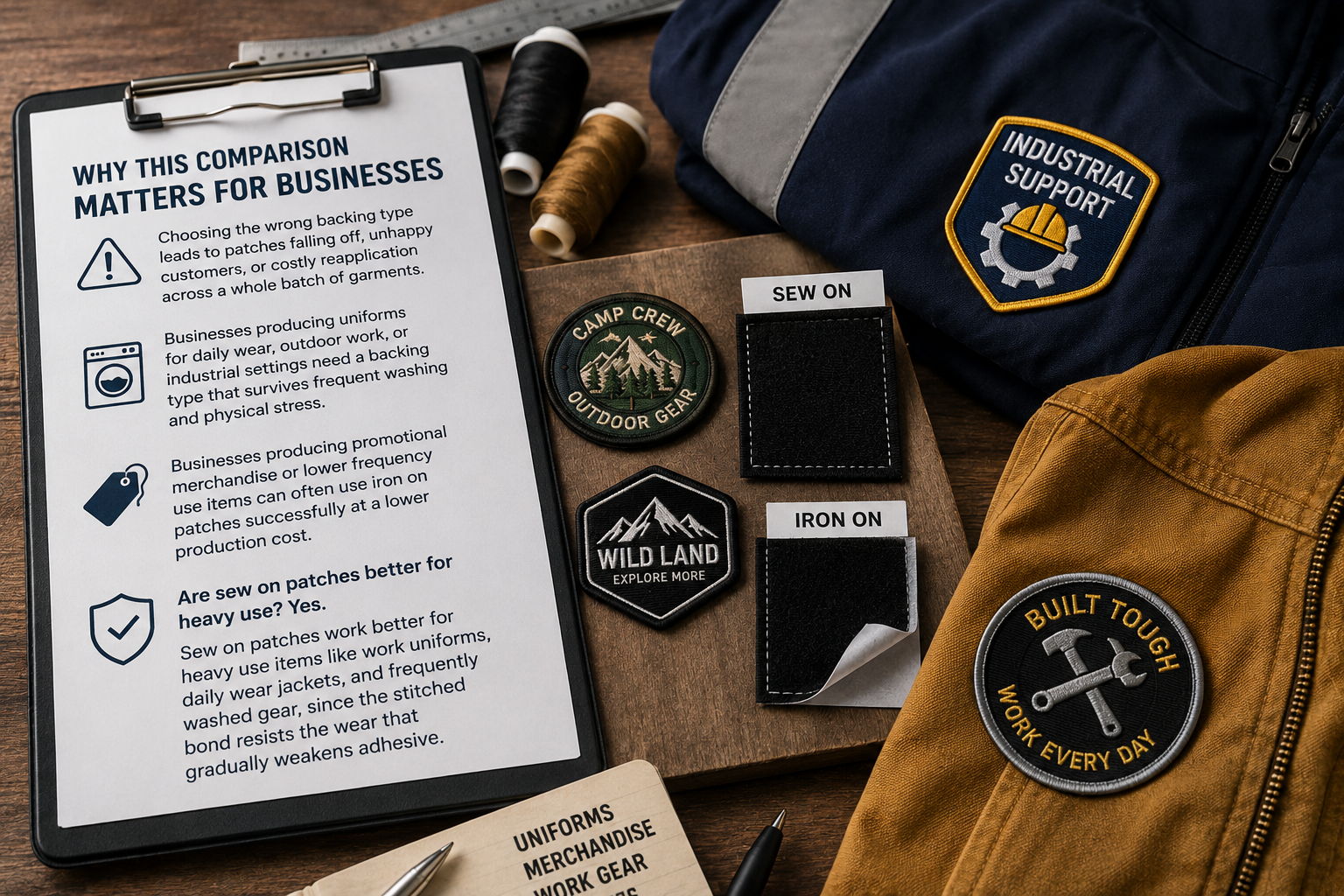
- Choosing the wrong backing type leads to patches falling off, unhappy customers, or costly reapplication across a whole batch of garments.
- Businesses producing uniforms for daily wear, outdoor work, or industrial settings need a backing type that survives frequent washing and physical stress.
- Businesses producing promotional merchandise or lower frequency use items can often use iron on patches successfully at a lower production cost.
- Are sew on patches better for heavy use? Yes. Sew on patches work better for heavy use items like work uniforms, daily wear jackets, and frequently washed gear, since the stitched bond resists the wear that gradually weakens adhesive.
Key Features and Specifications: Sew On vs Iron On
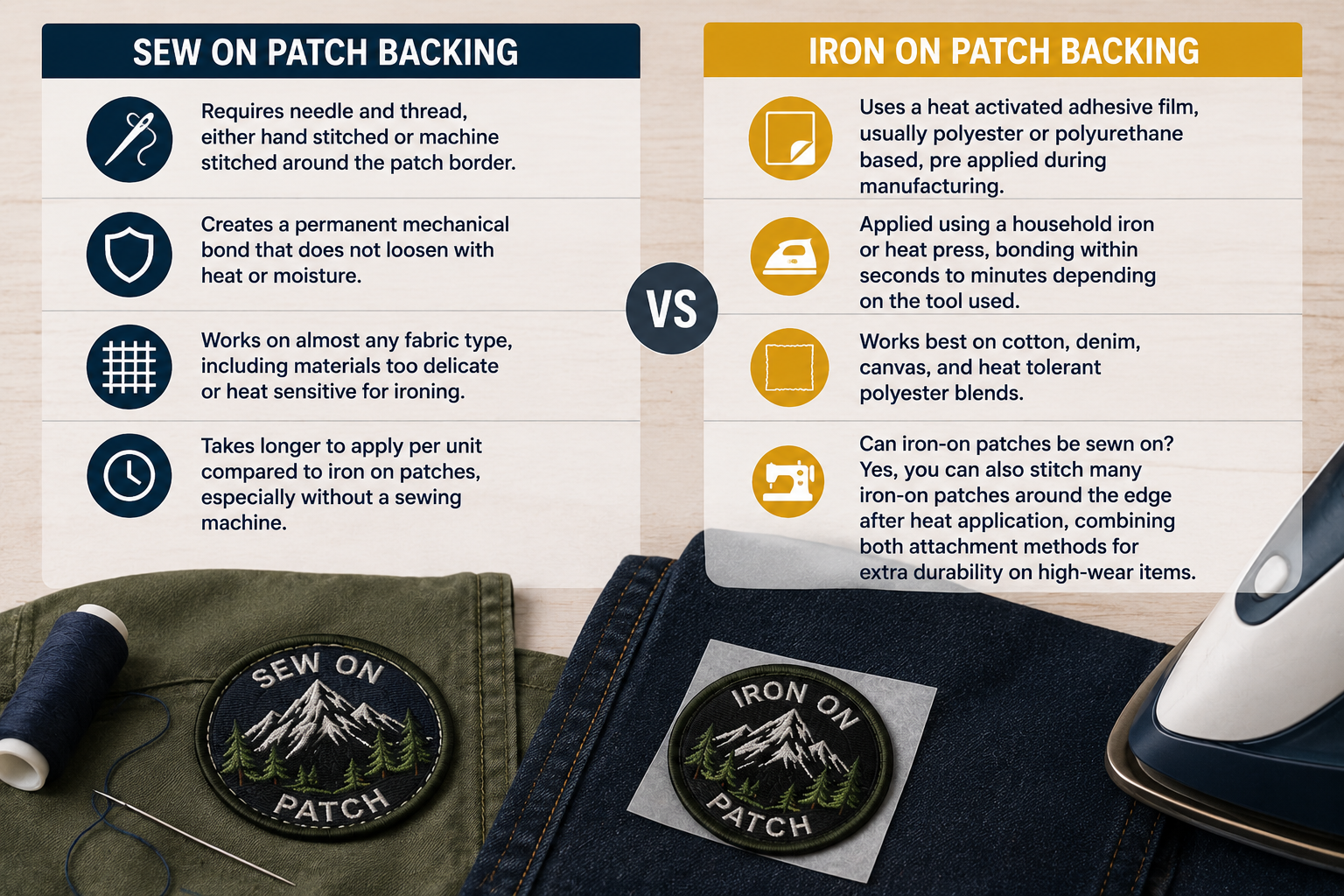
Sew On Patch Backing
- Requires needle and thread, either hand stitched or machine stitched around the patch border.
- Creates a permanent mechanical bond that does not loosen with heat or moisture.
- Works on almost any fabric type, including materials too delicate or heat sensitive for ironing.
- Takes longer to apply per unit compared to iron on patches, especially without a sewing machine.
Iron On Patch Backing
- Uses a heat activated adhesive film, usually polyester or polyurethane based, pre applied during manufacturing.
- Applied using a household iron or heat press, bonding within seconds to minutes depending on the tool used.
- Works best on cotton, denim, canvas, and heat tolerant polyester blends.
- Can iron-on patches be sewn on? Yes, you can also stitch many iron-on patches around the edge after heat application, combining both attachment methods for extra durability on high-wear items. This combines both attachment methods for extra durability on high wear items.
Patch Backing Comparison at a Glance
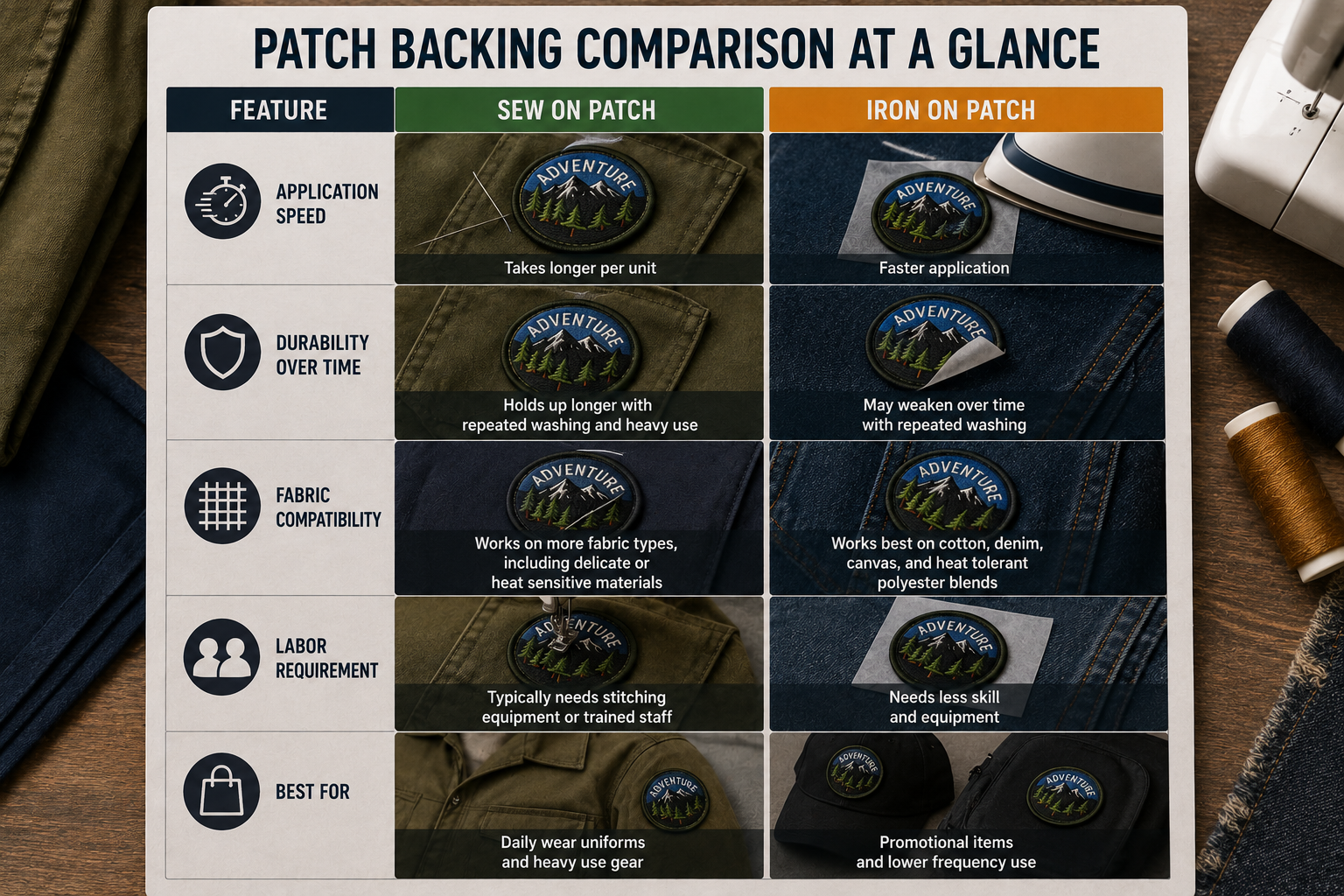
- Application speed: iron on is faster; sew on takes longer per unit.
- Durability over time: sew on holds up longer under repeated washing and heavy use.
- Fabric compatibility: sew on works on more fabric types, including delicate or heat sensitive materials.
- Labor requirement: iron on needs less skill; sew on typically needs stitching equipment or trained staff.
- Best for: iron on suits promotional and lower frequency use; sew on suits daily wear uniforms and heavy use gear.
Order Sample Today to test both backing types on your actual fabric before committing to a bulk order.
How Each Patch Attachment Method Works
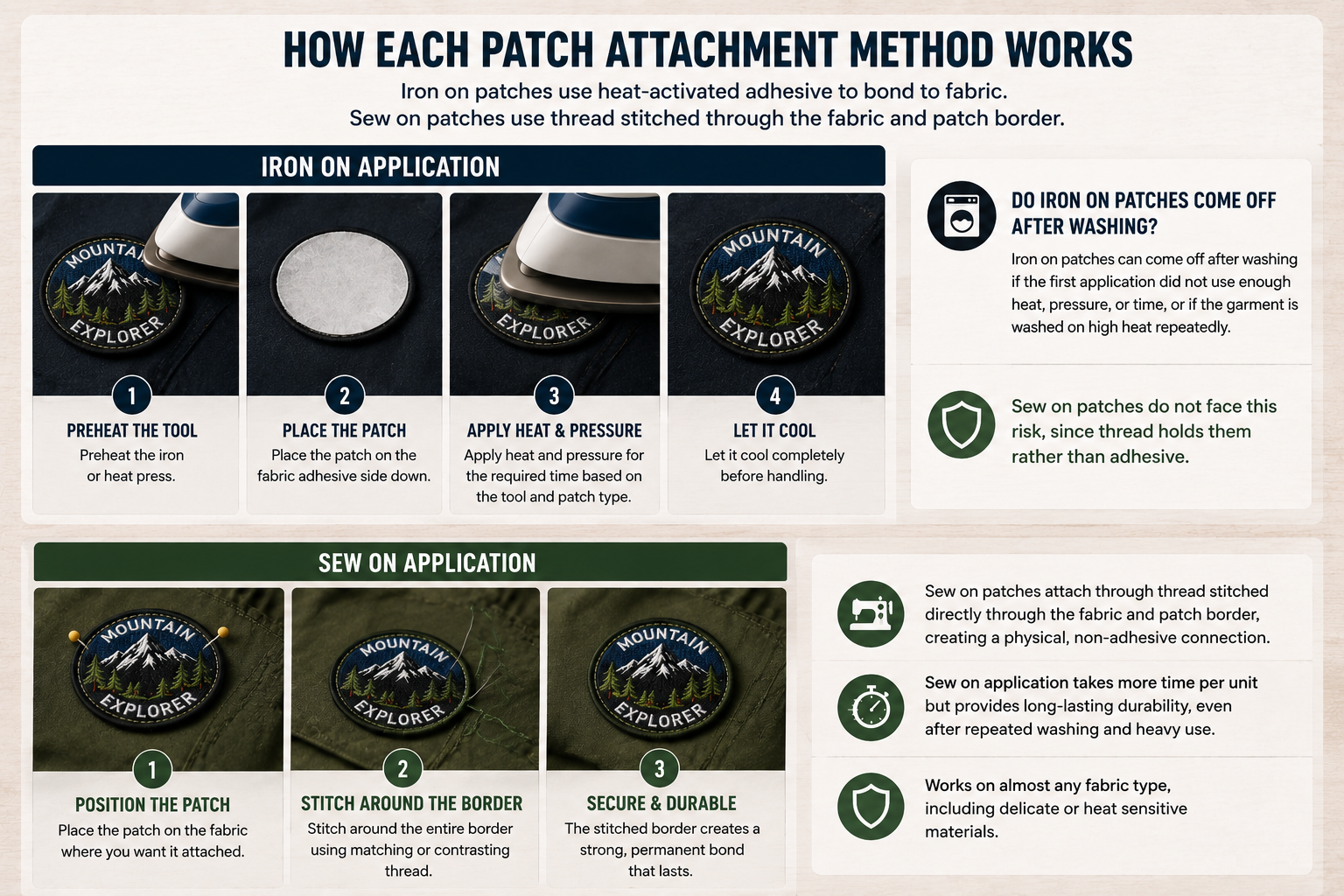
How do iron on and sew on patches attach to fabric? Iron on patches bond through a heat activated adhesive that melts under pressure, then re-hardens as it cools. Sew on patches attach through thread stitched directly through the fabric and patch border, creating a physical, non adhesive connection.
- Iron on application: preheat the tool, place the patch adhesive side down, apply heat and pressure for the required time, then let it cool before handling.
- Sew on application: position the patch, then stitch around the entire border using matching or contrasting thread, either by hand or machine for faster bulk production.
- Do iron on patches come off after washing? Iron on patches can come off after washing if the first application did not use enough heat, pressure, or time, or if the garment is washed on high heat repeatedly. Sew on patches do not face this risk, since thread holds them rather than adhesive.
Benefits of Each Option for B2B Buyers
Benefits of Sew On Patches
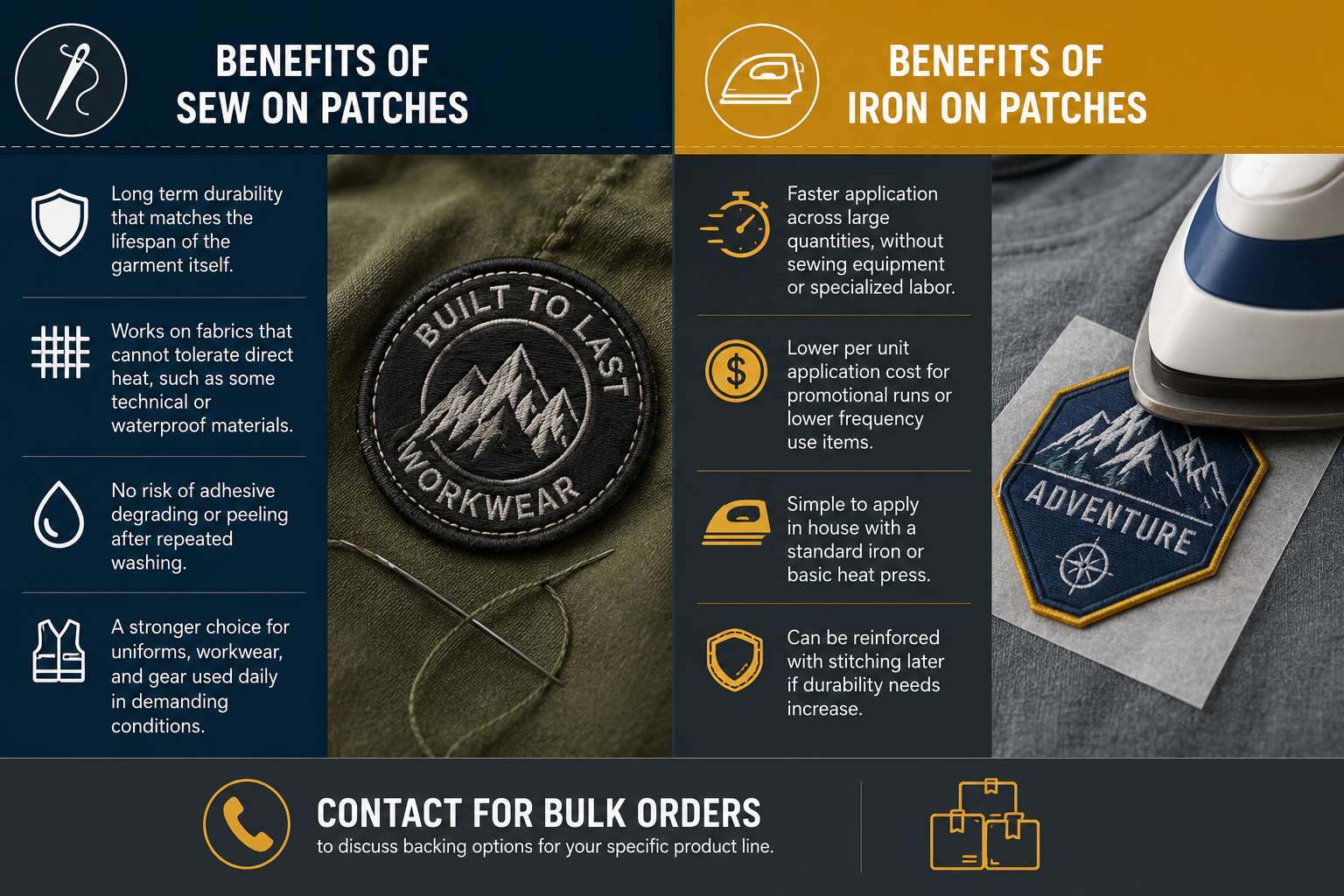
- Long term durability that matches the lifespan of the garment itself.
- Works on fabrics that cannot tolerate direct heat, such as some technical or waterproof materials.
- No risk of adhesive degrading or peeling after repeated washing.
- A stronger choice for uniforms, workwear, and gear used daily in demanding conditions.
Benefits of Iron On Patches
- Faster application across large quantities, without sewing equipment or specialized labor.
- Lower per unit application cost for promotional runs or lower frequency use items.
- Simple to apply in house with a standard iron or basic heat press.
- Can be reinforced with stitching later if durability needs increase.
Industry Use Cases and Applications
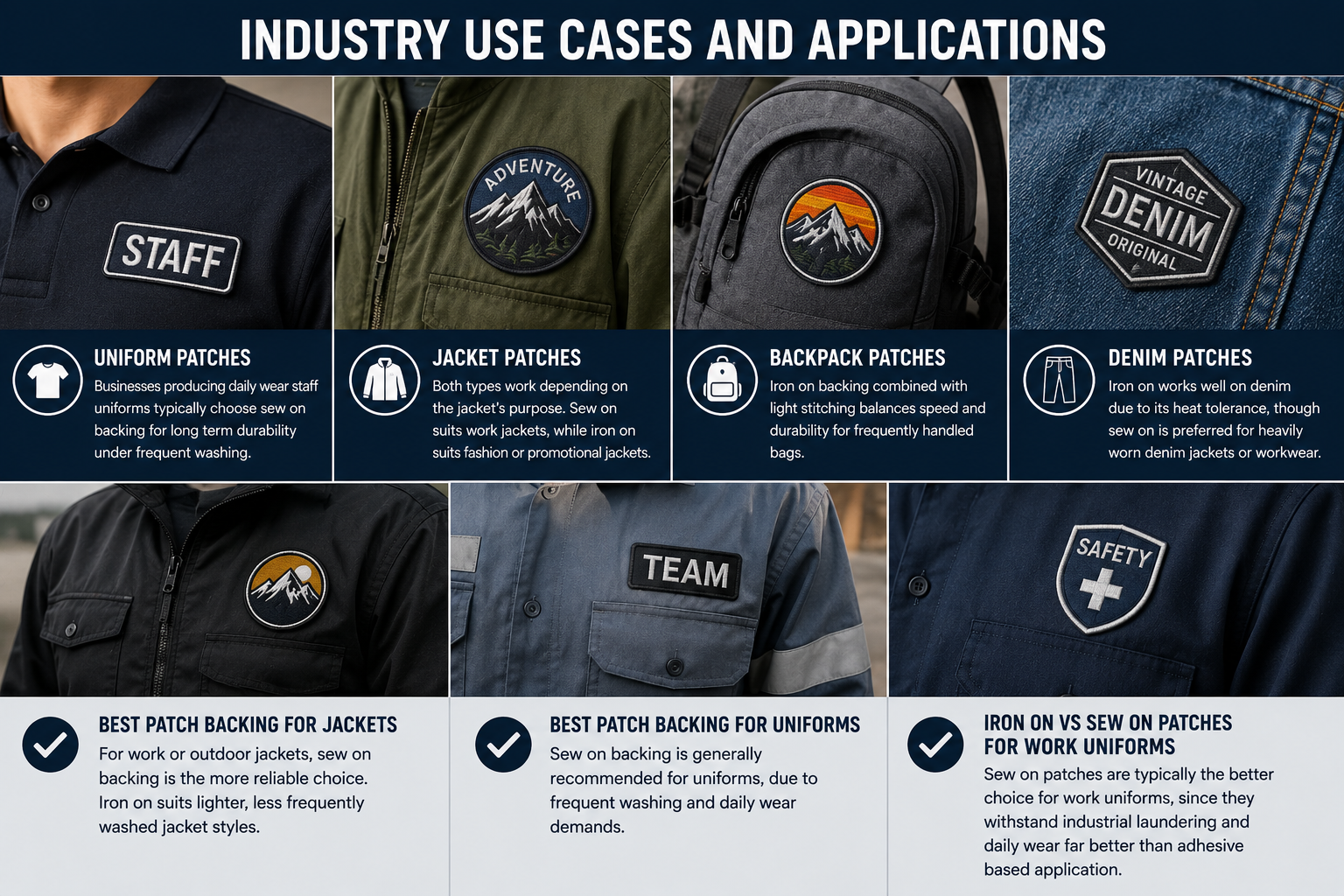
- Uniform patches. Businesses producing daily wear staff uniforms typically choose sew on backing for long term durability under frequent washing.
- Jacket patches. Both types work depending on the jacket’s purpose. Sew on suits work jackets, while iron on suits fashion or promotional jackets.
- Backpack patches. Iron on backing combined with light stitching balances speed and durability for frequently handled bags.
- Denim patches. Iron on works well on denim due to its heat tolerance, though sew on is preferred for heavily worn denim jackets or workwear.
- Best patch backing for jackets. For work or outdoor jackets, sew on backing is the more reliable choice. Iron on suits lighter, less frequently washed jacket styles.
- Best patch backing for uniforms. Sew on backing is generally recommended for uniforms, due to frequent washing and daily wear demands.
- Iron on vs sew on patches for work uniforms. Sew on patches are typically the better choice for work uniforms, since they withstand industrial laundering and daily wear far better than adhesive based application.
Customization and Ordering Process
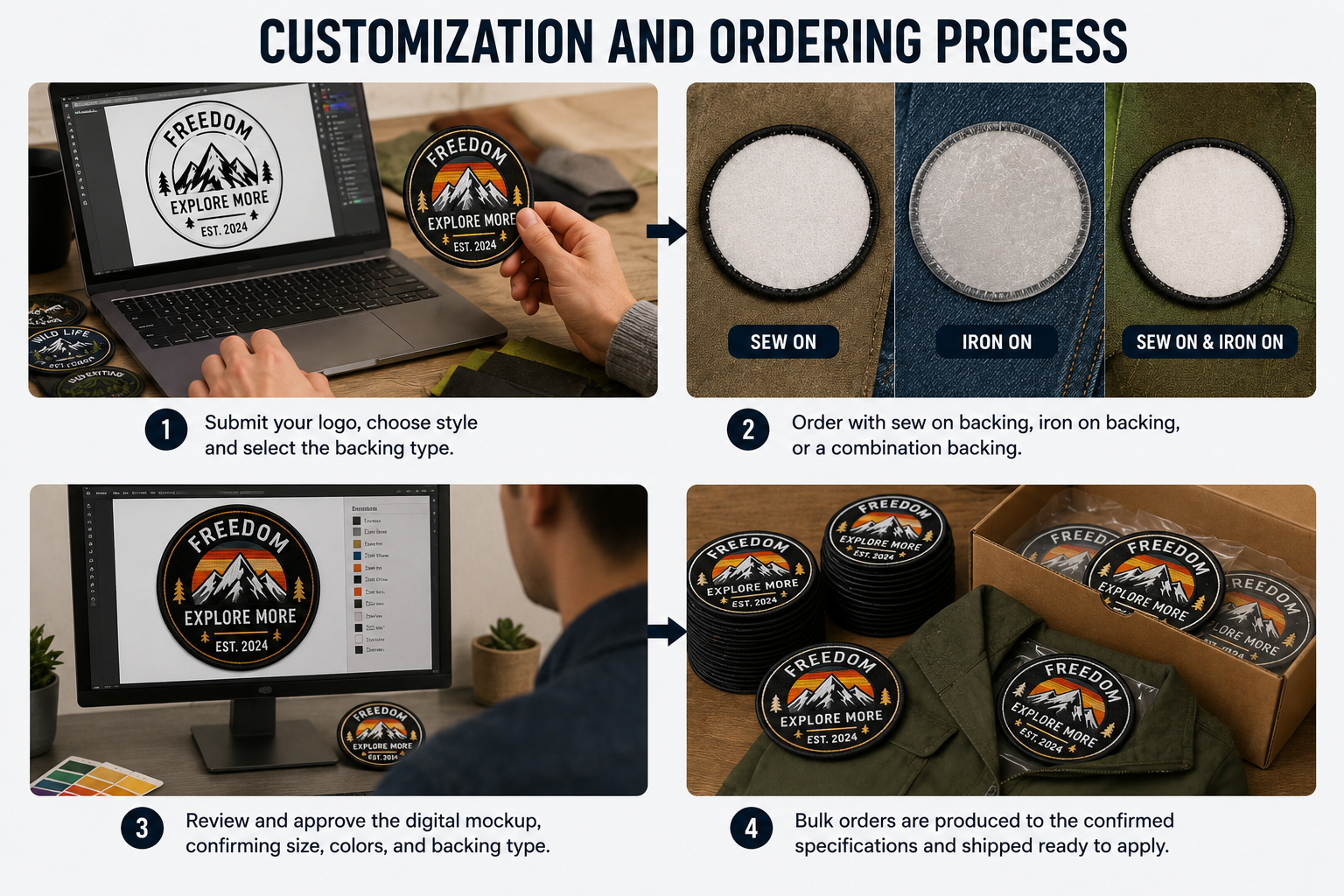
- Ordering custom patches for a business starts with submitting your logo artwork, choosing embroidered, woven, or printed style, and selecting the backing type that fits your use case.
- Businesses can order patches with sew on backing, iron on backing, or a combination backing that supports both stitching and heat application.
- A digital mockup is shared for approval before full production begins, confirming size, colors, and backing type.
- Bulk orders are produced to the confirmed specifications, then shipped ready for application using your chosen method.
Why Choose Custom Patches 4U
- Custom Patches 4U supplies both sew on and iron on patches, giving B2B buyers the flexibility to choose the right backing for each product line.
- Our team can recommend the best backing type based on your fabric, washing frequency, and expected use case, helping you avoid costly reapplication or returns.
- We produce embroidered, woven, PVC, and printed patches with consistent quality across large bulk orders.
- Our production process includes mockup approval before manufacturing, so businesses know exactly what they are getting before committing to a full run.
Contact for Bulk Orders and get a dedicated point of contact for your patch backing and production needs.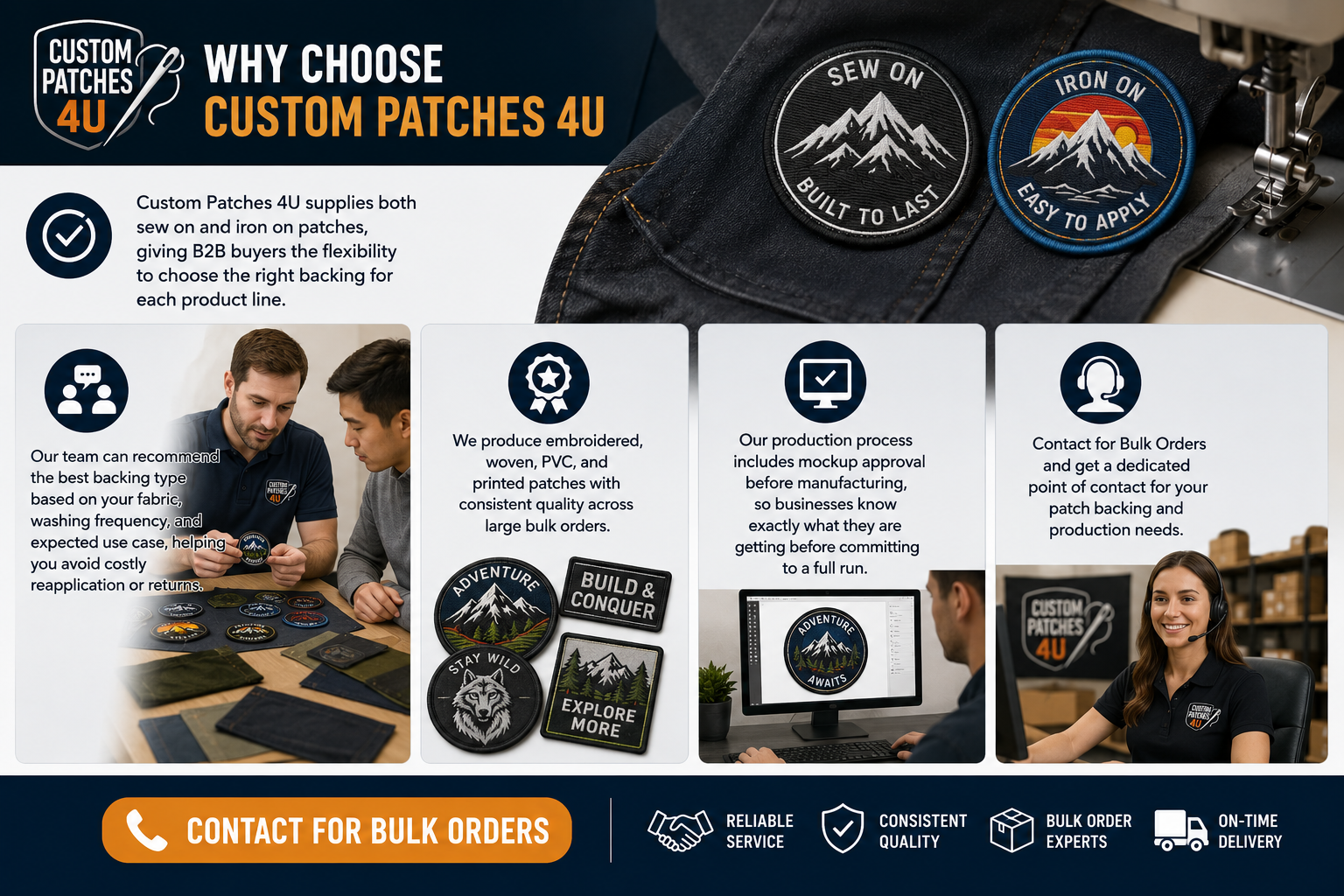
Frequently Asked Questions
Are sew on patches more durable than iron on patches?
Yes, sew on patches generally last longer because stitching creates a permanent bond that does not weaken with washing or heat, unlike adhesive based iron on backing.
Which patch lasts longer, sew on or iron on?
Sew on patches typically last as long as the garment itself, while iron on patches may loosen over time with repeated washing, especially under high heat.
Can iron on patches be sewn on?
Yes, many iron on patches can also be stitched around the edge after heat application, combining both methods for extra hold on frequently used items.
Do iron on patches come off after washing?
Iron on patches can come off after washing if they were not applied with enough heat, pressure, or time, or if the garment is regularly washed on high heat.
How long do sew on patches last?
Sew on patches typically last for the full lifespan of the garment, since the stitched bond does not degrade with washing or age the way adhesive can.
Are sew on patches better for heavy use?
Yes, sew on patches are the better choice for heavy use items like work uniforms and daily wear jackets, since the mechanical bond withstands frequent washing and physical stress.
What is the best patch backing for jackets?
Sew on backing is typically best for work or outdoor jackets that see frequent washing, while iron on backing works well for lighter, less frequently used jacket styles.
What is the best patch backing for uniforms?
Sew on backing is generally recommended for uniforms, since it holds up better to daily wear and industrial laundering than adhesive based application.
Iron on vs sew on patches for work uniforms, which is better?
Sew on patches are typically the better option for work uniforms, since they withstand repeated washing and daily physical wear more reliably than iron on adhesive.
Can I combine sew on and iron on methods on the same patch?
Yes, many patches feature a combination backing that includes both an iron on adhesive layer and a merrow border suited for stitching, giving businesses added durability where needed.