
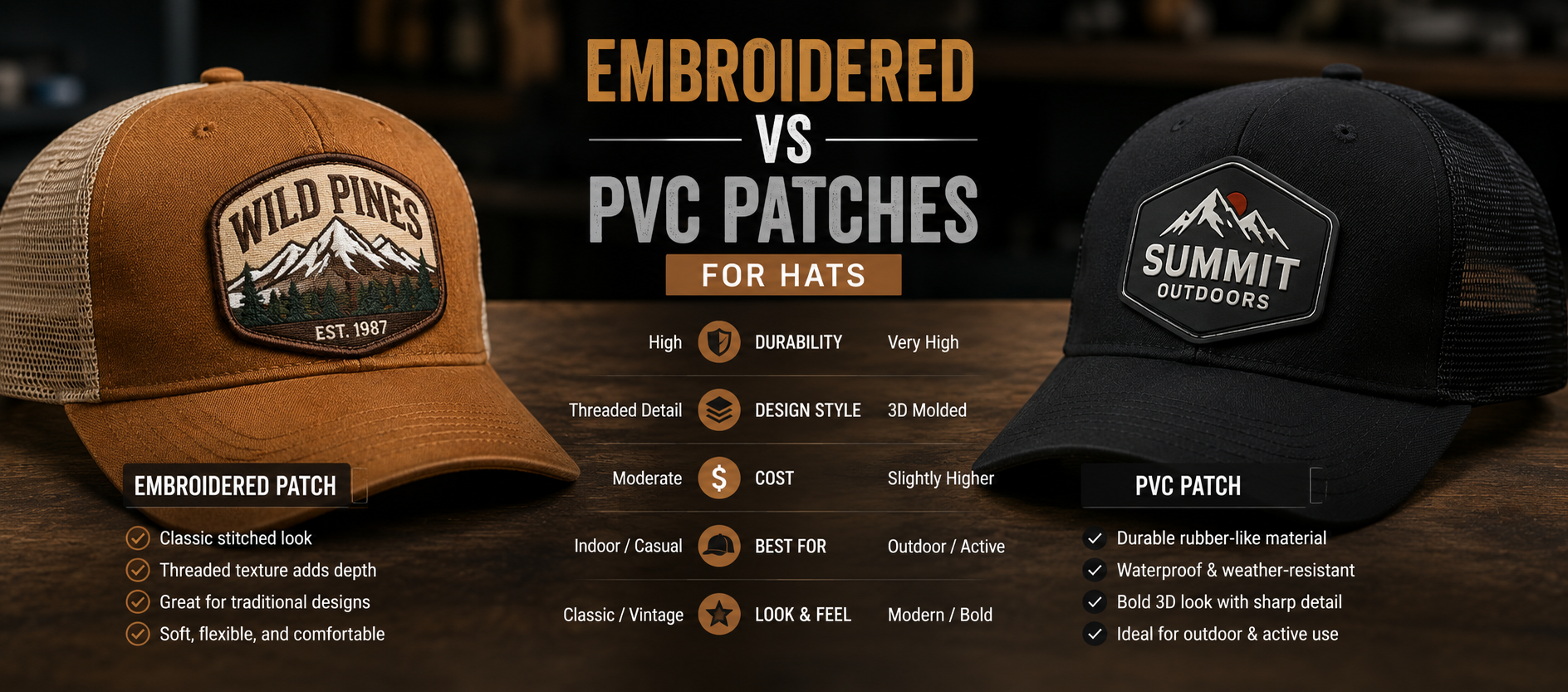
Embroidered and PVC patches both offer strong options for custom hats, but they differ significantly in material, texture, and durability. Embroidered patches use stitched thread for a classic, textured look best suited to indoor or low-moisture use, while PVC patches use molded plastic for a glossy, water-resistant finish ideal for outdoor and bold graphic designs. The right choice depends on how the hat will be worn, your design's color complexity, and your budget for the order size you need.
Introduction
Hat patches come in a lot of different styles, but two of the most common options, embroidered and PVC, look and perform very differently once they’re actually on a hat. If you’re ordering custom hats for a team, brand, or event, picking the wrong patch type can mean a design that doesn’t hold up outdoors, or a texture that doesn’t match the look you were going for. This guide compares embroidered and PVC patches specifically for hats, covering durability, detail, cost, and which option fits different use cases.
Featured Snippet Answer
Embroidered patches use stitched thread to create a textured, raised design, giving hats a classic, premium look. Manufacturers mold PVC patches from rubber-like material, producing a glossy, 3D finish that resists water and fading. Embroidered patches suit traditional and vintage-style hats, while PVC patches work better for outdoor, waterproof, or bold graphic designs.
Why This Matters
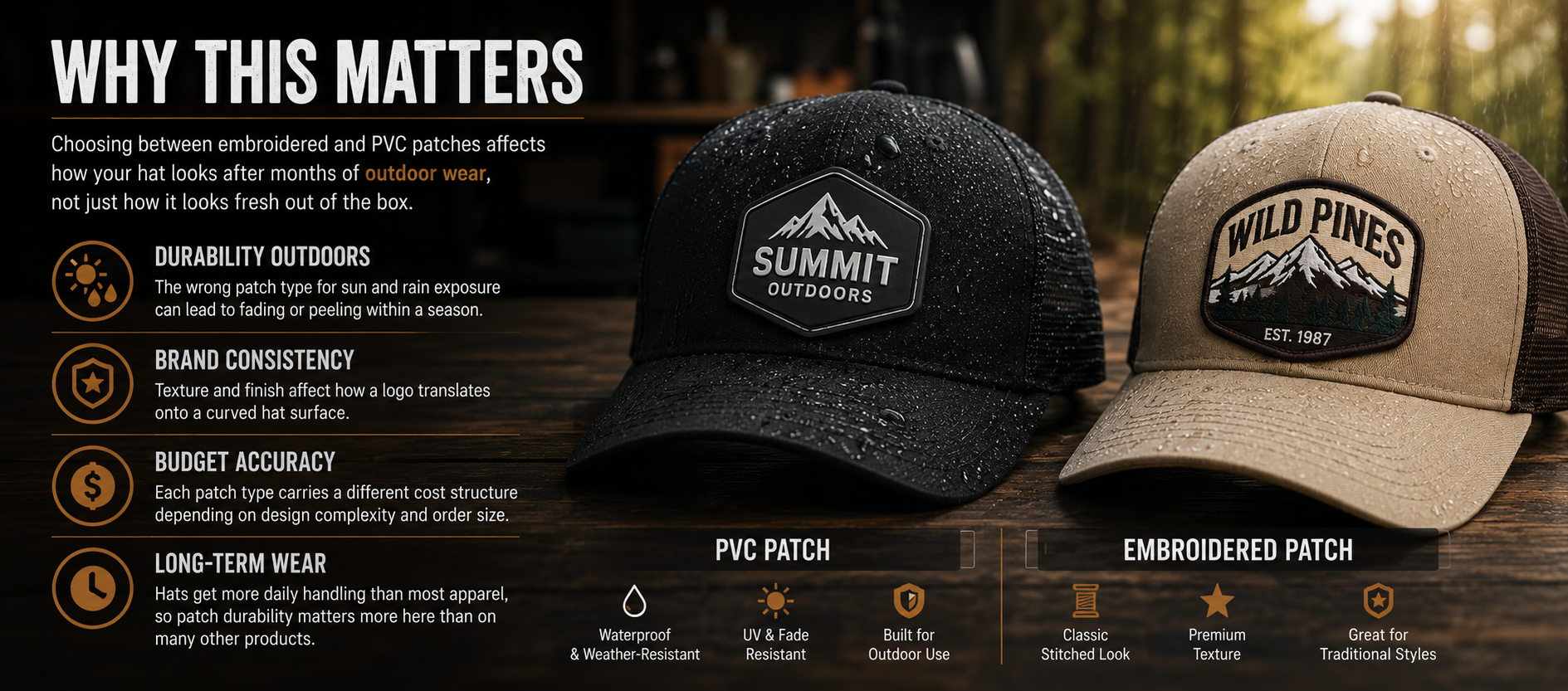
Choosing between embroidered and PVC patches affects how your hat looks after months of outdoor wear, not just how it looks fresh out of the box.
- Durability outdoors: The wrong patch type for sun and rain exposure can lead to fading or peeling within a season.
- Brand consistency: Texture and finish affect how a logo translates onto a curved hat surface.
- Budget accuracy: Each patch type carries a different cost structure depending on design complexity and order size.
- Long-term wear: Hats get more daily handling than most apparel, so patch durability matters more here than on many other products.
What Are Embroidered Patches
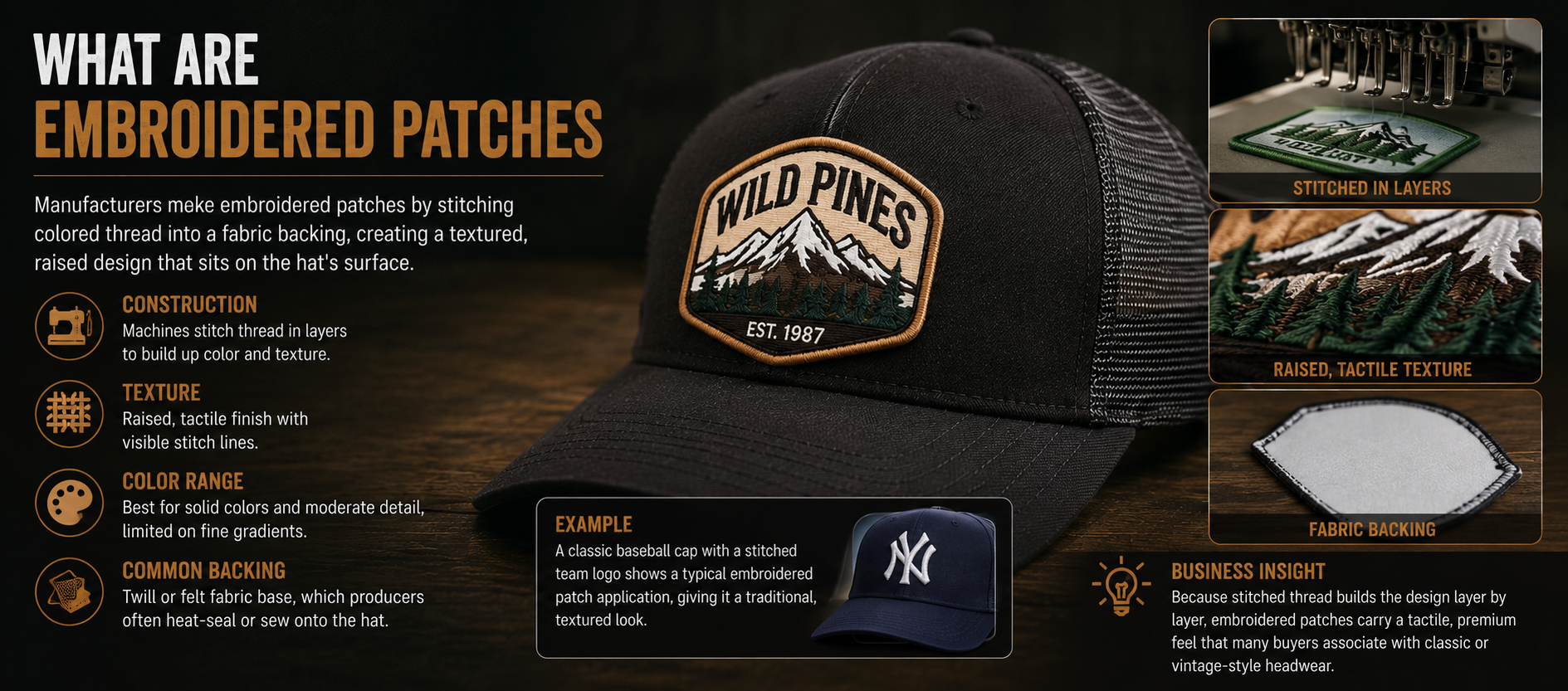
Manufacturers make embroidered patches by stitching colored thread into a fabric backing, creating a textured, raised design that sits on the hat’s surface.
- Construction: Machines stitch thread in layers to build up color and texture.
- Texture: Raised, tactile finish with visible stitch lines.
- Color range: Best for solid colors and moderate detail, limited on fine gradients.
- Common backing: Twill or felt fabric base, which producers often heat-seal or sew onto the hat.
Example: A classic baseball cap with a stitched team logo shows a typical embroidered patch application, giving it a traditional, textured look.
Business Insight: Because stitched thread builds the design layer by layer, embroidered patches carry a tactile, premium feel that many buyers associate with classic or vintage-style headwear.
What Are PVC Patches
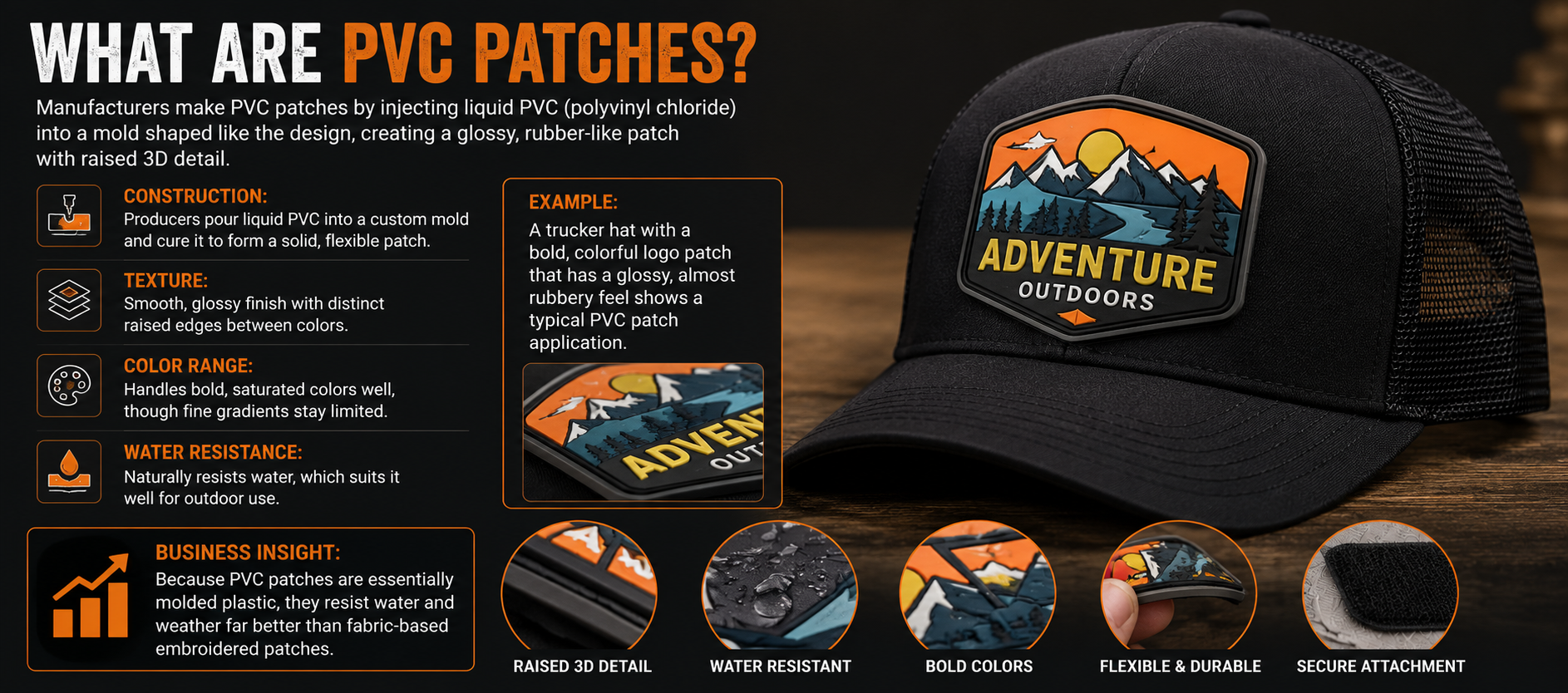
Manufacturers make PVC patches by injecting liquid PVC (polyvinyl chloride) into a mold shaped like the design, creating a glossy, rubber-like patch with raised 3D detail.
- Construction: Producers pour liquid PVC into a custom mold and cure it to form a solid, flexible patch.
- Texture: Smooth, glossy finish with distinct raised edges between colors.
- Color range: Handles bold, saturated colors well, though fine gradients stay limited.
- Water resistance: Naturally resists water, which suits it well for outdoor use.
Example: A trucker hat with a bold, colorful logo patch that has a glossy, almost rubbery feel shows a typical PVC patch application.
Business Insight: Because PVC patches are essentially molded plastic, they resist water and weather far better than fabric-based embroidered patches.
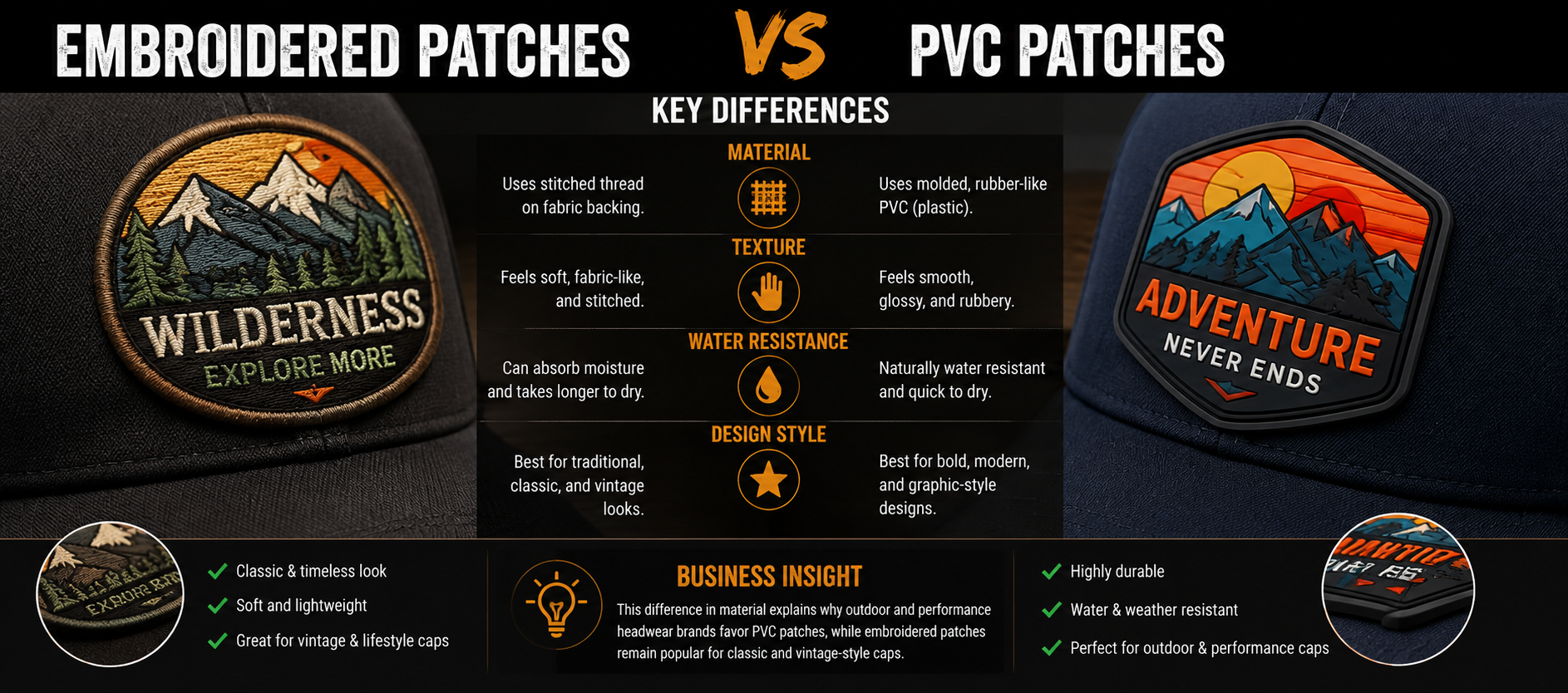
Embroidered Patches vs PVC Patches: Key Differences
The core difference between these two patch types comes down to material and construction method, which directly affects texture, durability, and cost.
- Material: Embroidered patches use stitched thread on fabric; PVC patches use molded rubber-like plastic.
- Texture: Embroidered patches feel soft and stitched; PVC patches feel smooth and glossy.
- Water resistance: PVC patches naturally resist water; embroidered patches can absorb moisture and take longer to dry.
- Design style: Embroidered patches suit traditional, classic looks; PVC patches suit bold, modern, graphic-style designs.
Business Insight: This difference in material explains why outdoor and performance headwear brands favor PVC patches, while embroidered patches remain popular for classic and vintage-style caps.
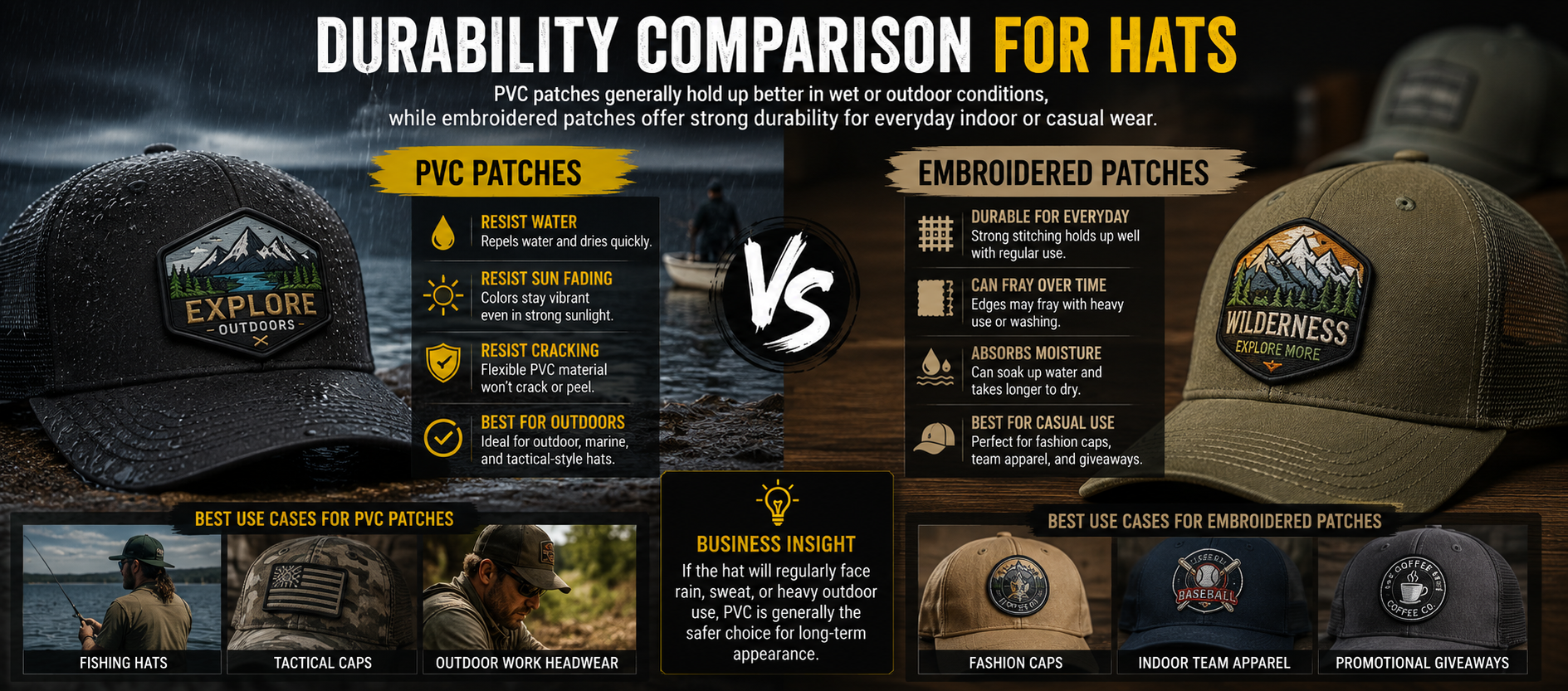
Durability Comparison for Hats
PVC patches generally hold up better in wet or outdoor conditions, while embroidered patches offer strong durability for everyday indoor or casual wear.
- PVC patches: Resist water, sun fading, and cracking; well-suited for outdoor, marine, or tactical-style hats.
- Embroidered patches: Durable for regular wear but can fray at the edges over time or absorb moisture in wet conditions.
- When durability outdoors matters most: Fishing hats, tactical caps, outdoor work headwear.
- When it matters less: Fashion caps, indoor team apparel, promotional giveaways.
Business Insight: If the hat will regularly face rain, sweat, or heavy outdoor use, PVC is generally the safer choice for long-term appearance.
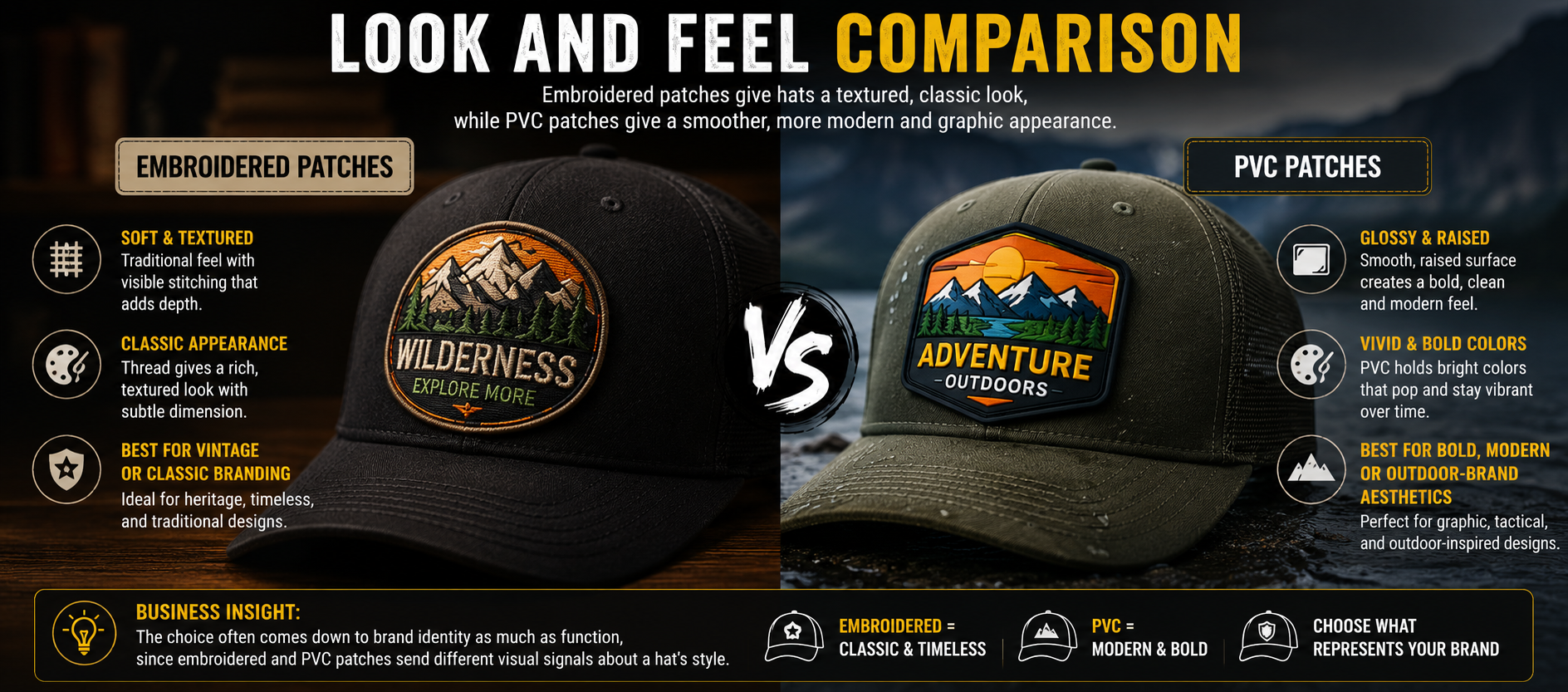
Look and Feel Comparison
Embroidered patches give hats a textured, classic look, while PVC patches give a smoother, more modern and graphic appearance.
- Embroidered patches: Soft, textured, traditional feel; visible stitching adds depth.
- PVC patches: Glossy, raised, bold appearance; colors appear more vivid and saturated.
- Best for vintage or classic branding: Embroidered.
- Best for bold, modern, or outdoor-brand aesthetics: PVC.
Business Insight: The choice often comes down to brand identity as much as function, since embroidered and PVC patches send different visual signals about a hat’s style.
Cost Comparison
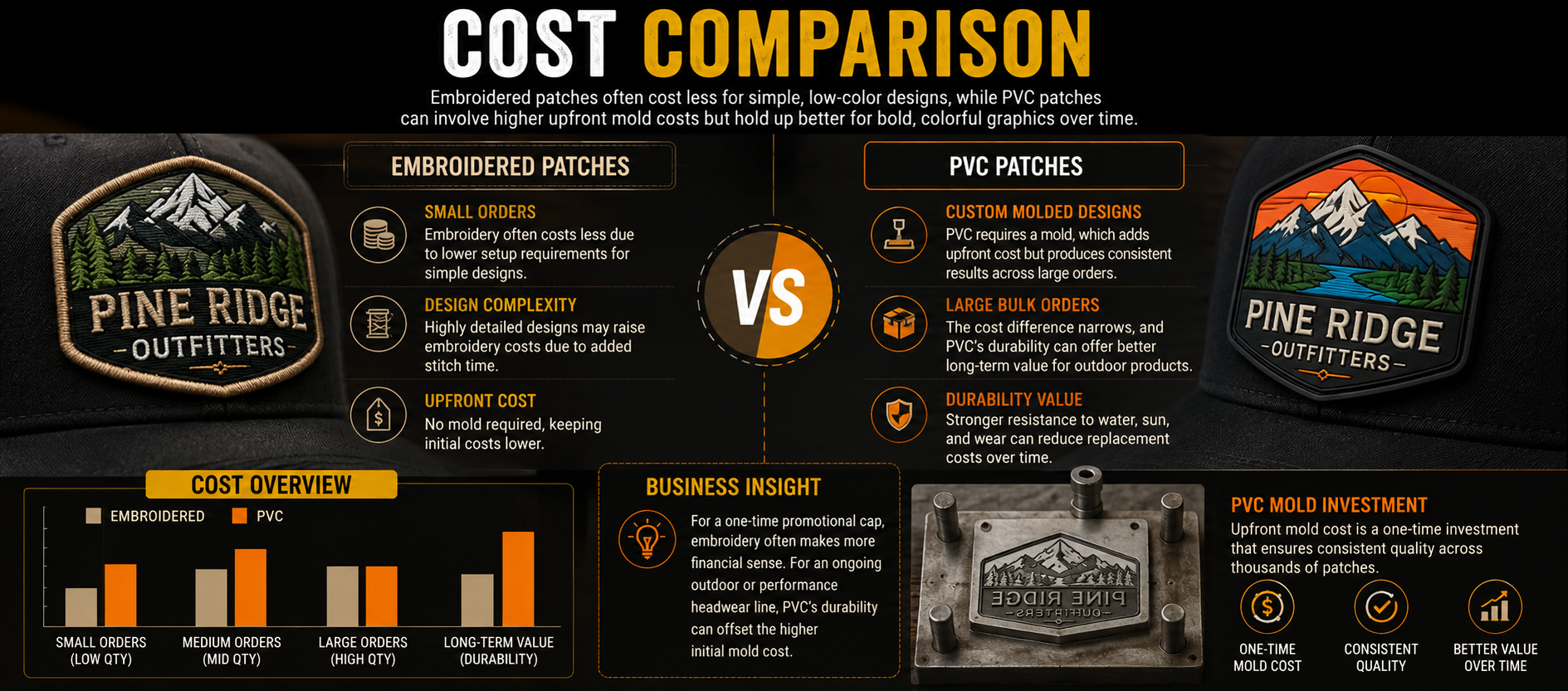
Embroidered patches often cost less for simple, low-color designs, while PVC patches can involve higher upfront mold costs but hold up better for bold, colorful graphics over time.
- Small orders: Embroidery often costs less due to lower setup requirements for simple designs.
- Custom molded designs: PVC requires a mold, which adds upfront cost but produces consistent results across large orders.
- Large bulk orders: The cost difference narrows, and PVC’s durability can offer better long-term value for outdoor products.
- Design complexity: Highly detailed designs may raise embroidery costs due to added stitch time.
Business Insight: For a one-time promotional cap, embroidery often makes more financial sense. For an ongoing outdoor or performance headwear line, PVC’s durability can offset the higher initial mold cost.
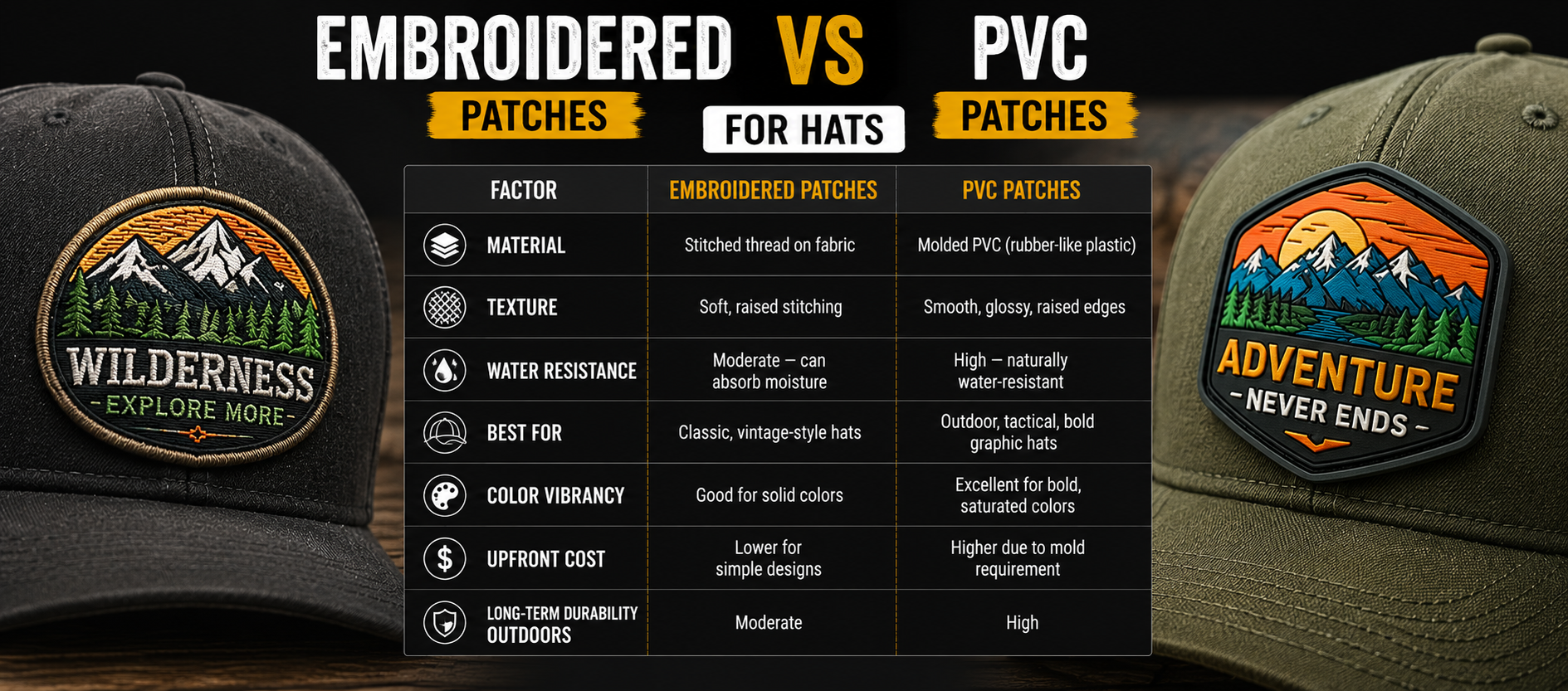
Comparison Table: Embroidered vs PVC Patches for Hats
| Factor | Embroidered Patches | PVC Patches |
|---|---|---|
| Material | Stitched thread on fabric | Molded PVC (rubber-like plastic) |
| Texture | Soft, raised stitching | Smooth, glossy, raised edges |
| Water resistance | Moderate can absorb moisture | High naturally water-resistant |
| Best for | Classic, vintage-style hats | Outdoor, tactical, bold graphic hats |
| Color vibrancy | Good for solid colors | Excellent for bold, saturated colors |
| Upfront cost | Lower for simple designs | Higher due to mold requirement |
| Long-term durability outdoors | Moderate | High |
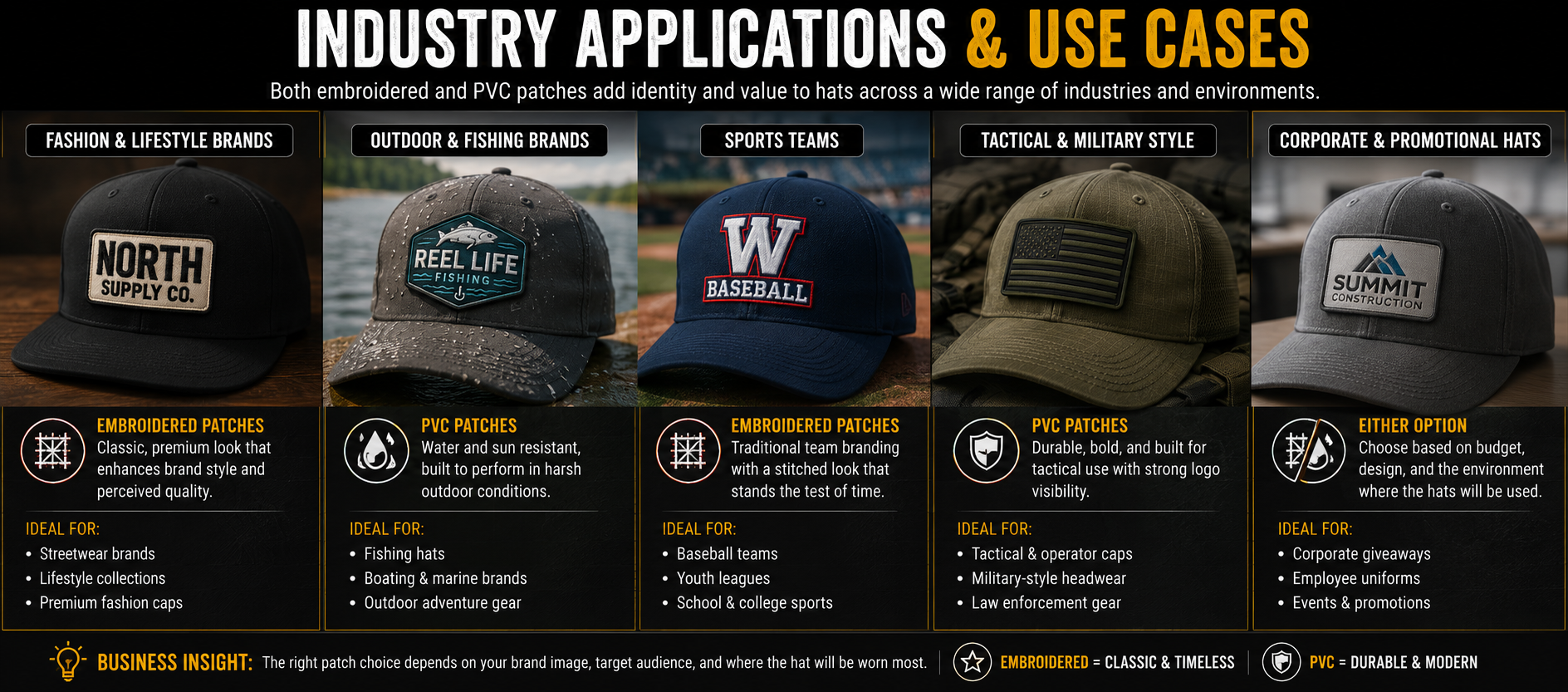
Industry Applications and Use Cases
- Fashion and lifestyle brands: Embroidered patches for a classic, premium cap look.
- Outdoor and fishing brands: PVC patches for water and sun resistance.
- Sports teams: Embroidered patches for traditional team branding on caps.
- Tactical and military-style headwear: PVC patches for durability and bold logo visibility.
- Corporate promotional hats: Either option depending on budget and intended use environment.
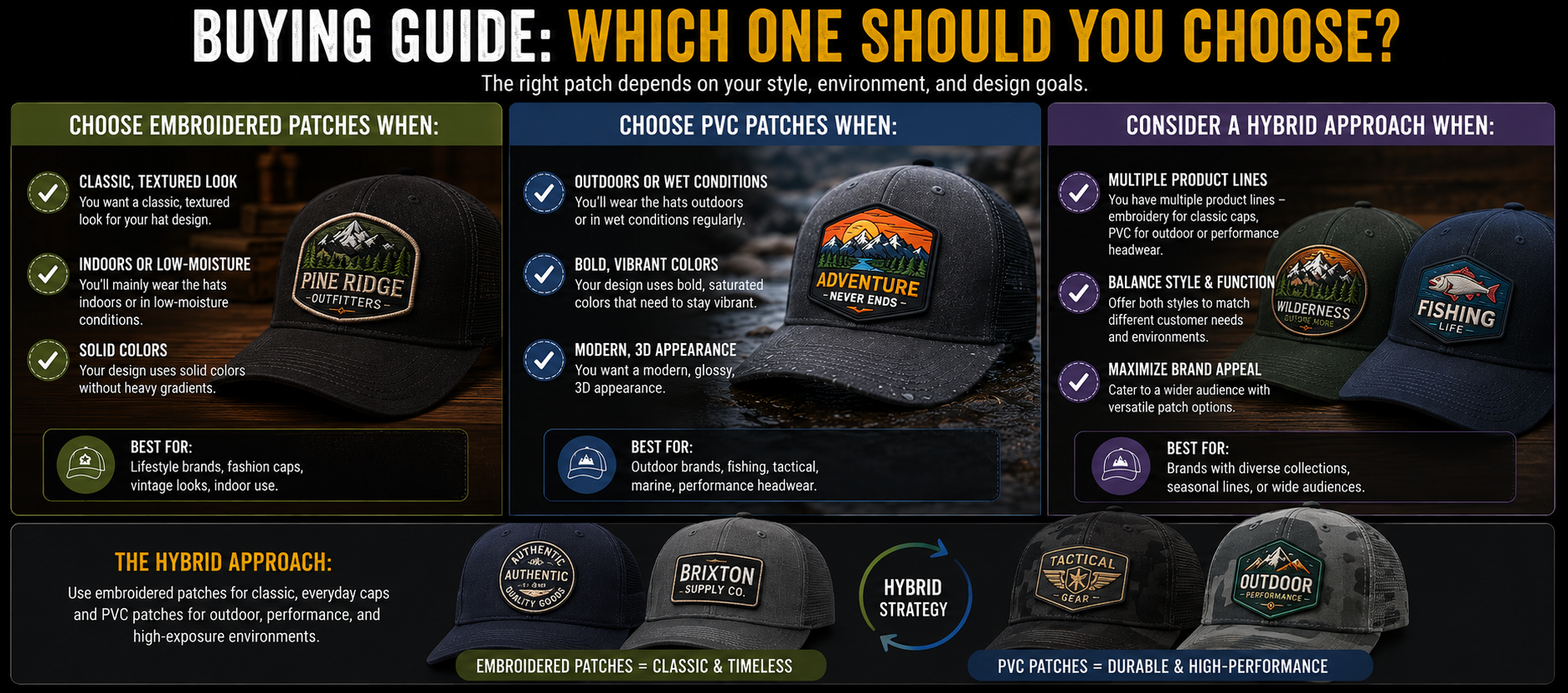
Buying Guide: Which One Should You Choose
Choose embroidered patches when:
- You want a classic, textured look for your hat design.
- You’ll mainly wear the hats indoors or in low-moisture conditions.
- Your design uses solid colors without heavy gradients.
Choose PVC patches when:
- You’ll wear the hats outdoors or in wet conditions regularly.
- Your design uses bold, saturated colors that need to stay vibrant.
- You want a modern, glossy, 3D appearance.
Consider a hybrid approach when:
- You have multiple product lines embroidery for classic caps, PVC for outdoor or performance headwear.
Common Mistakes When Ordering Hat Patches
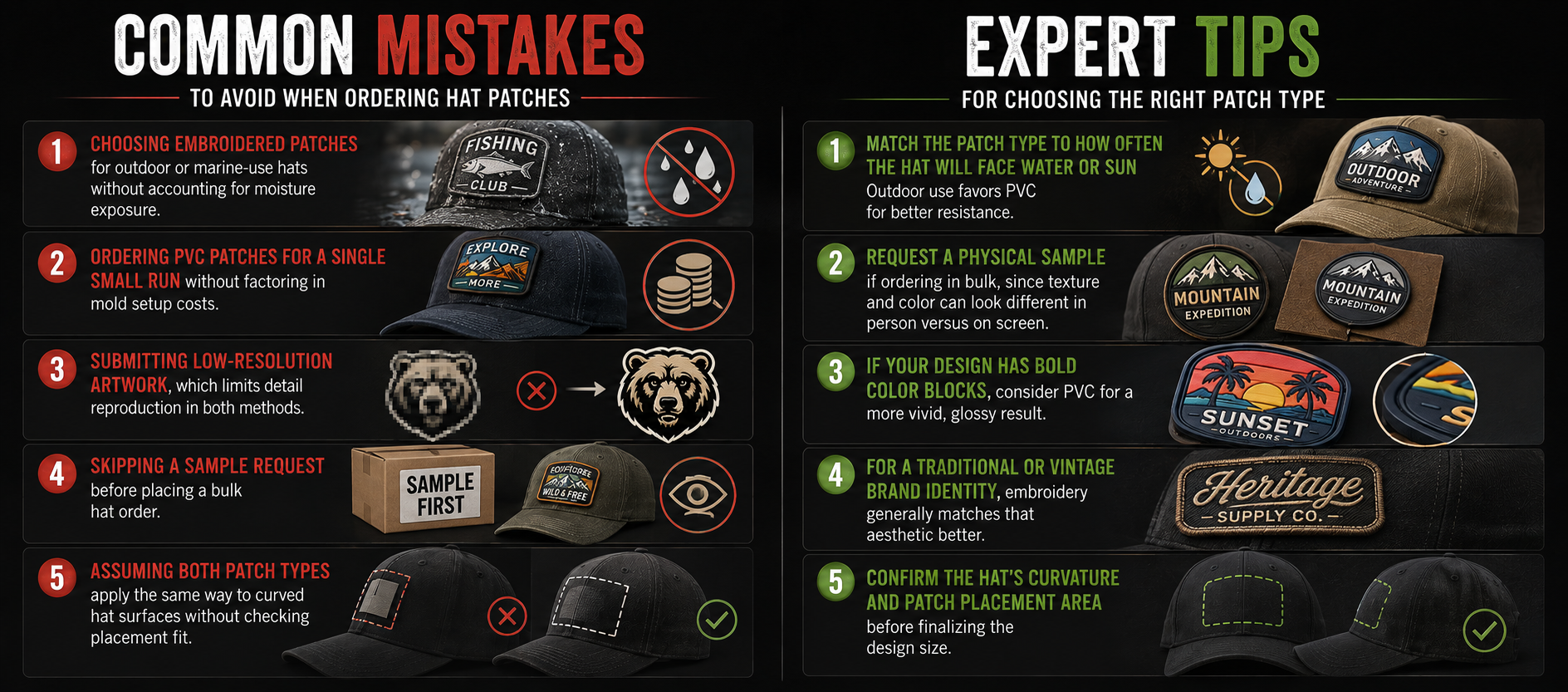
- Mistake 1: Choosing embroidered patches for outdoor or marine-use hats without accounting for moisture exposure.
- Mistake 2: Ordering PVC patches for a single small run without factoring in mold setup costs.
- Mistake 3: Submitting low-resolution artwork, which limits detail reproduction in both methods.
- Mistake 4: Skipping a sample request before placing a bulk hat order.
- Mistake 5: Assuming both patch types apply the same way to curved hat surfaces without checking placement fit.
Expert Tips for Choosing the Right Patch Type
- Tip 1: Match the patch type to how often the hat will face water or sun outdoor use favors PVC.
- Tip 2: Request a physical sample if ordering in bulk, since texture and color can look different in person versus on screen.
- Tip 3: If your design has bold color blocks, consider PVC for a more vivid, glossy result.
- Tip 4: For a traditional or vintage brand identity, embroidery generally matches that aesthetic better.
- Tip 5: Confirm the hat’s curvature and patch placement area before finalizing the design size.
Maintenance Tips for Patched Hats
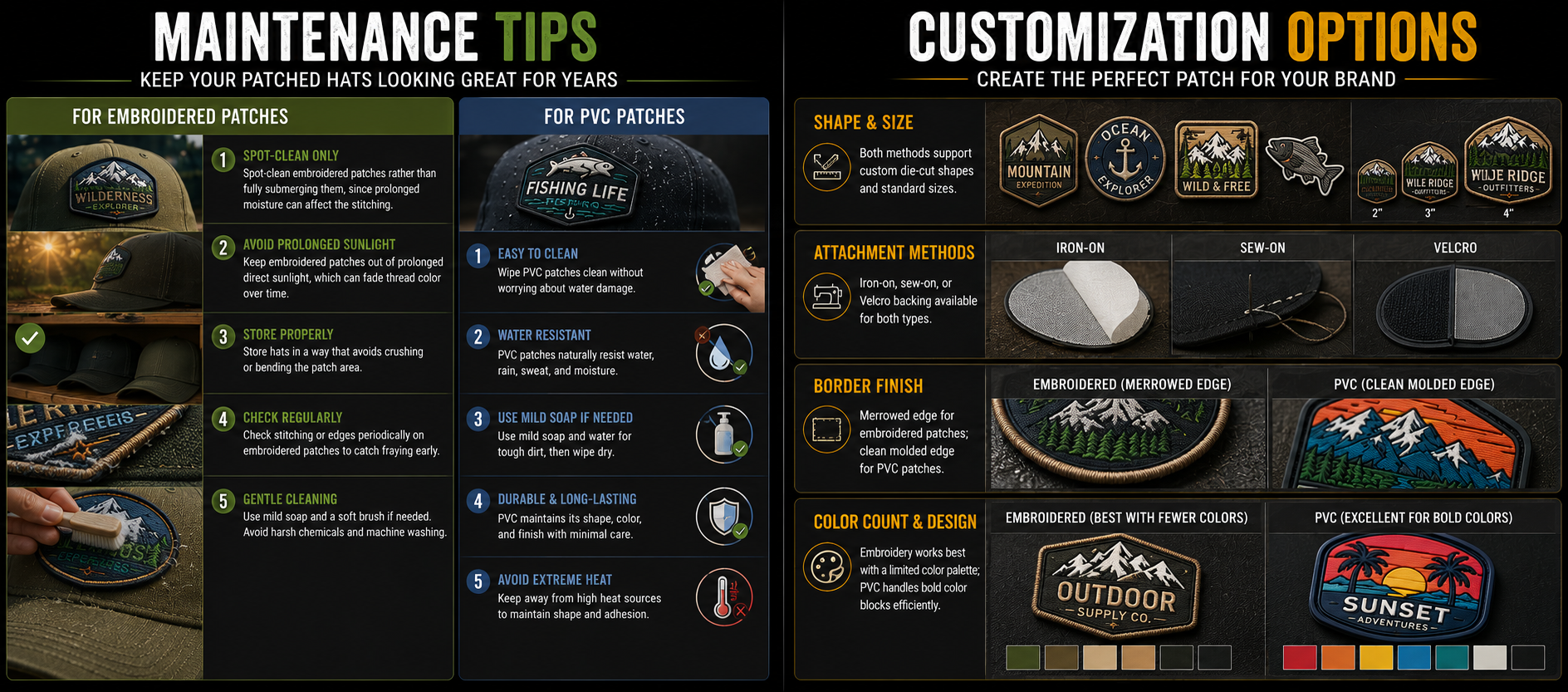
- Tip 1: Spot-clean embroidered patches rather than fully submerging them, since prolonged moisture can affect the stitching.
- Tip 2: Wipe PVC patches clean without worrying about water damage.
- Tip 3: Keep embroidered patches out of prolonged direct sunlight, which can fade thread color over time.
- Tip 4: Store hats in a way that avoids crushing or bending the patch area.
- Tip 5: Check stitching or edges periodically on embroidered patches to catch fraying early.
Customization Options
- Shape and size: Both methods support custom die-cut shapes and standard sizes.
- Attachment method: Iron-on, sew-on, or Velcro backing available for both types.
- Border finish: Merrowed edge for embroidered patches; clean molded edge for PVC.
- Color count: Embroidery works best with a limited color palette; PVC handles bold color blocks efficiently.
Pricing Factors
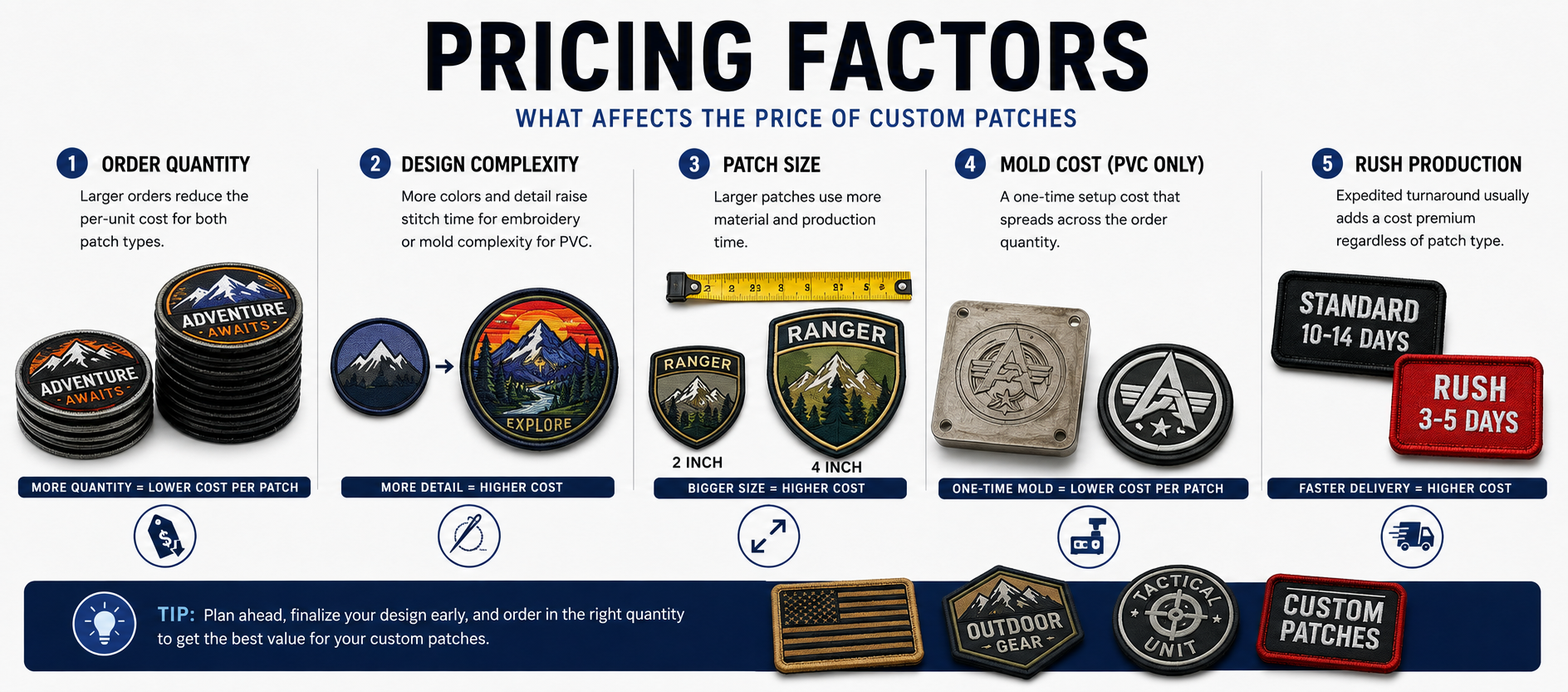
- Order quantity: Larger orders reduce the per-unit cost for both patch types.
- Design complexity: More colors and detail raise stitch time for embroidery or mold complexity for PVC.
- Patch size: Larger patches use more material and production time.
- Mold cost (PVC only): A one-time setup cost that spreads across the order quantity.
- Rush production: Expedited turnaround usually adds a cost premium regardless of patch type.
Why Choose Custom Patches 4U
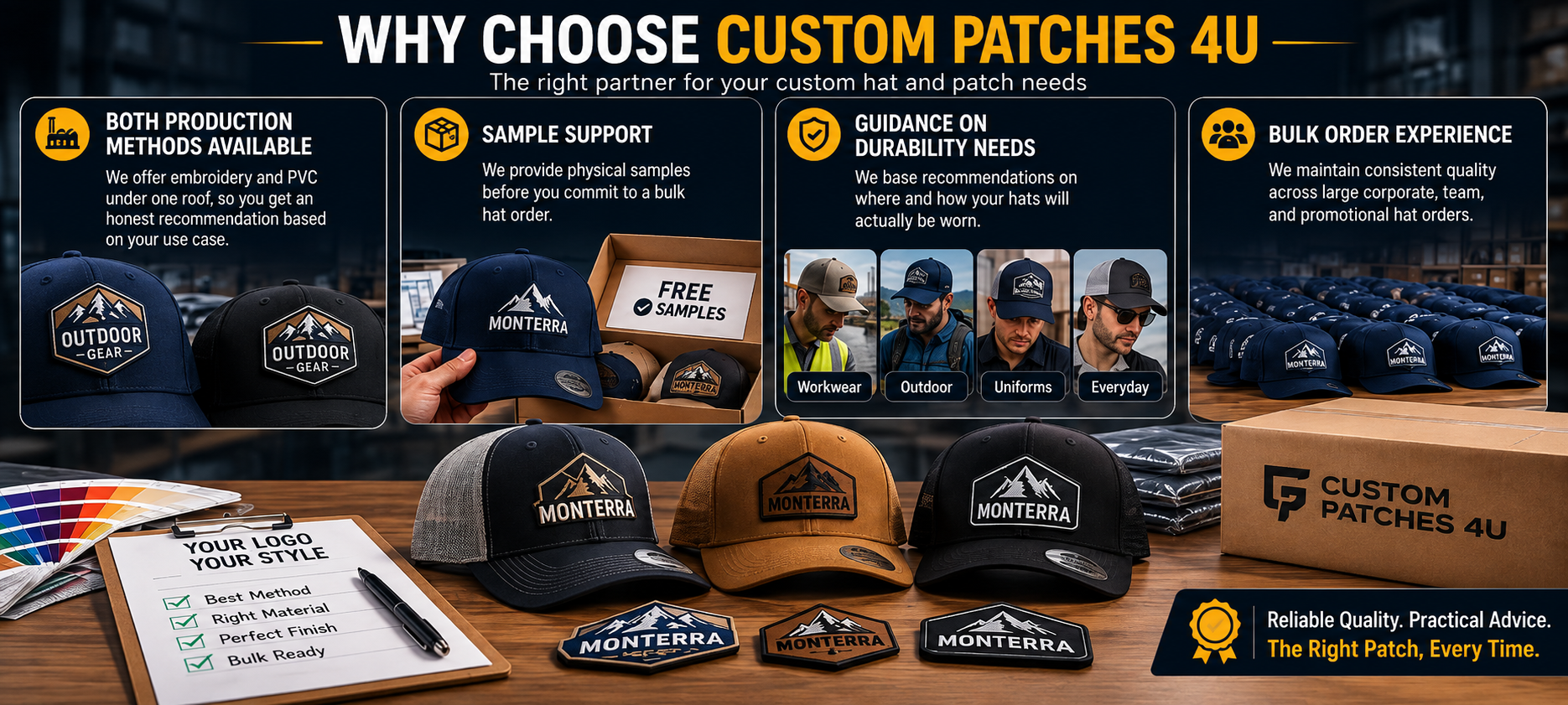
- Both production methods available: We offer embroidery and PVC under one roof, so you get an honest recommendation based on your use case.
- Sample support: We provide physical samples before you commit to a bulk hat order.
- Guidance on durability needs: We base recommendations on where and how your hats will actually be worn.
- Bulk order experience: We maintain consistent quality across large corporate, team, and promotional hat orders.
FAQs
What are embroidered patches?
Manufacturers make embroidered patches by stitching colored thread into a fabric backing, creating a textured, raised design commonly used on classic and vintage-style hats.
What are PVC patches?
Manufacturers make PVC patches by injecting liquid PVC into a custom mold, producing a glossy, 3D patch that naturally resists water and fading.
Which patch type is better for hats: embroidered or PVC?
It depends on use embroidered patches suit classic, indoor-friendly designs, while PVC patches suit outdoor, water-resistant, or bold graphic hat designs.
Are PVC patches more durable than embroidered patches?
For outdoor and wet conditions, yes. PVC resists water and fading better, while embroidered patches perform well in drier, everyday wear.
Do PVC patches work on curved hat surfaces?
Yes, manufacturers mold PVC patches with flexibility in mind, so they fit curved surfaces like hat fronts and panels.
Are embroidered patches more expensive than PVC patches?
For small, simple designs, embroidery often costs less. PVC involves a mold cost, which pays off better at higher order volumes.
Can embroidered patches get wet?
Embroidered patches can handle light moisture but don’t hold up well under regular water exposure, since prolonged wetness can affect stitching over time.
Which patch type looks more modern?
PVC patches generally carry a more modern, glossy, graphic look, while embroidered patches lean toward a classic, textured aesthetic.
Can I combine embroidered and PVC patches in one hat order?
Yes, some brands use embroidery for certain product lines and PVC for others, depending on the intended use of each hat style.
How do I know which patch type is right for my hat design?
Consider how you’ll wear the hat (indoor vs outdoor), your design’s color complexity, and your budget and order size each factor points toward one method over the other.
Get a Custom Hat Patch Quote
If you're deciding between embroidered and PVC patches for your hat order, share your design, intended use, and quantity for a tailored recommendation and quote. Request a sample, ask about bulk pricing, or get guidance on which patch type fits your hat line before you place your order.