
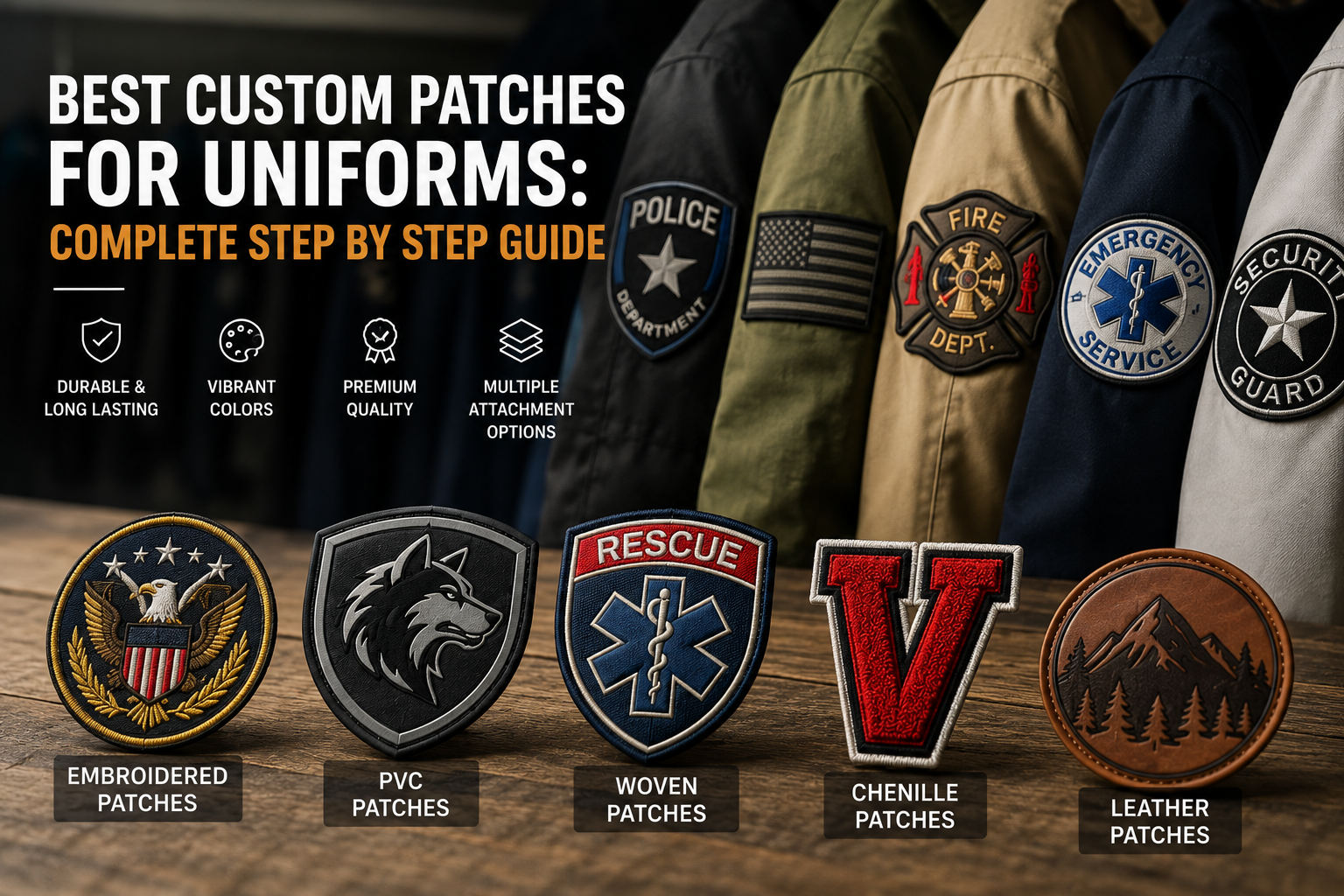
The best custom patches for uniforms depend on how the uniform is worn, washed, and how detailed the design needs to be. Embroidered patches offer a reliable, classic option for standard uniforms, PVC patches excel in outdoor and wet conditions, and woven patches handle fine detail better than standard embroidery. Chenille and leather patches serve more specific branding needs, while printed and iron-on patches suit budget-conscious or short-term uniform programs. Matching the patch type to your organization's actual use case is the key factor in getting long-term value from your uniform patches.
Introduction
Choosing the right patch type for a uniform program affects more than appearance, it determines how well your branding holds up across months or years of daily wear. With options like embroidery, PVC, chenille, leather, woven, and printed patches all available, picking the wrong one can mean patches that fade, peel, or look inconsistent across your team. This guide breaks down each patch type, compares them directly, and walks through how to choose the best custom patches for your specific uniform program, whether you’re ordering a handful of jackets or outfitting an entire organization.
Featured Snippet Answer
The best custom patches for uniforms depend on your design, budget, and durability needs. Embroidered patches offer a classic, textured look and strong durability for logos with moderate detail. PVC patches resist water and fading, making them ideal for outdoor or tactical uniforms. Woven patches suit fine text and detailed designs, while chenille and leather patches work well for varsity-style or premium branding.
Why This Matters
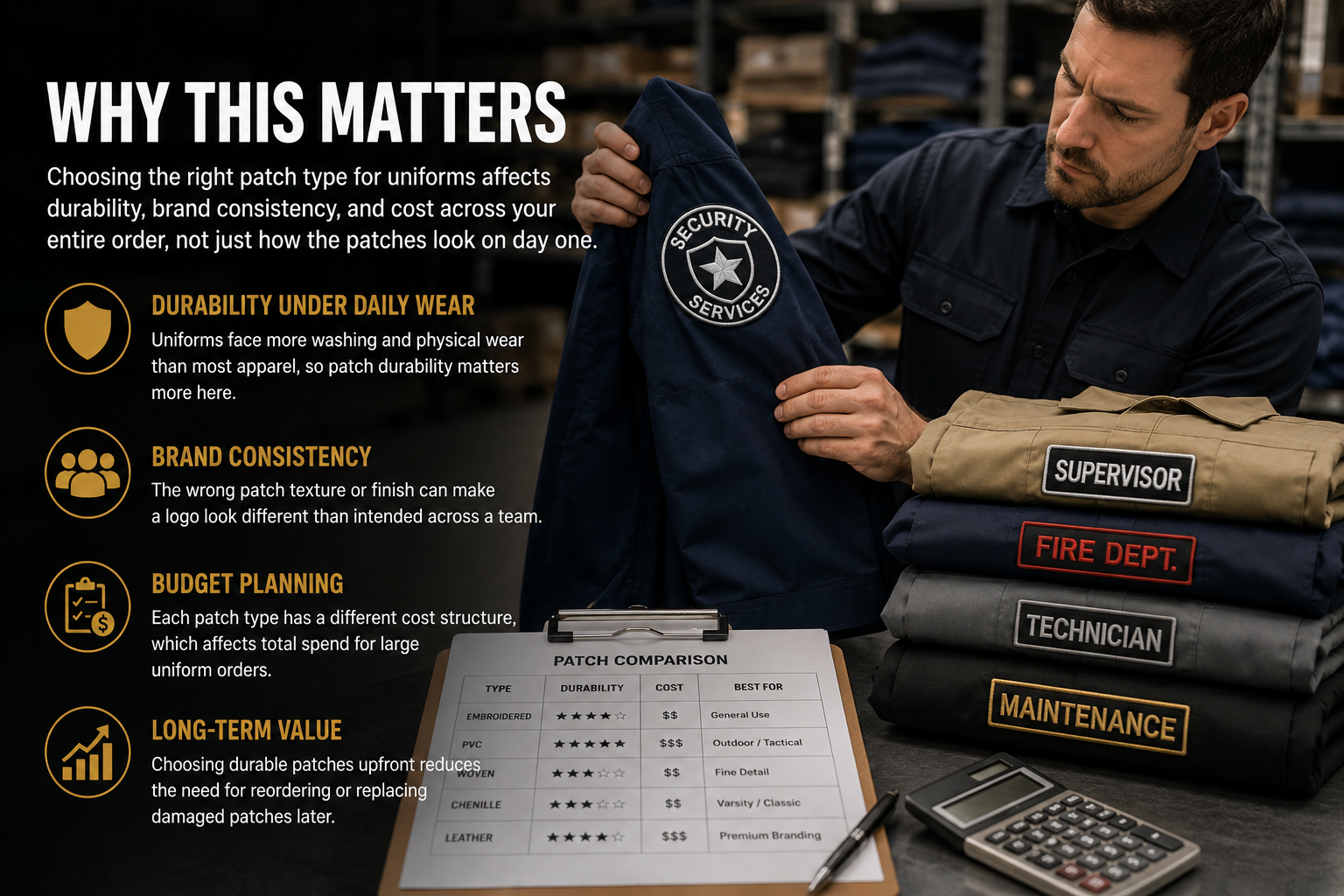
Choosing the right patch type for uniforms affects durability, brand consistency, and cost across your entire order, not just how the patches look on day one.
- Durability under daily wear: Uniforms face more washing and physical wear than most apparel, so patch durability matters more here.
- Brand consistency: The wrong patch texture or finish can make a logo look different than intended across a team.
- Budget planning: Each patch type has a different cost structure, which affects total spend for large uniform orders.
- Long-term value: Choosing durable patches upfront reduces the need for reordering or replacing damaged patches later.
What Makes a Patch “Best” for Uniforms
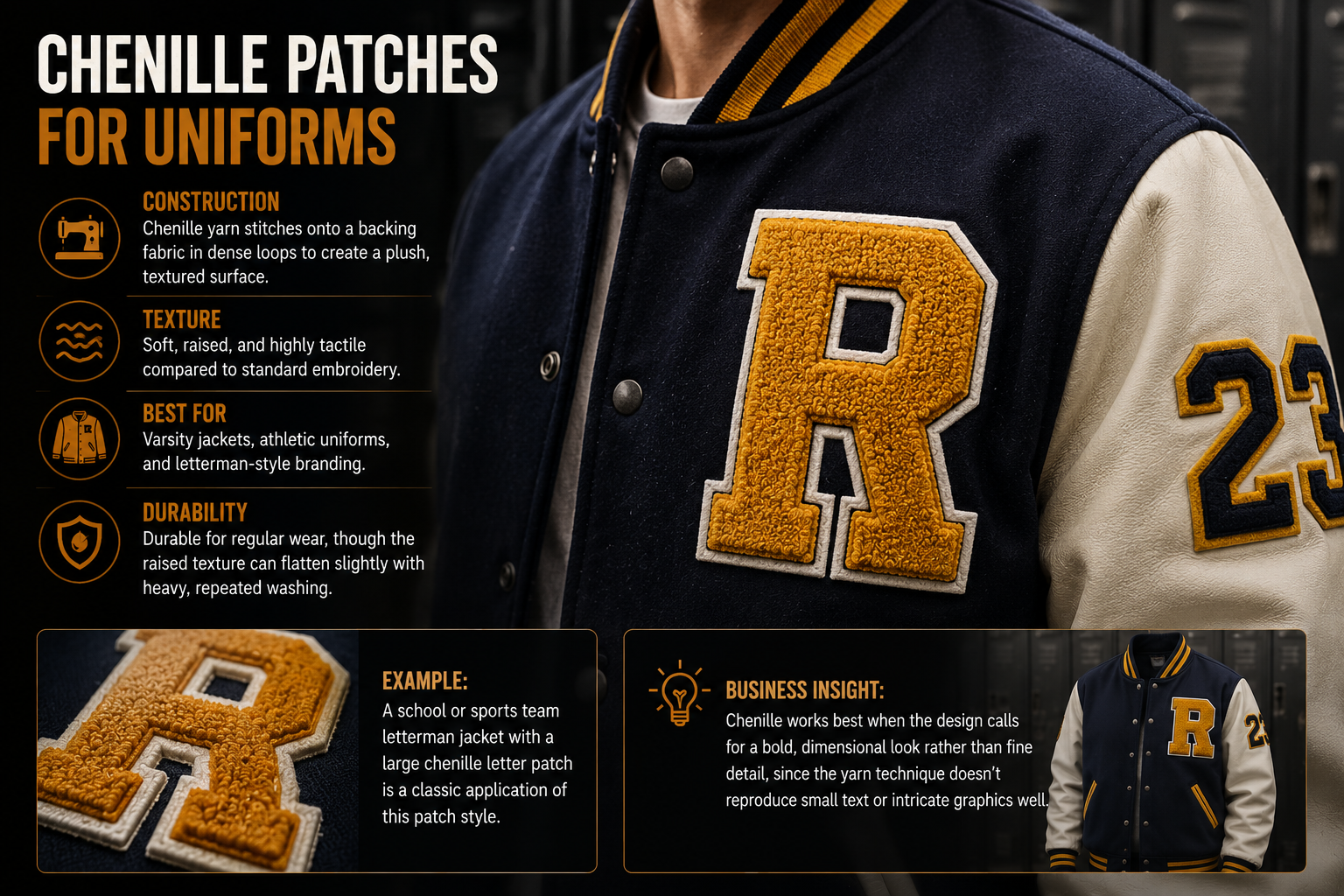
The best patch for a uniform program depends on how you use the uniform, how often you wash it, and how detailed the logo or design is.
- Durability match: The patch should hold up to the uniform’s actual wear conditions, indoor, outdoor, or industrial.
- Design compatibility: Some patch types handle fine detail and gradients better than others.
- Attachment method: Sew-on, iron-on, or Velcro backing should match how you wear and maintain the uniform.
- Budget fit: The best patch for a small order may differ from the best choice for a large wholesale run.
Example: Employees who wear a tactical uniform outdoors daily need very different patches than those who wear an office uniform indoors, even if both use the same logo.
Business Insight: There’s no single “best” patch type across all uniforms, the right choice depends entirely on matching the patch to the uniform’s real-world use.
Custom Embroidered Patches for Jackets and Uniforms
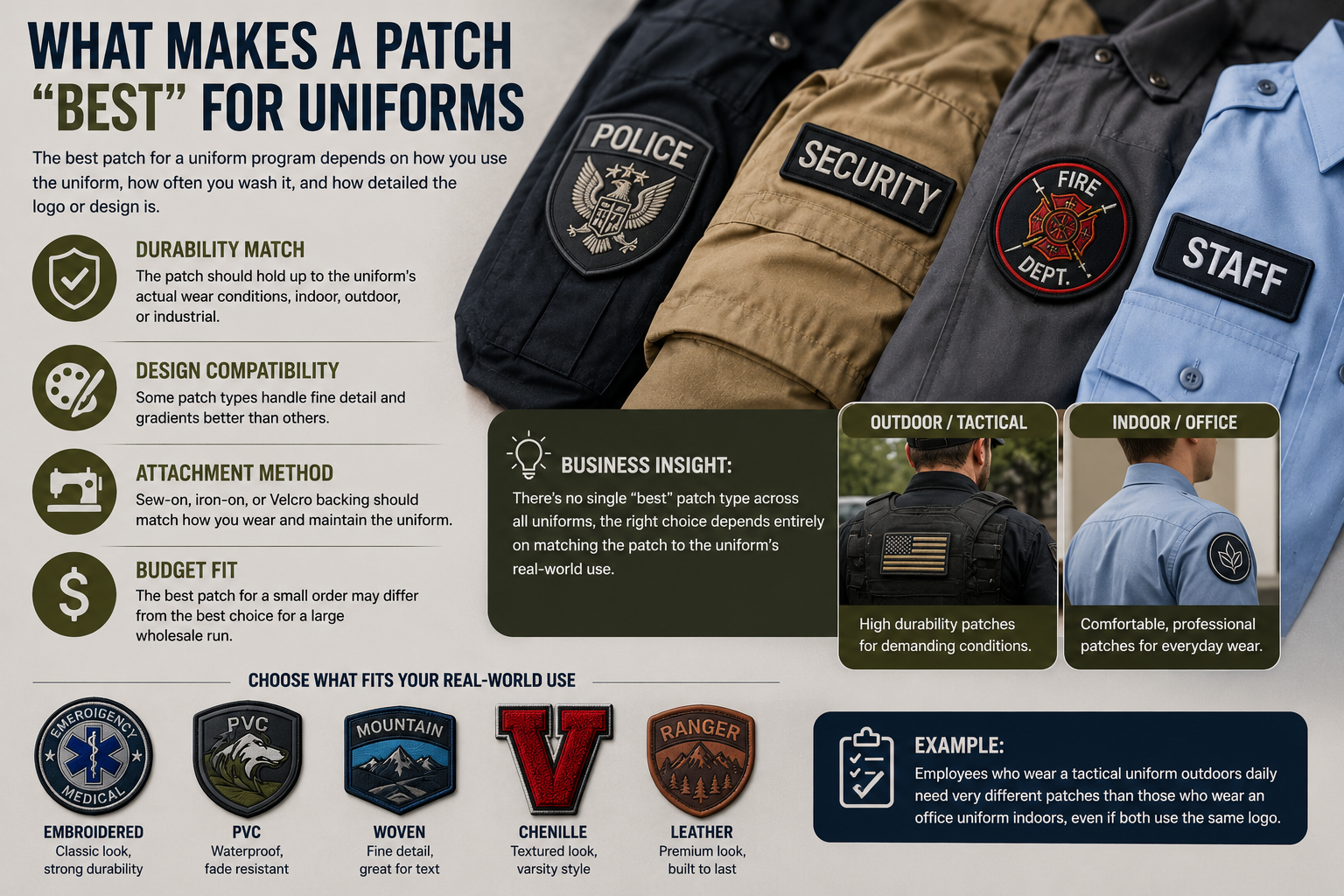
Custom embroidered patches use stitched thread to create a textured, raised design, making them one of the most popular choices for jackets and standard uniforms.
- Construction: Machines stitch colored thread into a fabric backing to build up the design.
- Texture: Raised, tactile finish with visible stitch lines that gives a classic, professional look.
- Best for: Jacket patches, standard uniform branding, and logos with moderate detail and limited color gradients.
- Durability: Holds up well to regular washing and daily wear, especially with proper edge finishing.
Example: A company jacket with an embroidered logo on the chest is one of the most common uniform patch applications, offering a professional, textured appearance.
Business Insight: Embroidery remains a strong default choice for most uniform programs because it balances durability, cost, and a professional appearance well.
Custom Logo Patches: PVC Patches Explained
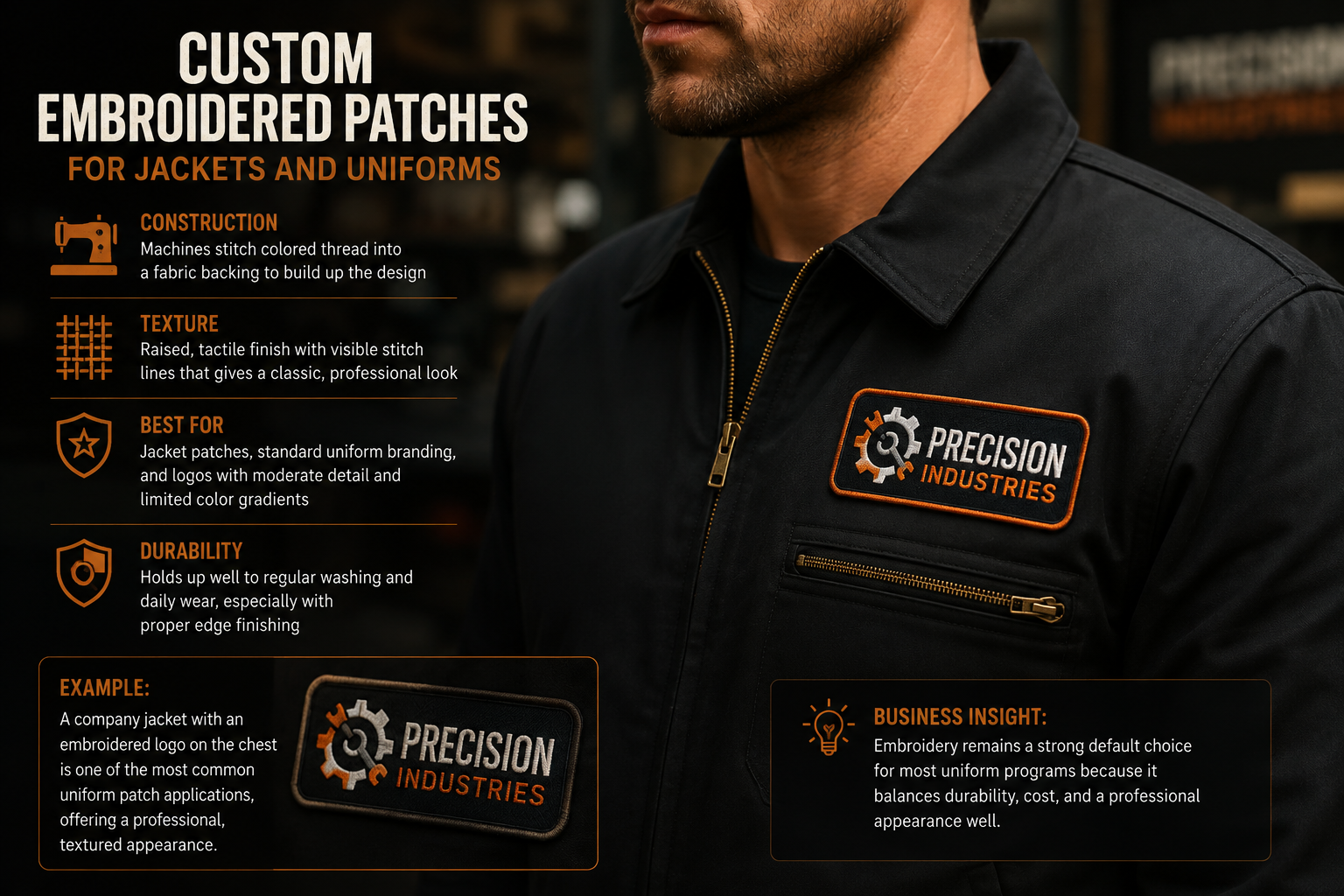
Custom logo patches made from PVC use molded rubber-like material to create a glossy, 3D design that resists water and fading, making them well-suited for outdoor or high-exposure uniforms.
- Construction: Manufacturers pour liquid PVC into a custom mold to form a solid, flexible patch.
- Texture: Smooth, glossy finish with raised, distinct color separation.
- Best for: Outdoor uniforms, tactical gear, and bold, colorful logos that need to stay vibrant.
- Durability: Naturally resists water, sun fading, and cracking better than fabric-based patch types.
Example: A security or outdoor maintenance uniform often uses PVC patches specifically because they hold up better against rain and sun exposure than embroidered alternatives.
Business Insight: PVC’s water resistance makes it a strong choice for any uniform program where employees regularly work outdoors or in wet conditions.
Chenille Patches for Uniforms
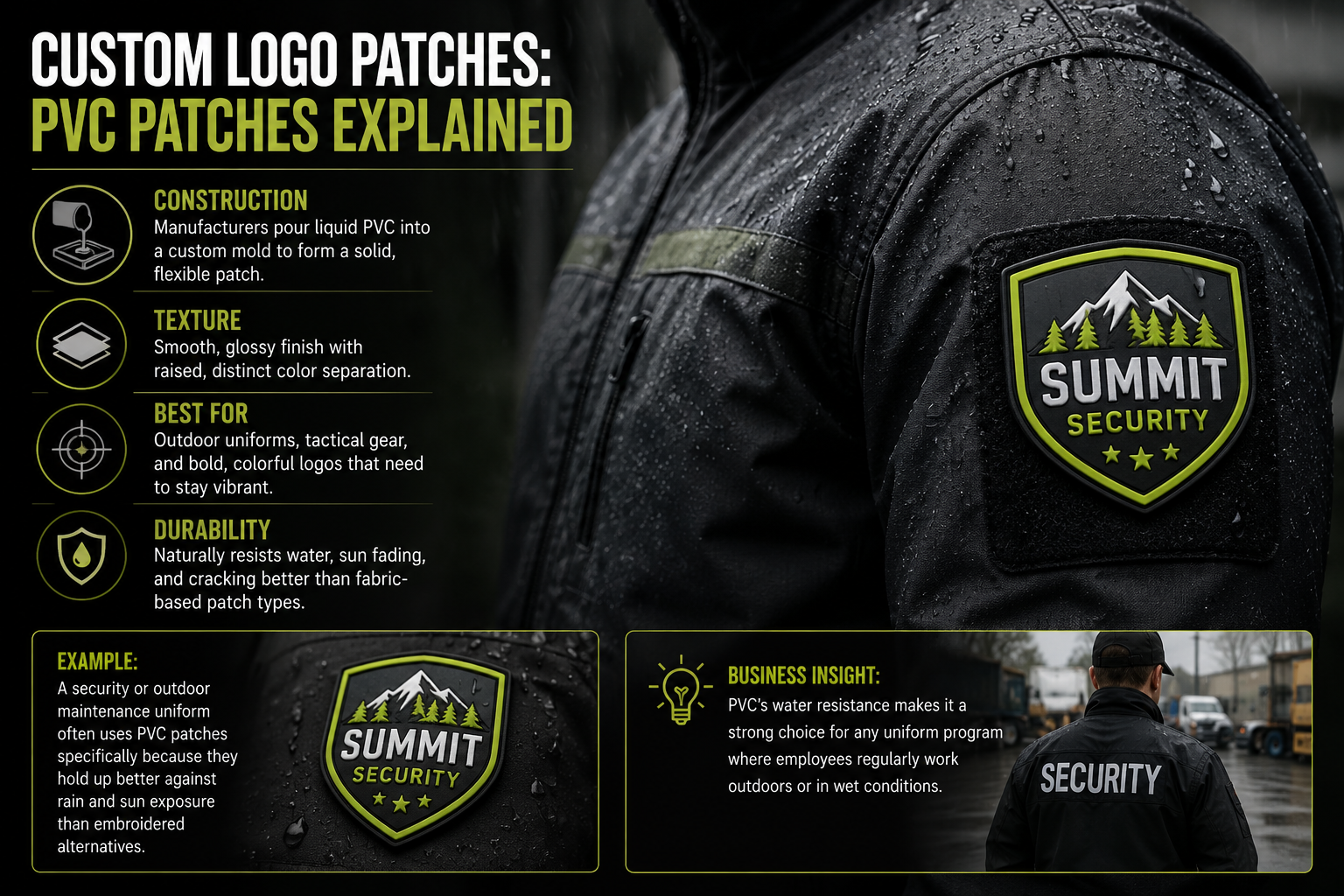
Chenille patches use a soft, textured yarn stitched in a looped pattern, creating a raised, fuzzy finish commonly associated with varsity and letterman-style uniforms.
- Construction: Chenille yarn stitches onto a backing fabric in dense loops to create a plush, textured surface.
- Texture: Soft, raised, and highly tactile compared to standard embroidery.
- Best for: Varsity jackets, athletic uniforms, and letterman-style branding.
- Durability: Durable for regular wear, though the raised texture can flatten slightly with heavy, repeated washing.
Example: A school or sports team letterman jacket with a large chenille letter patch is a classic application of this patch style.
Business Insight: Chenille works best when the design calls for a bold, dimensional look rather than fine detail, since the yarn technique doesn’t reproduce small text or intricate graphics well.
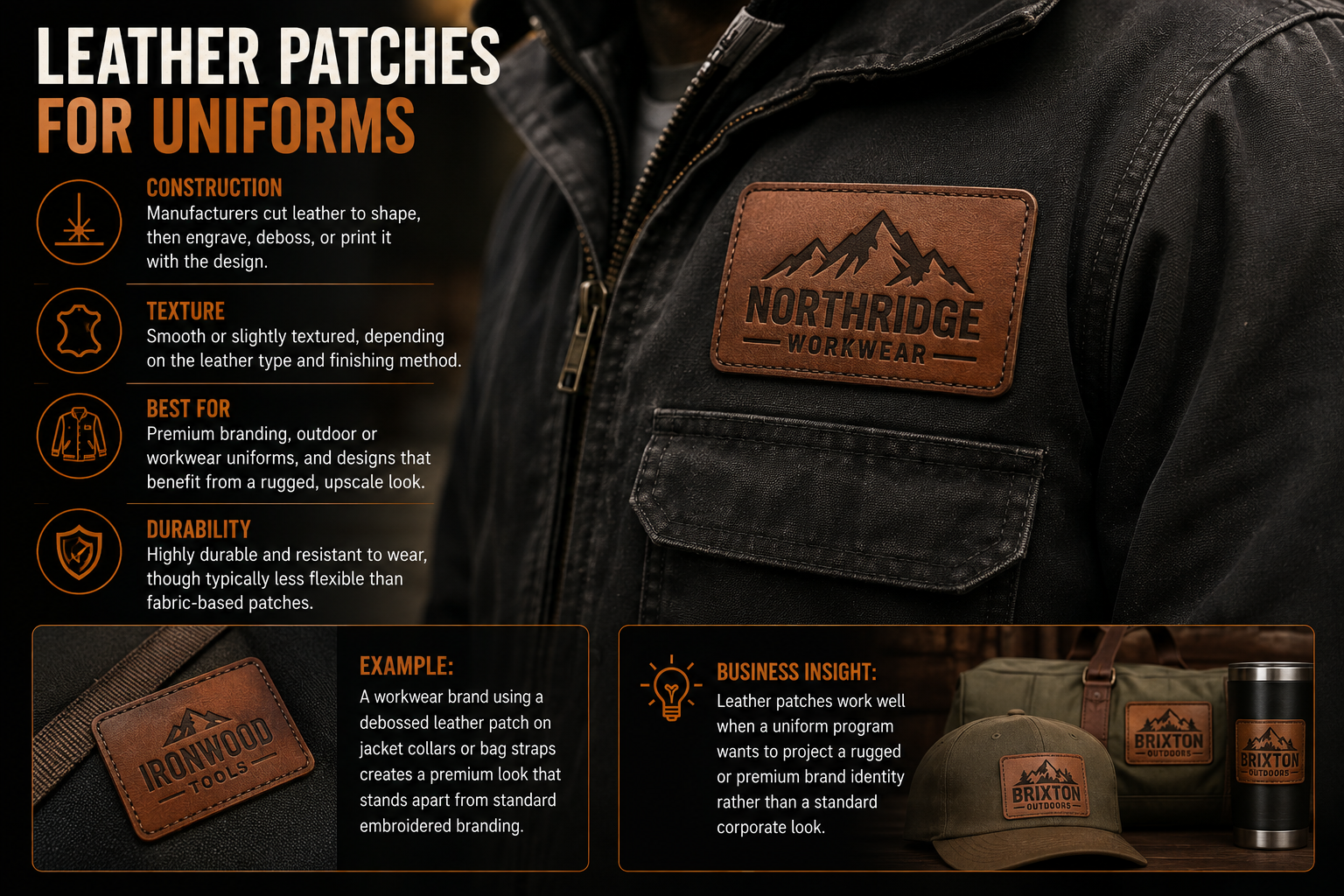
Leather Patches for Uniforms
Leather patches use genuine or faux leather, often laser-engraved or debossed with a logo, to create a premium, rugged look suited to specific uniform styles.
- Construction: Manufacturers cut leather to shape, then engrave, deboss, or print it with the design.
- Texture: Smooth or slightly textured, depending on the leather type and finishing method.
- Best for: Premium branding, outdoor or workwear uniforms, and designs that benefit from a rugged, upscale look.
- Durability: Highly durable and resistant to wear, though typically less flexible than fabric-based patches.
Example: A workwear brand using a debossed leather patch on jacket collars or bag straps creates a premium look that stands apart from standard embroidered branding.
Business Insight: Leather patches work well when a uniform program wants to project a rugged or premium brand identity rather than a standard corporate look.
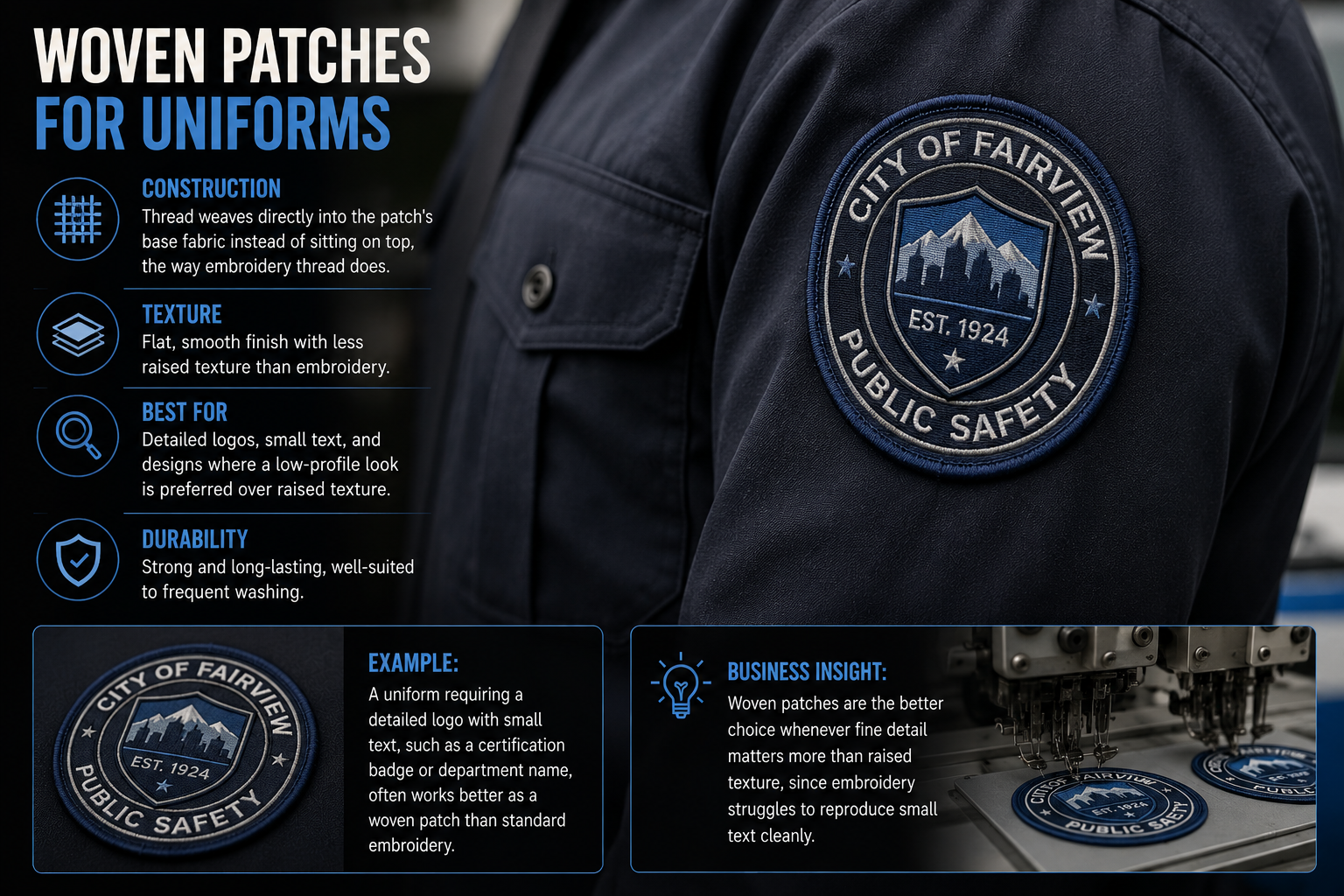
Woven Patches for Uniforms
Woven patches use tightly woven thread on a flat, low-profile backing, allowing for finer detail and smaller text than standard embroidery can achieve.
- Construction: Thread weaves directly into the patch’s base fabric instead of sitting on top, the way embroidery thread does.
- Texture: Flat, smooth finish with less raised texture than embroidery.
- Best for: Detailed logos, small text, and designs where a low-profile look is preferred over raised texture.
- Durability: Strong and long-lasting, well-suited to frequent washing.
Example: A uniform requiring a detailed logo with small text, such as a certification badge or department name, often works better as a woven patch than standard embroidery.
Business Insight: Woven patches are the better choice whenever fine detail matters more than raised texture, since embroidery struggles to reproduce small text cleanly.
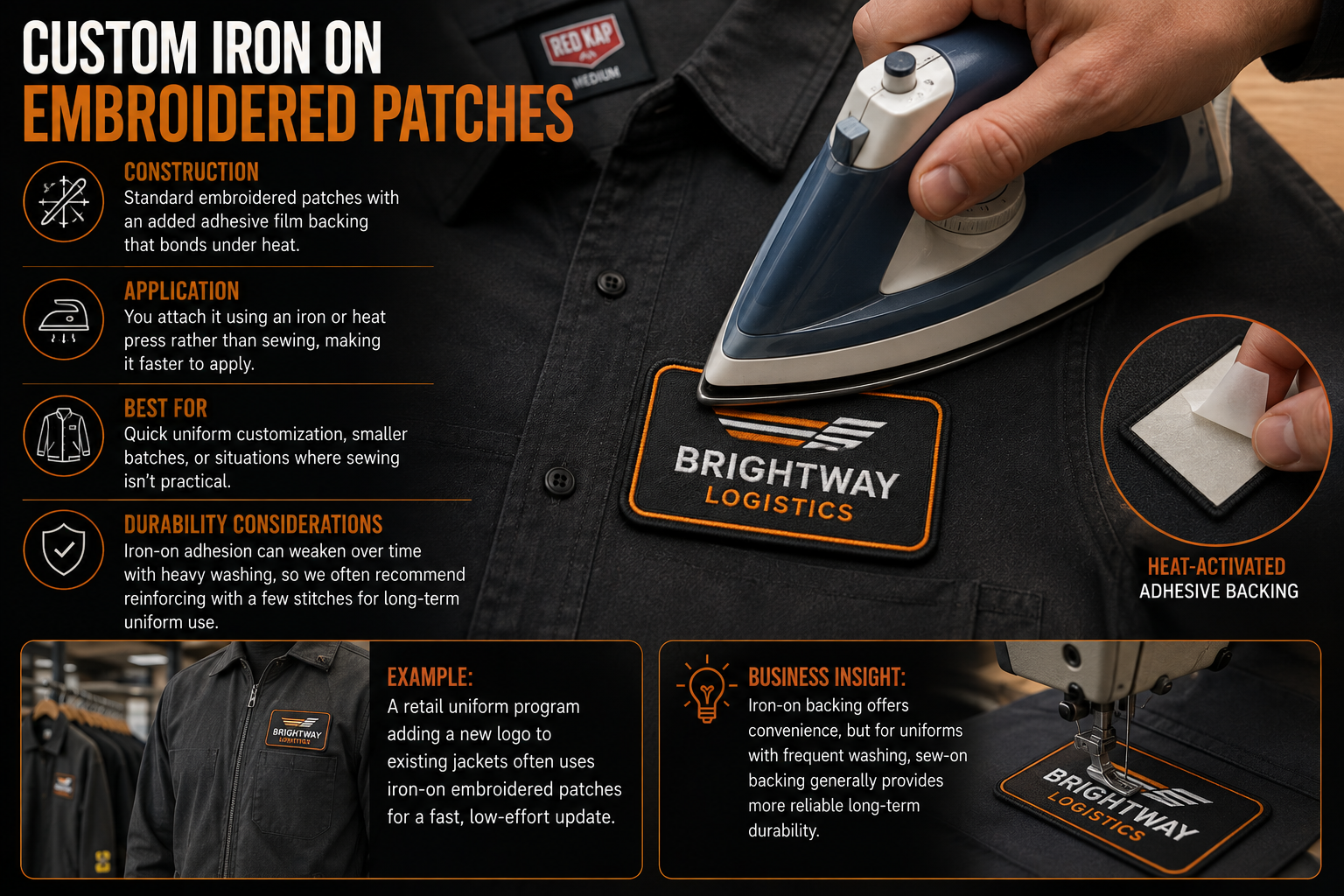
Custom Iron On Embroidered Patches
Custom iron-on embroidered patches combine the textured look of embroidery with a heat-activated adhesive backing, allowing for fast, no-sew application onto uniforms.
- Construction: Standard embroidered patches with an added adhesive film backing that bonds under heat.
- Application: You attach it using an iron or heat press rather than sewing, making it faster to apply.
- Best for: Quick uniform customization, smaller batches, or situations where sewing isn’t practical.
- Durability considerations: Iron-on adhesion can weaken over time with heavy washing, so we often recommend reinforcing with a few stitches for long-term uniform use.
Example: A retail uniform program adding a new logo to existing jackets often uses iron-on embroidered patches for a fast, low-effort update.
Business Insight: Iron-on backing offers convenience, but for uniforms with frequent washing, sew-on backing generally provides more reliable long-term durability.
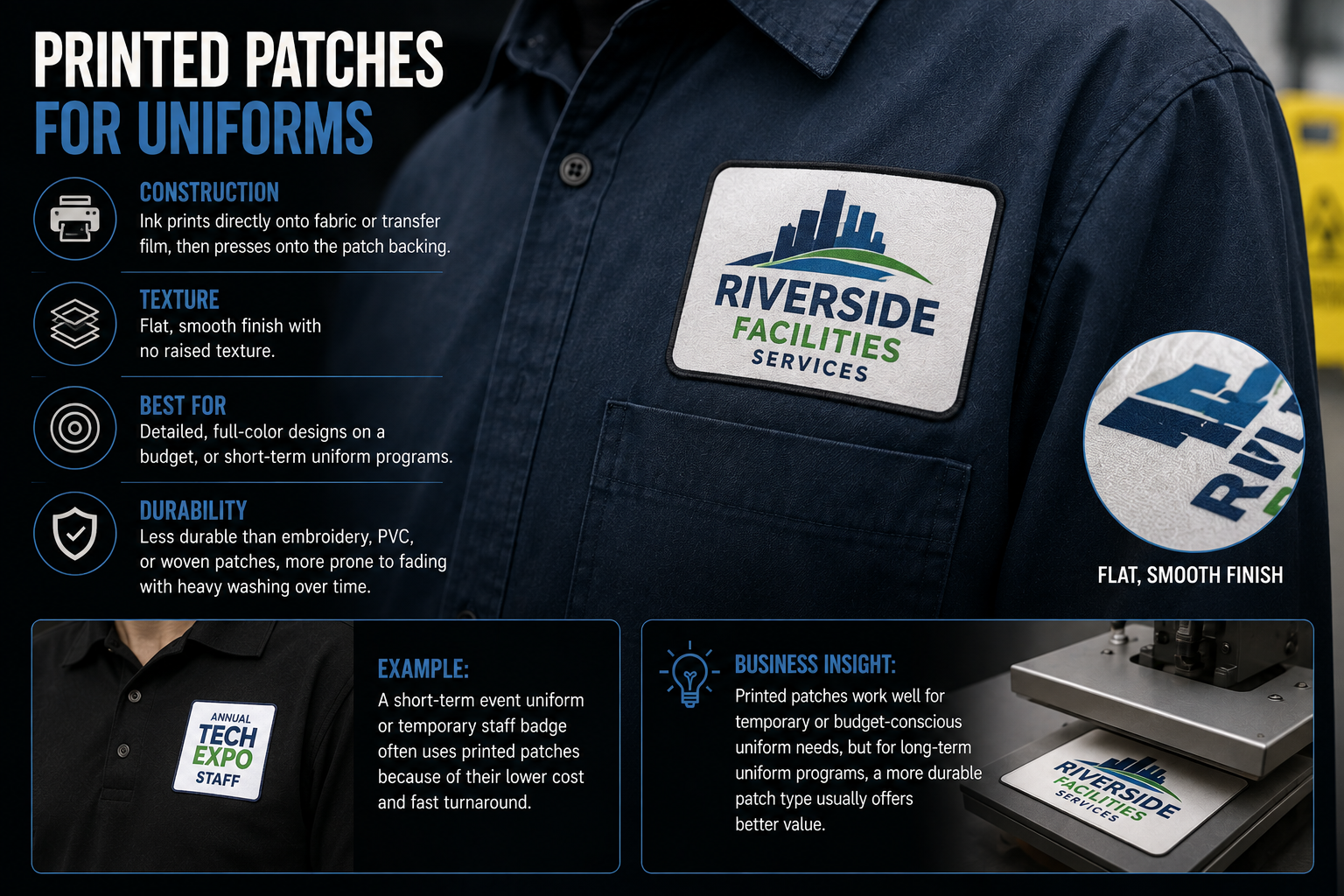
Printed Patches for Uniforms
Printed patches apply ink directly onto the fabric surface, offering a cost-effective option for detailed, full-color uniform branding without the cost of embroidery or molding.
- Construction: Ink prints directly onto fabric or transfer film, then presses onto the patch backing.
- Texture: Flat, smooth finish with no raised texture.
- Best for: Detailed, full-color designs on a budget, or short-term uniform programs.
- Durability: Less durable than embroidery, PVC, or woven patches, more prone to fading with heavy washing over time.
Example: A short-term event uniform or temporary staff badge often uses printed patches because of their lower cost and fast turnaround.
Business Insight: Printed patches work well for temporary or budget-conscious uniform needs, but for long-term uniform programs, a more durable patch type usually offers better value.
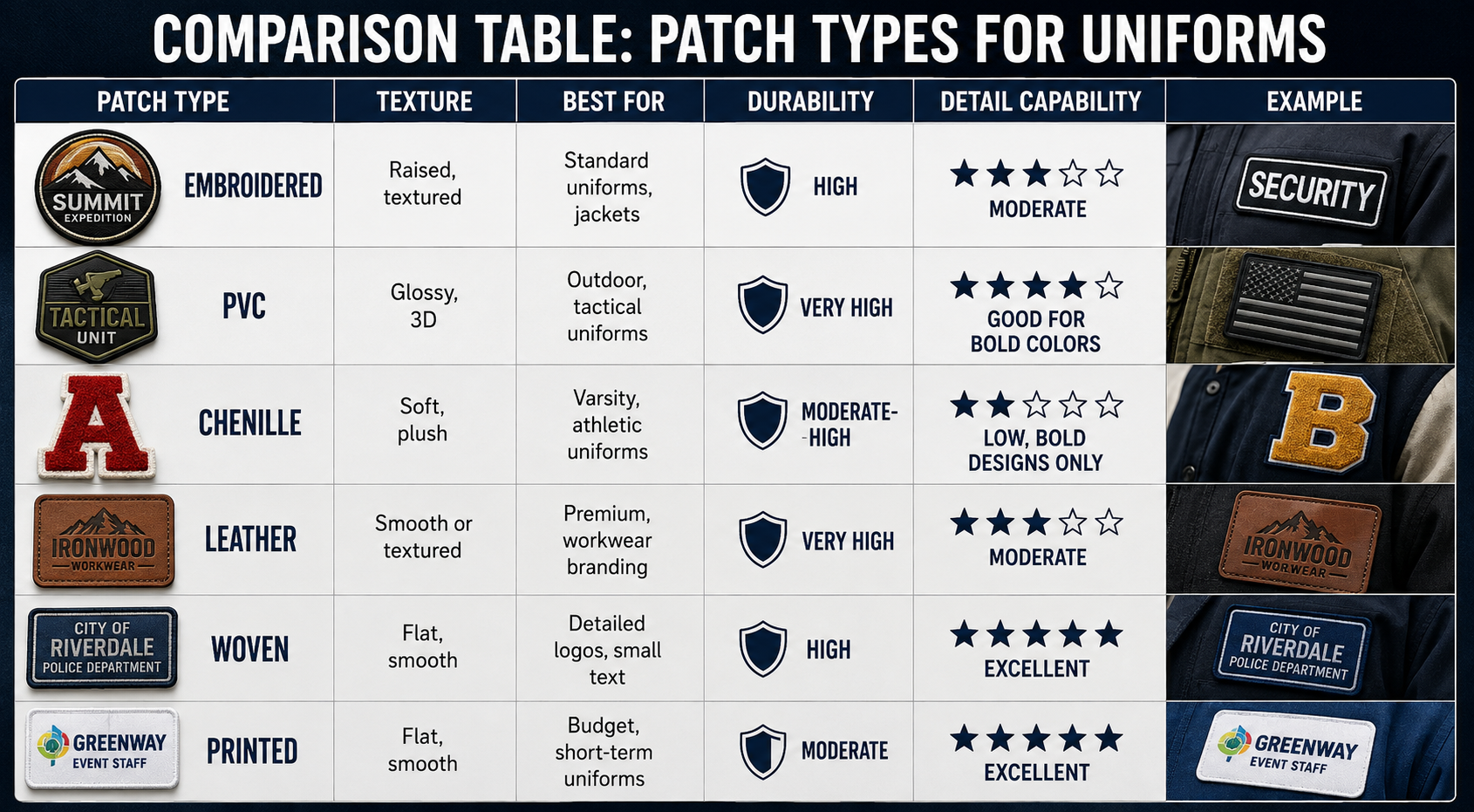
Comparison Table: Patch Types for Uniforms
| Patch Type | Texture | Best For | Durability | Detail Capability |
|---|---|---|---|---|
| Embroidered | Raised, textured | Standard uniforms, jackets | High | Moderate |
| PVC | Glossy, 3D | Outdoor, tactical uniforms | Very high | Good for bold colors |
| Chenille | Soft, plush | Varsity, athletic uniforms | Moderate-high | Low, bold designs only |
| Leather | Smooth or textured | Premium, workwear branding | Very high | Moderate |
| Woven | Flat, smooth | Detailed logos, small text | High | Excellent |
| Printed | Flat, smooth | Budget, short-term uniforms | Moderate | Excellent |
Best Custom Patches for Uniforms Wholesale
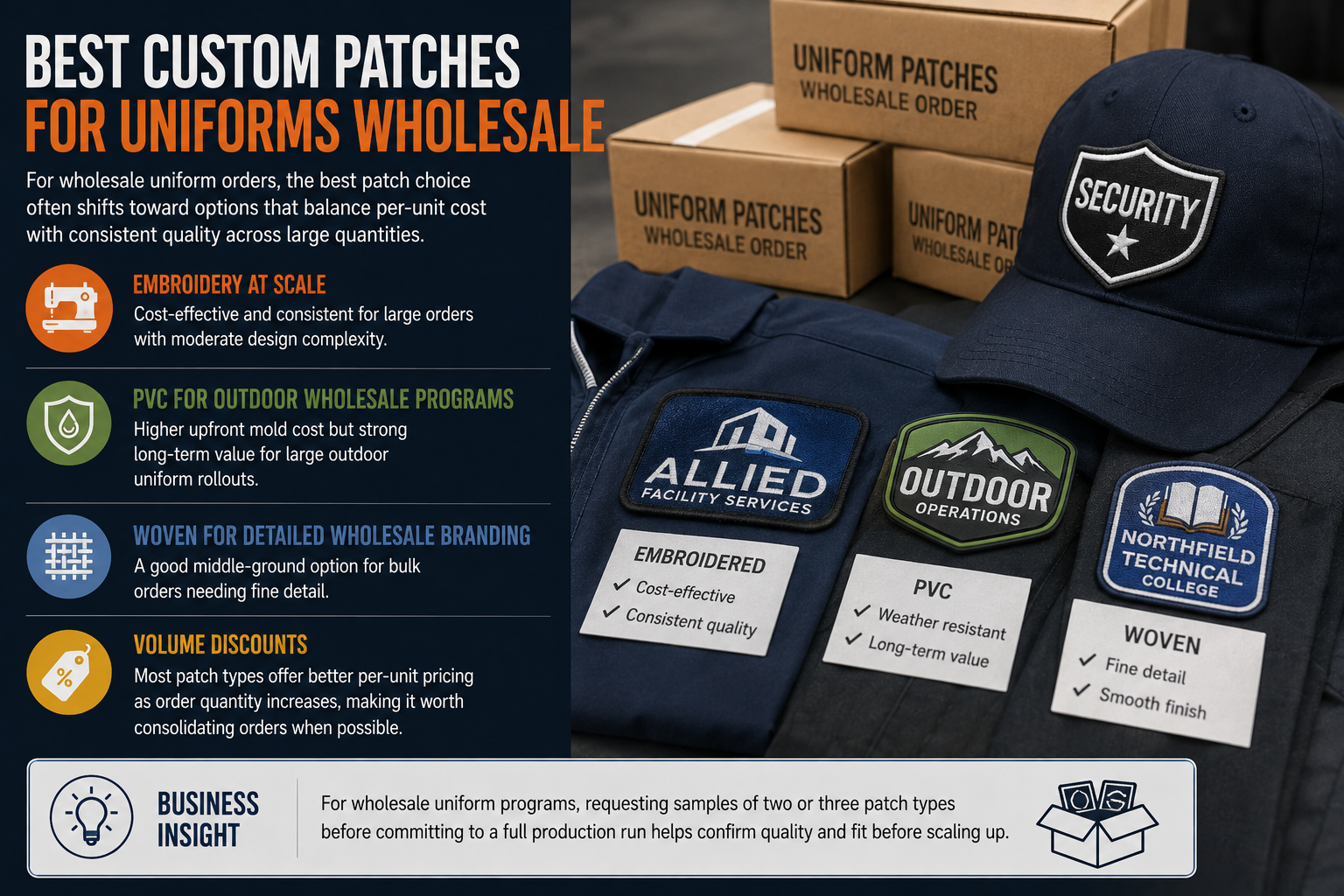
For wholesale uniform orders, the best patch choice often shifts toward options that balance per-unit cost with consistent quality across large quantities.
- Embroidery at scale: Cost-effective and consistent for large orders with moderate design complexity.
- PVC for outdoor wholesale programs: Higher upfront mold cost but strong long-term value for large outdoor uniform rollouts.
- Woven for detailed wholesale branding: A good middle-ground option for bulk orders needing fine detail.
- Volume discounts: Most patch types offer better per-unit pricing as order quantity increases, making it worth consolidating orders when possible.
Business Insight: For wholesale uniform programs, requesting samples of two or three patch types before committing to a full production run helps confirm quality and fit before scaling up.
Industry Applications and Use Cases
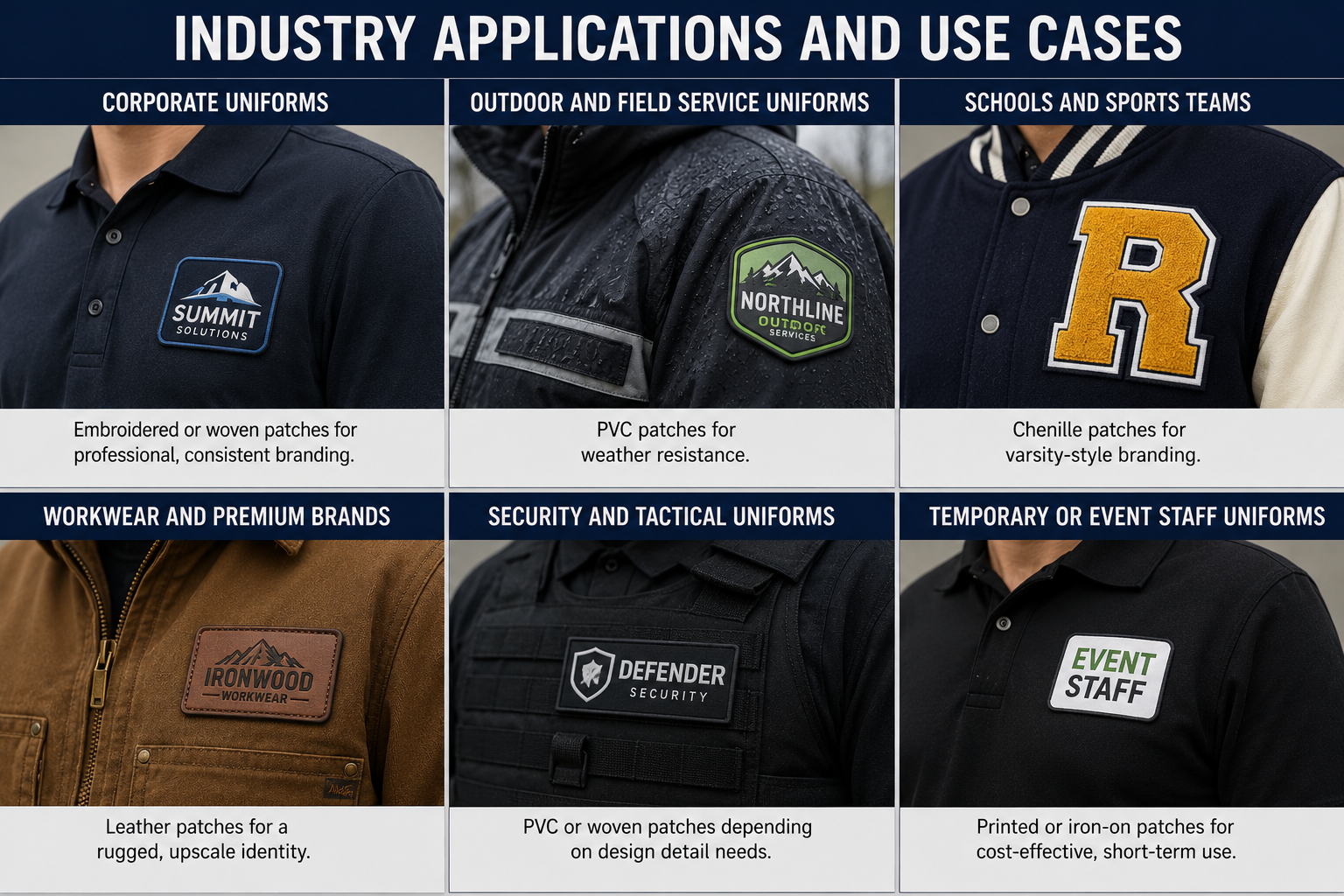
- Corporate uniforms: Embroidered or woven patches for professional, consistent branding.
- Outdoor and field service uniforms: PVC patches for weather resistance.
- Schools and sports teams: Chenille patches for varsity-style branding.
- Workwear and premium brands: Leather patches for a rugged, upscale identity.
- Security and tactical uniforms: PVC or woven patches depending on design detail needs.
- Temporary or event staff uniforms: Printed or iron-on patches for cost-effective, short-term use.
Buying Guide: Which Patch Type Fits Your Uniform Program
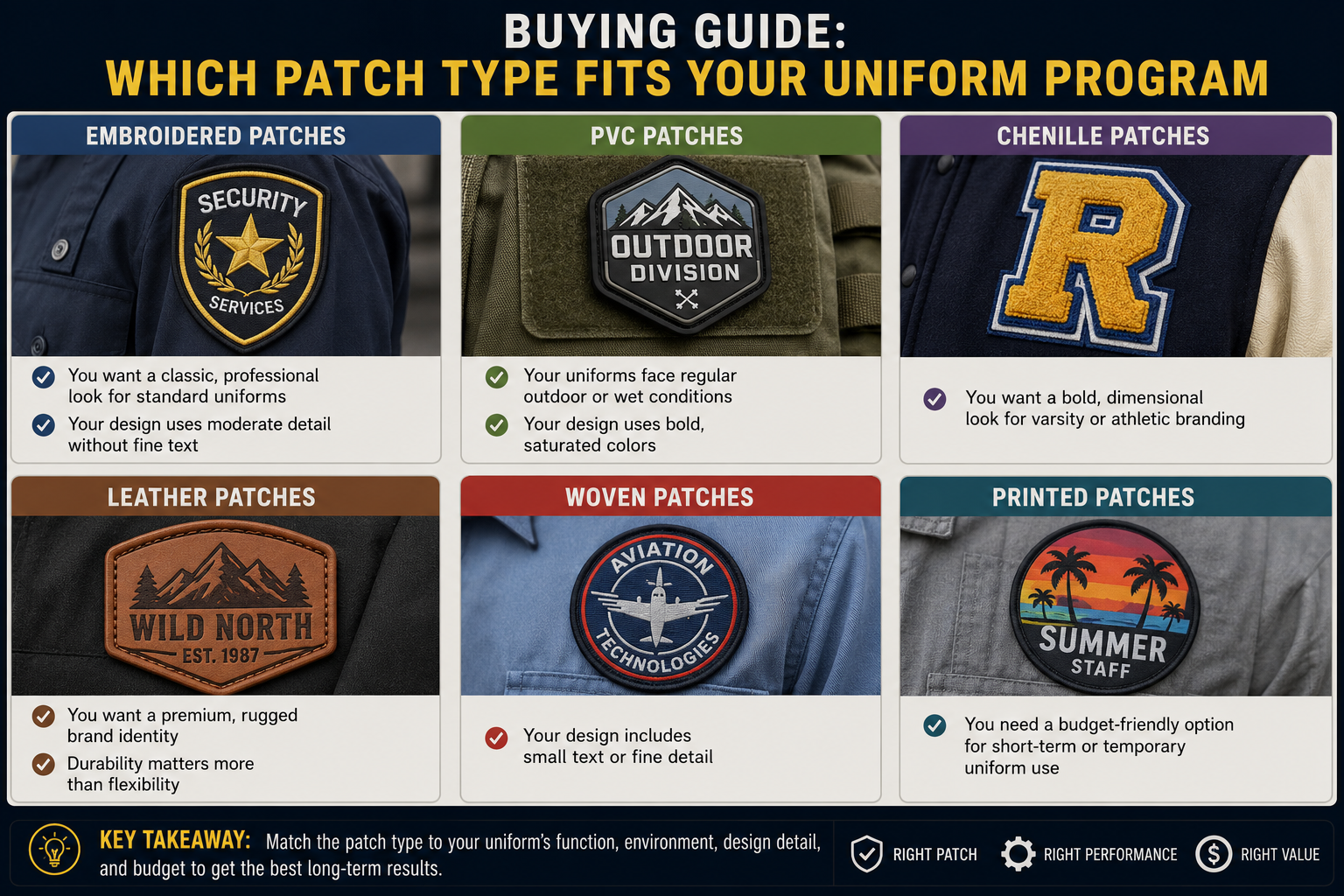
Choose embroidered patches when:
- You want a classic, professional look for standard uniforms.
- Your design uses moderate detail without fine text.
Choose PVC patches when:
- Your uniforms face regular outdoor or wet conditions.
- Your design uses bold, saturated colors.
Choose chenille patches when:
- You want a bold, dimensional look for varsity or athletic branding.
Choose leather patches when:
- You want a premium, rugged brand identity.
- Durability matters more than flexibility.
Choose woven patches when:
- Your design includes small text or fine detail.
Choose printed patches when:
- You need a budget-friendly option for short-term or temporary uniform use.
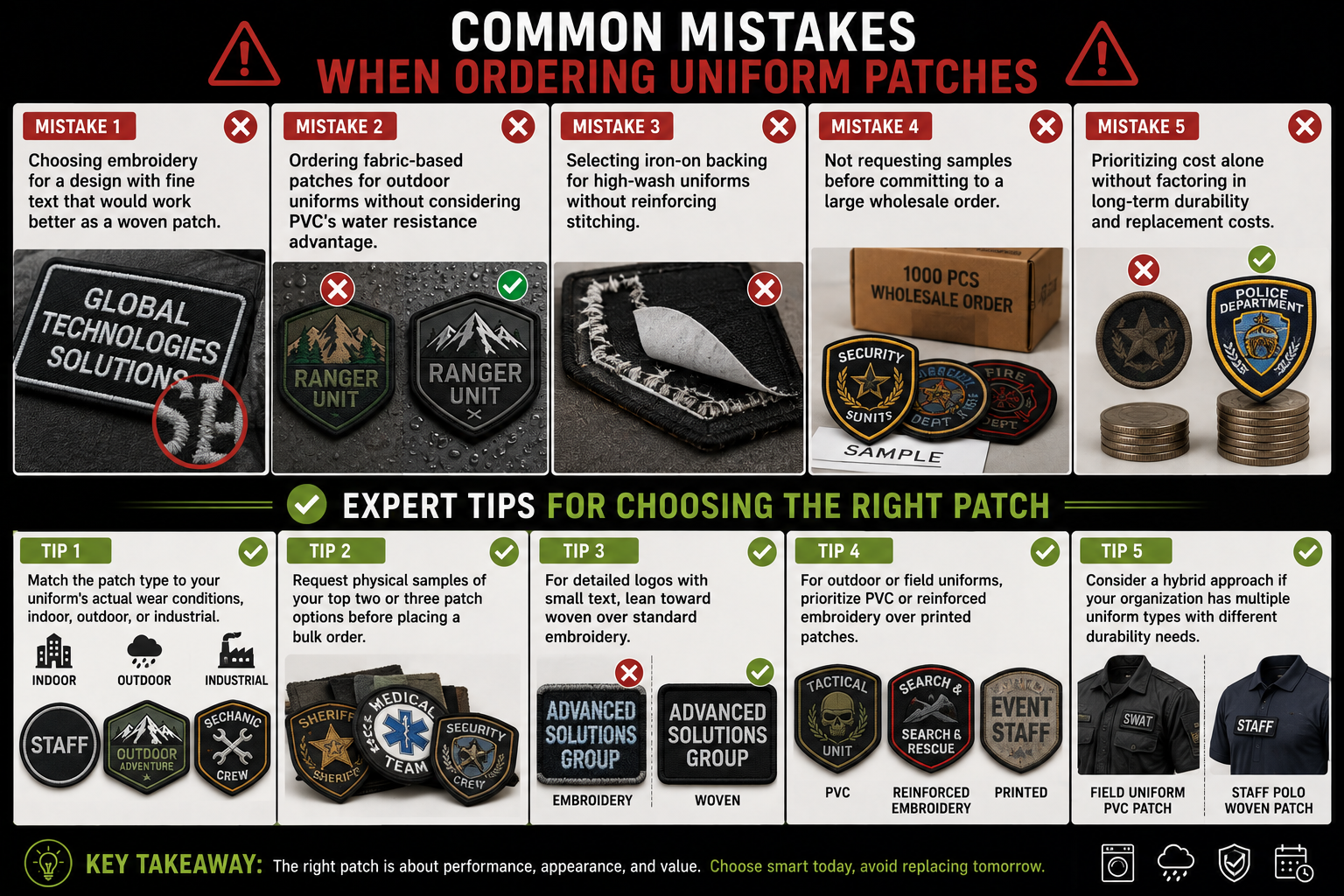
Common Mistakes When Ordering Uniform Patches
- Mistake 1: Choosing embroidery for a design with fine text that would work better as a woven patch.
- Mistake 2: Ordering fabric-based patches for outdoor uniforms without considering PVC’s water resistance advantage.
- Mistake 3: Selecting iron-on backing for high-wash uniforms without reinforcing stitching.
- Mistake 4: Not requesting samples before committing to a large wholesale order.
- Mistake 5: Prioritizing cost alone without factoring in long-term durability and replacement costs.
Expert Tips for Choosing the Right Patch
- Tip 1: Match the patch type to your uniform’s actual wear conditions, indoor, outdoor, or industrial.
- Tip 2: Request physical samples of your top two or three patch options before placing a bulk order.
- Tip 3: For detailed logos with small text, lean toward woven over standard embroidery.
- Tip 4: For outdoor or field uniforms, prioritize PVC or reinforced embroidery over printed patches.
- Tip 5: Consider a hybrid approach if your organization has multiple uniform types with different durability needs.
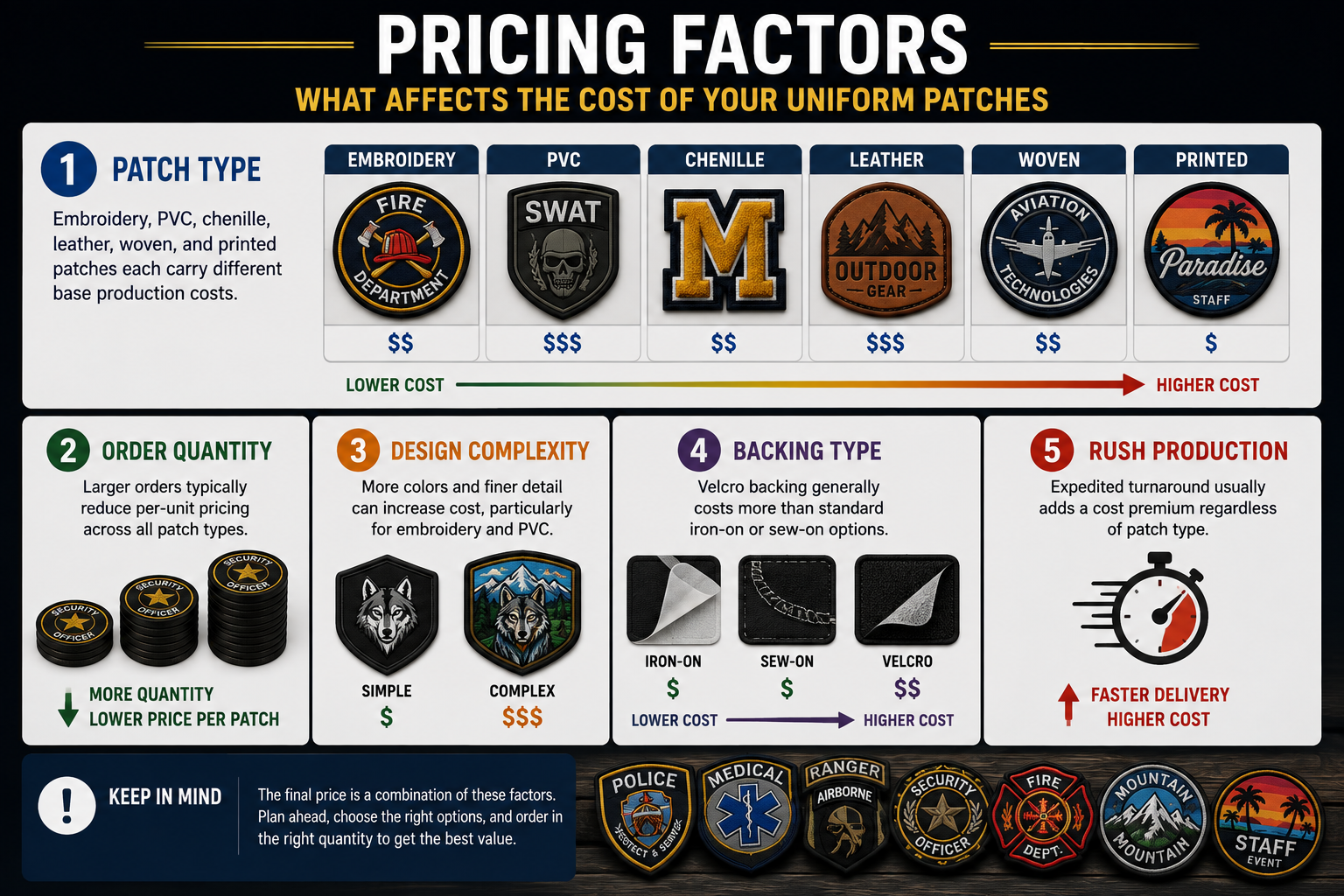
Pricing Factors
- Patch type: Embroidery, PVC, chenille, leather, woven, and printed patches each carry different base production costs.
- Order quantity: Larger orders typically reduce per-unit pricing across all patch types.
- Design complexity: More colors and finer detail can increase cost, particularly for embroidery and PVC.
- Backing type: Velcro backing generally costs more than standard iron-on or sew-on options.
- Rush production: Expedited turnaround usually adds a cost premium regardless of patch type.
Why Choose Custom Patches 4U
- Full range of patch types: Embroidery, PVC, chenille, leather, woven, and printed patches available under one roof.
- Sample support: We provide physical samples before you commit to a bulk uniform order.
- Guidance on durability needs: We base recommendations on how and where you’ll actually wear your uniforms.
- Wholesale order experience: Consistent quality and pricing support for large organizational uniform programs.
FAQs
What are the best custom patches for uniforms?
The best choice depends on use: embroidery suits standard uniforms, PVC suits outdoor conditions, and woven patches suit detailed logos with fine text.
Are embroidered or PVC patches better for uniforms?
Embroidered patches offer a classic look for standard, indoor uniforms, while PVC patches perform better in outdoor or wet conditions due to their water resistance.
What’s the difference between woven and embroidered patches?
Woven patches have a flat, low-profile finish suited to fine detail, while embroidered patches have a raised, textured finish suited to moderate detail.
Are chenille patches durable enough for uniforms?
Yes, chenille patches hold up well to regular wear, though their raised texture can flatten slightly over many wash cycles compared to other patch types.
What are custom iron-on embroidered patches used for?
People use them for fast, no-sew uniform customization, combining embroidery’s textured look with a heat-activated adhesive backing for quick application.
Are leather patches practical for everyday uniforms?
Leather patches work well for premium or workwear-style uniforms but are less flexible than fabric-based patches, making them better suited to specific applications like collars or straps.
How do I order the best custom patches for uniforms wholesale?
Request samples of a few patch types first, confirm durability needs based on how the uniforms will be worn, and compare per-unit pricing across quantities before committing to a full order.
Are printed patches a good option for uniforms?
Printed patches work well for budget-conscious or short-term uniform needs but are generally less durable than embroidery, PVC, or woven patches over long-term use.
Can I mix different patch types across one uniform program?
Yes, some organizations use different patch types for different uniform categories, such as PVC for outdoor staff and embroidery for office-based employees.
How do I know which patch type is right for my organization’s uniforms?
Consider how you’ll wear the uniforms (indoor vs outdoor), how often you’ll wash them, your design’s detail level, and your budget for the order size you need.
Get a Custom Uniform Patch Quote
If you're planning a uniform patch order, share your design, uniform type, and quantity for a tailored recommendation and quote. Request a sample, ask about wholesale pricing, or get guidance on which patch type fits your uniform program before you place your order.