
Sublimated and printed patches both offer affordable alternatives to embroidery, but they differ in how they apply color, how long they last, and how well they reproduce detailed designs. Sublimated patches bond dye into polyester fabric, making them more durable and better suited for detailed, gradient-heavy designs and long-term use. Printed patches apply ink to the fabric surface, making them a faster and often more budget-friendly option for smaller or short-term orders. The right choice depends on your fabric type, design complexity, durability needs, and budget.
Introduction
If you’re ordering custom patches for a team, brand, or event, you’ve probably run into two options that look similar but are made very differently: sublimated and printed patches. Both are budget-friendly alternatives to embroidery, but they aren’t the same product, and choosing the wrong one can mean colors that fade faster than expected or detail that doesn’t show up the way you wanted. This guide breaks down how each type gets made, where they perform well, and where they fall short, so you can order with confidence whether you’re buying one patch or ten thousand.
Featured Snippet Answer
Sublimated patches use a heat-transfer dye process that bonds color into polyester fabric, giving them vibrant, long-lasting color and a smooth, flat finish. Printed patches use a direct-print or heat-transfer method where ink sits on top of the fabric surface. Sublimated patches generally last longer and resist fading better, while printed patches are typically faster to produce and cost less for small orders.
Why This Matters
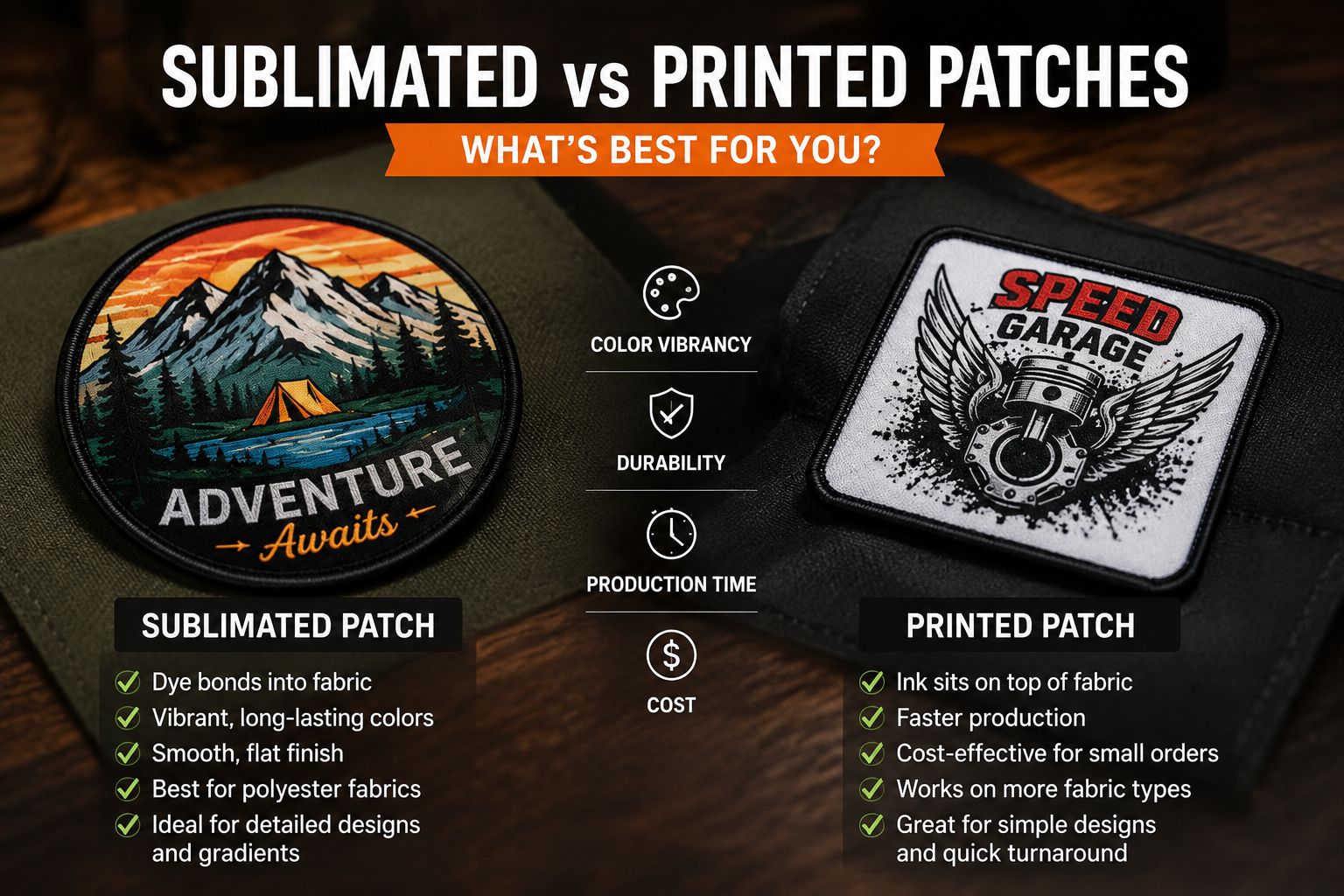
Choosing between sublimated and printed patches affects how your patches look after months of wear, not just how they look on day one.
- Longevity: The wrong choice for an outdoor or high-wash-frequency use case can mean faded or peeling patches within a year
- Budget accuracy: Each method has a different cost structure depending on order size and design complexity
- Brand consistency: Colors and detail level affect how accurately your logo or design translates onto fabric
- Order planning: Production timelines differ between the two methods, which matters for time-sensitive orders
What Is a Sublimated Patch
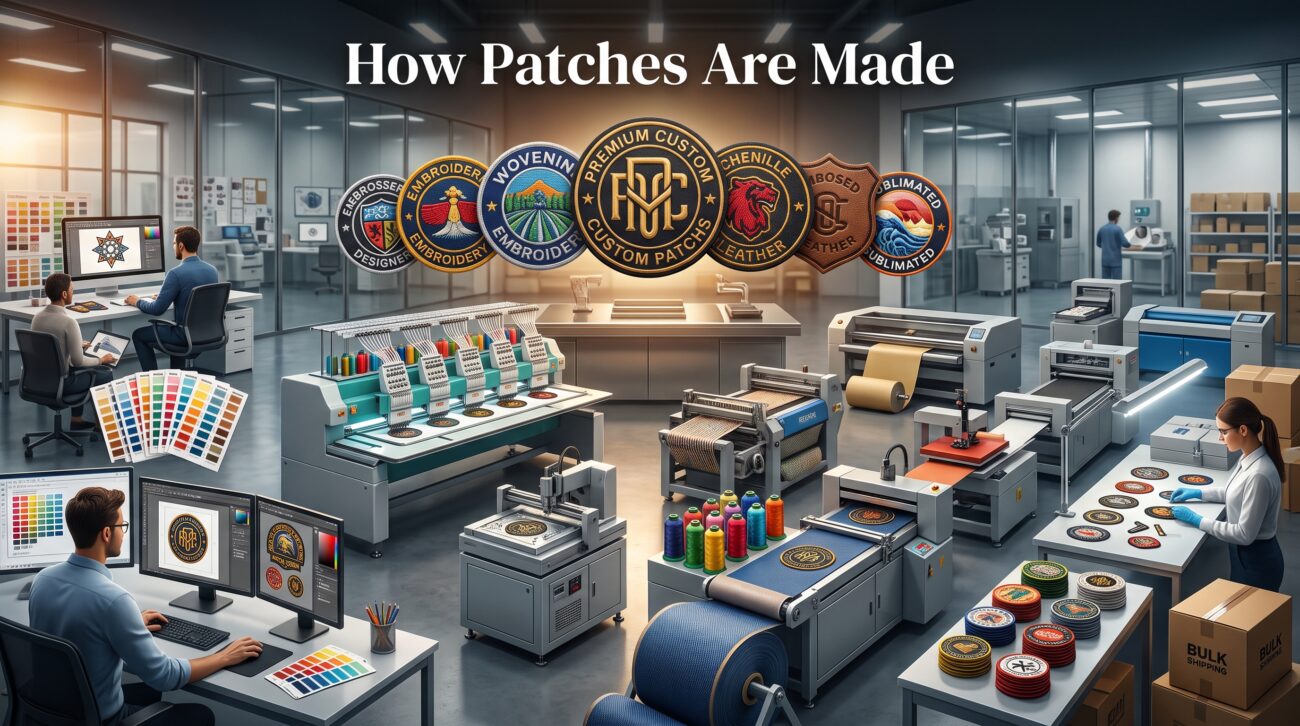
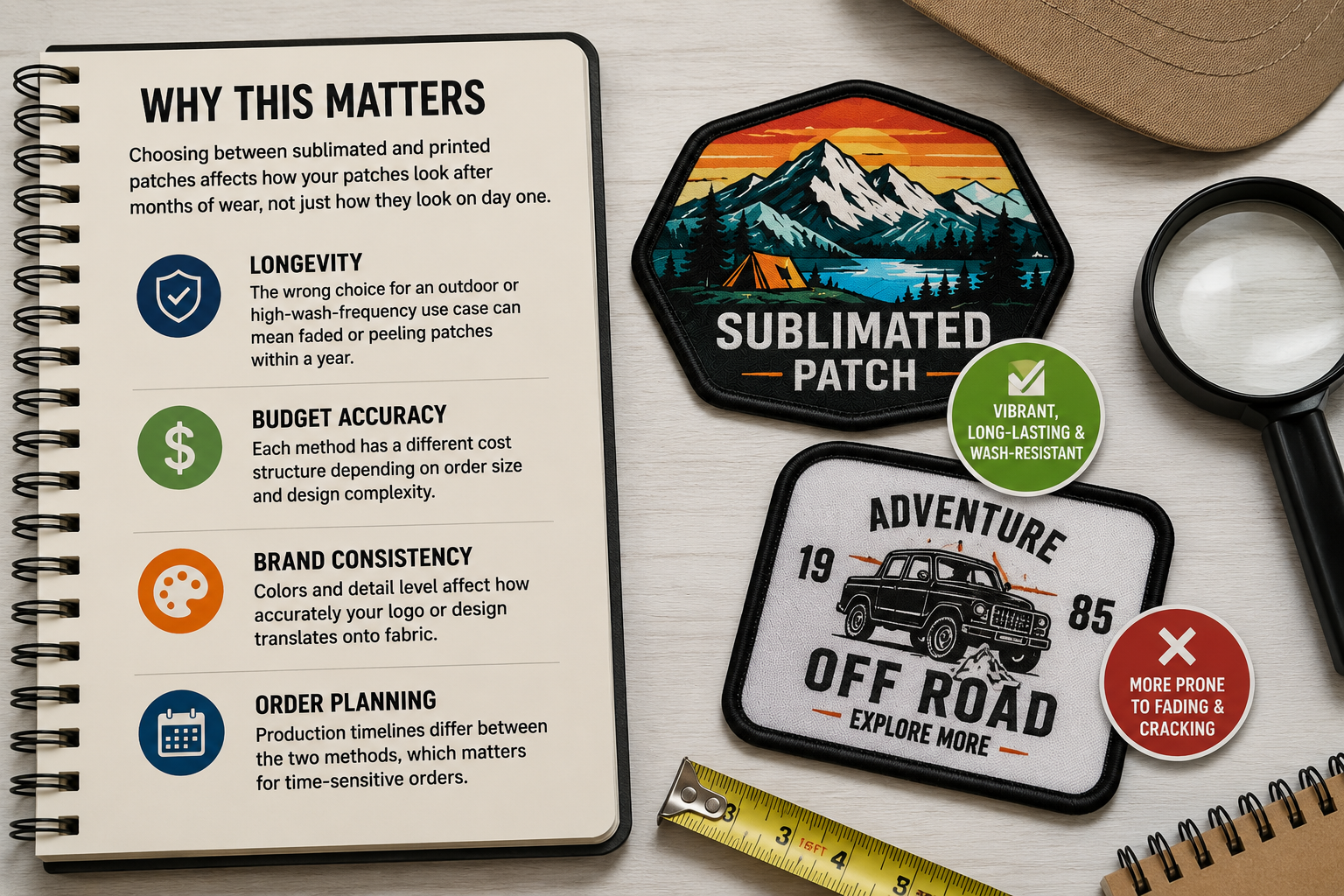
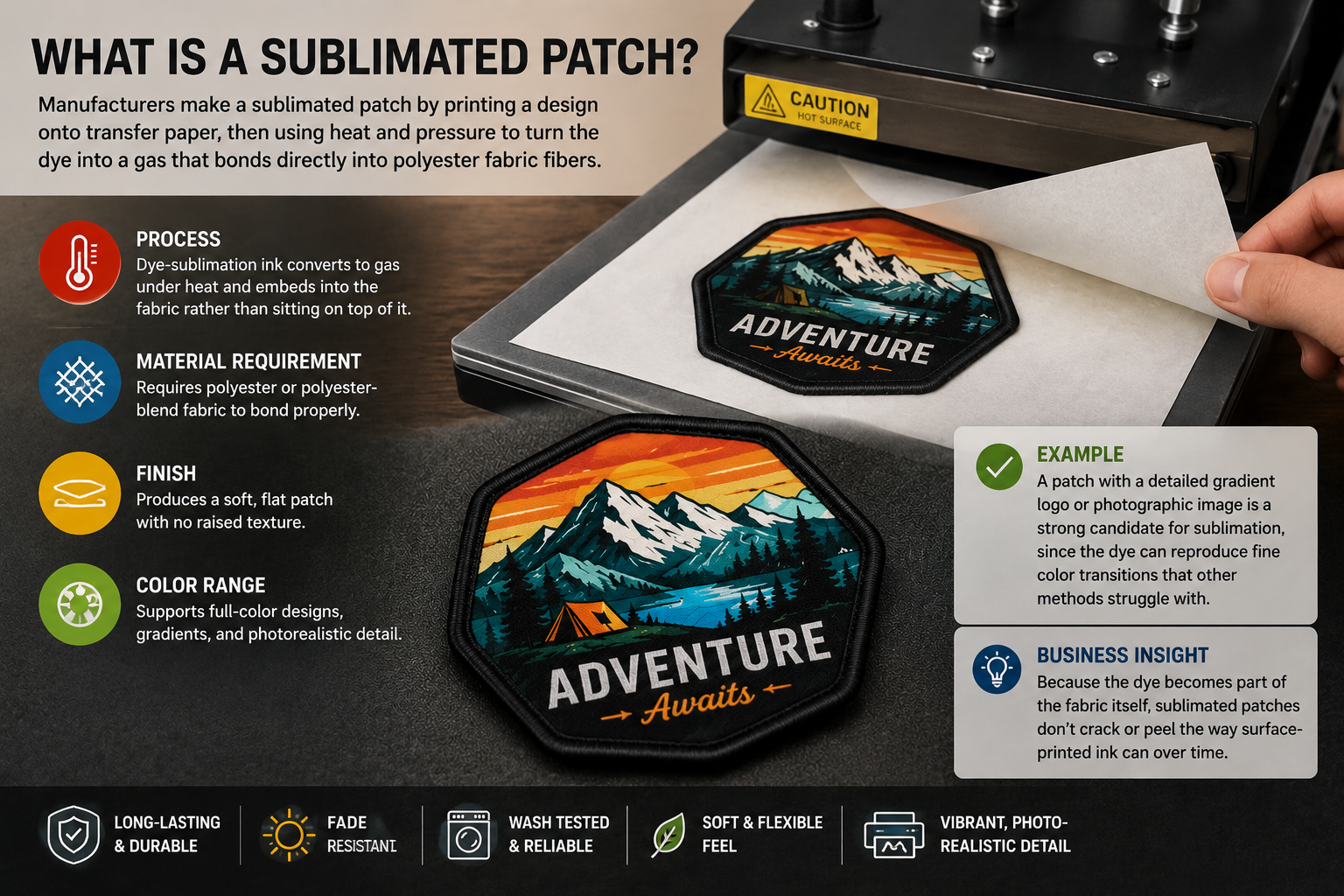
Manufacturers make a sublimated patch by printing a design onto transfer paper, then using heat and pressure to turn the dye into a gas that bonds directly into polyester fabric fibers.
- Process: Dye-sublimation ink converts to gas under heat and embeds into the fabric rather than sitting on top of it
- Material requirement: Requires polyester or polyester-blend fabric to bond properly
- Finish: Produces a soft, flat patch with no raised texture
- Color range: Supports full-color designs, gradients, and photorealistic detail
Example: A patch with a detailed gradient logo or photographic image is a strong candidate for sublimation, since the dye can reproduce fine color transitions that other methods struggle with.
Business Insight: Because the dye becomes part of the fabric itself, sublimated patches don’t crack or peel the way surface-printed ink can over time.
What Is a Printed Patch
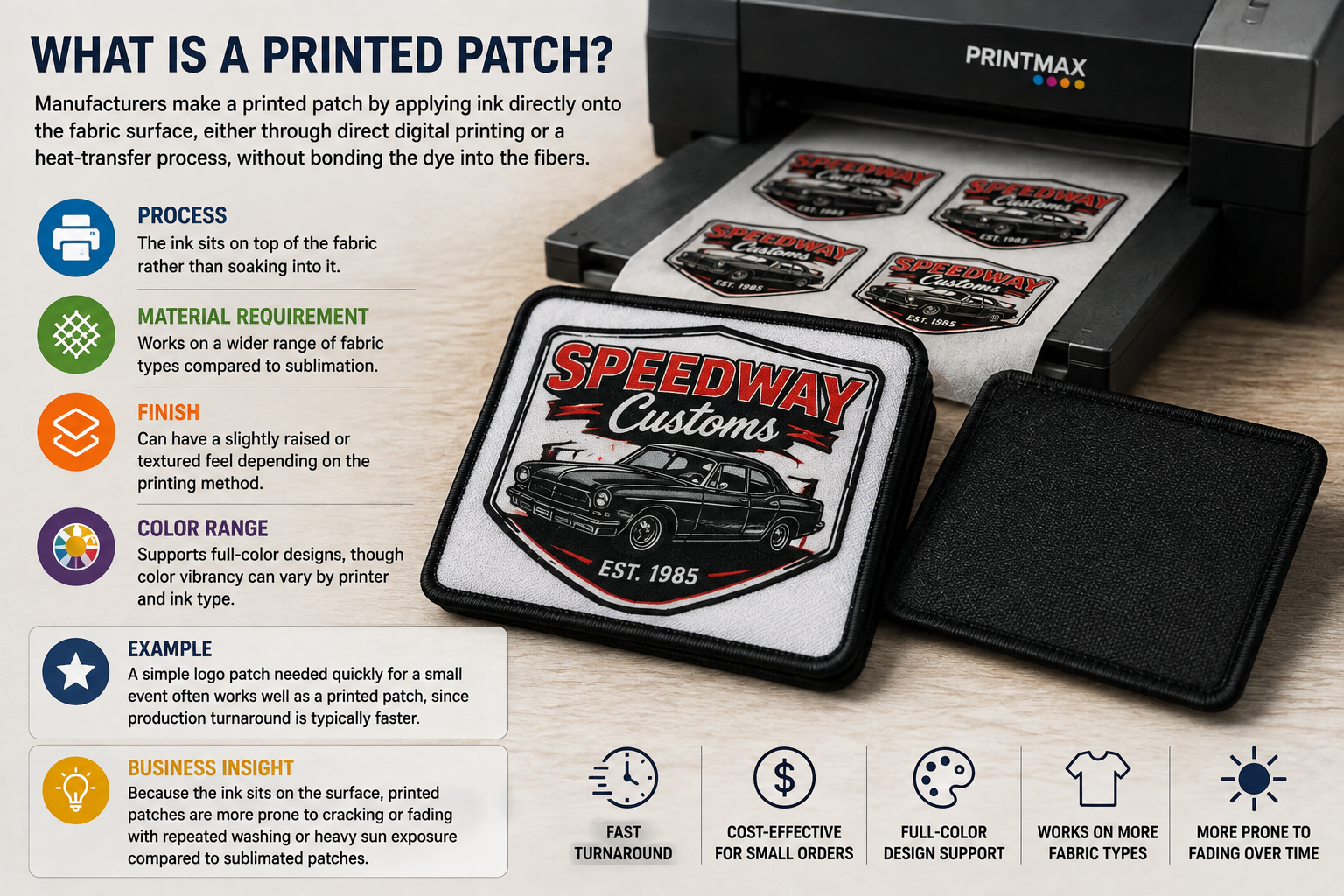
Manufacturers make a printed patch by applying ink directly onto the fabric surface, either through direct digital printing or a heat-transfer process, without bonding the dye into the fibers.
- Process: The ink sits on top of the fabric rather than soaking into it
- Material requirement: Works on a wider range of fabric types compared to sublimation
- Finish: Can have a slightly raised or textured feel depending on the printing method
- Color range: Supports full-color designs, though color vibrancy can vary by printer and ink type
Example: A simple logo patch needed quickly for a small event often works well as a printed patch, since production turnaround is typically faster.
Business Insight: Because the ink sits on the surface, printed patches are more prone to cracking or fading with repeated washing or heavy sun exposure compared to sublimated patches.
Sublimated Patch vs Printed Patch: How They’re Made
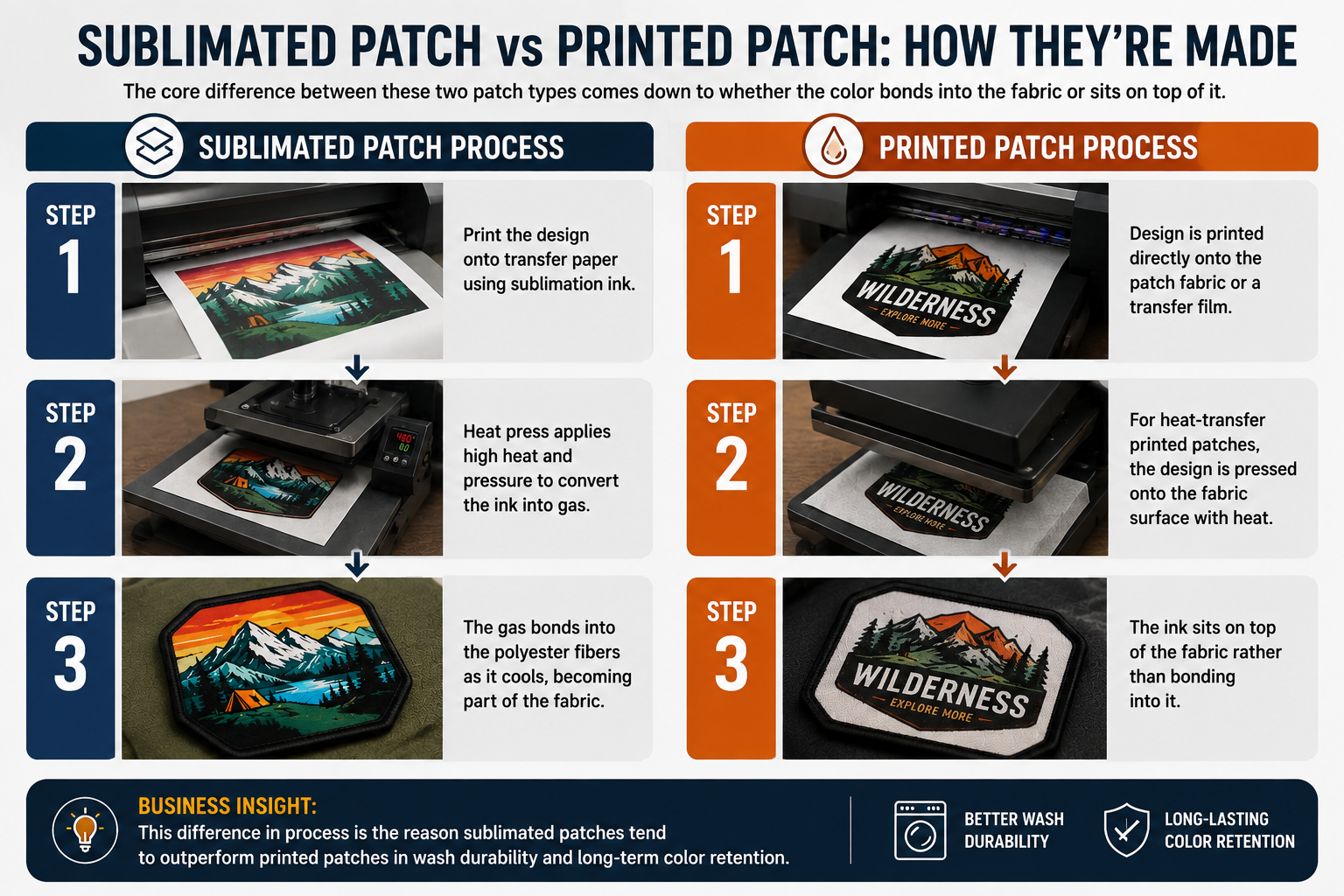
The core difference between these two patch types comes down to whether the color bonds into the fabric or sits on top of it.
- Step 1 (Sublimated): Print the design onto transfer paper using sublimation ink
- Step 2 (Sublimated): Heat press applies high heat and pressure to convert the ink into gas
- Step 3 (Sublimated): The gas bonds into the polyester fibers as it cools, becoming part of the fabric
- Step 1 (Printed): Design is printed directly onto the patch fabric or a transfer film
- Step 2 (Printed): For heat-transfer printed patches, the design is pressed onto the fabric surface with heat
- Step 3 (Printed): The ink sits on top of the fabric rather than bonding into it
Business Insight: This difference in process is the reason sublimated patches tend to outperform printed patches in wash durability and long-term color retention.
Durability Comparison
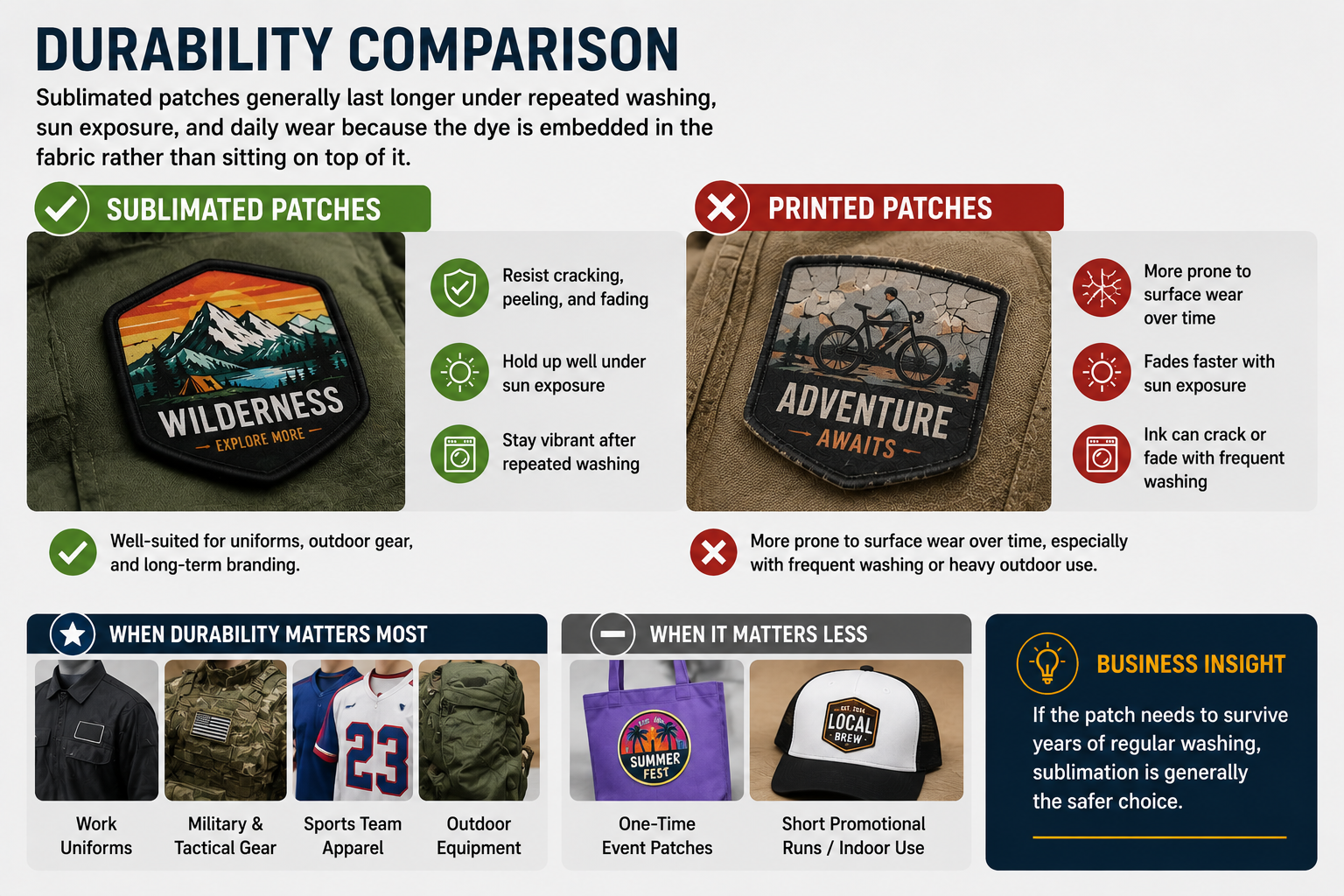
Sublimated patches generally last longer under repeated washing, sun exposure, and daily wear because the dye is embedded in the fabric rather than sitting on top of it.
- Sublimated patches: Resist cracking, peeling, and fading; well-suited for uniforms, outdoor gear, and long-term branding
- Printed patches: More prone to surface wear over time, especially with frequent washing or heavy outdoor use
- When durability matters most: Work uniforms, military and tactical gear, sports team apparel, outdoor equipment
- When it matters less: One-time event patches, short promotional runs, indoor-only use
Business Insight: If the patch needs to survive years of regular washing, sublimation is generally the safer choice.
Color and Detail Comparison
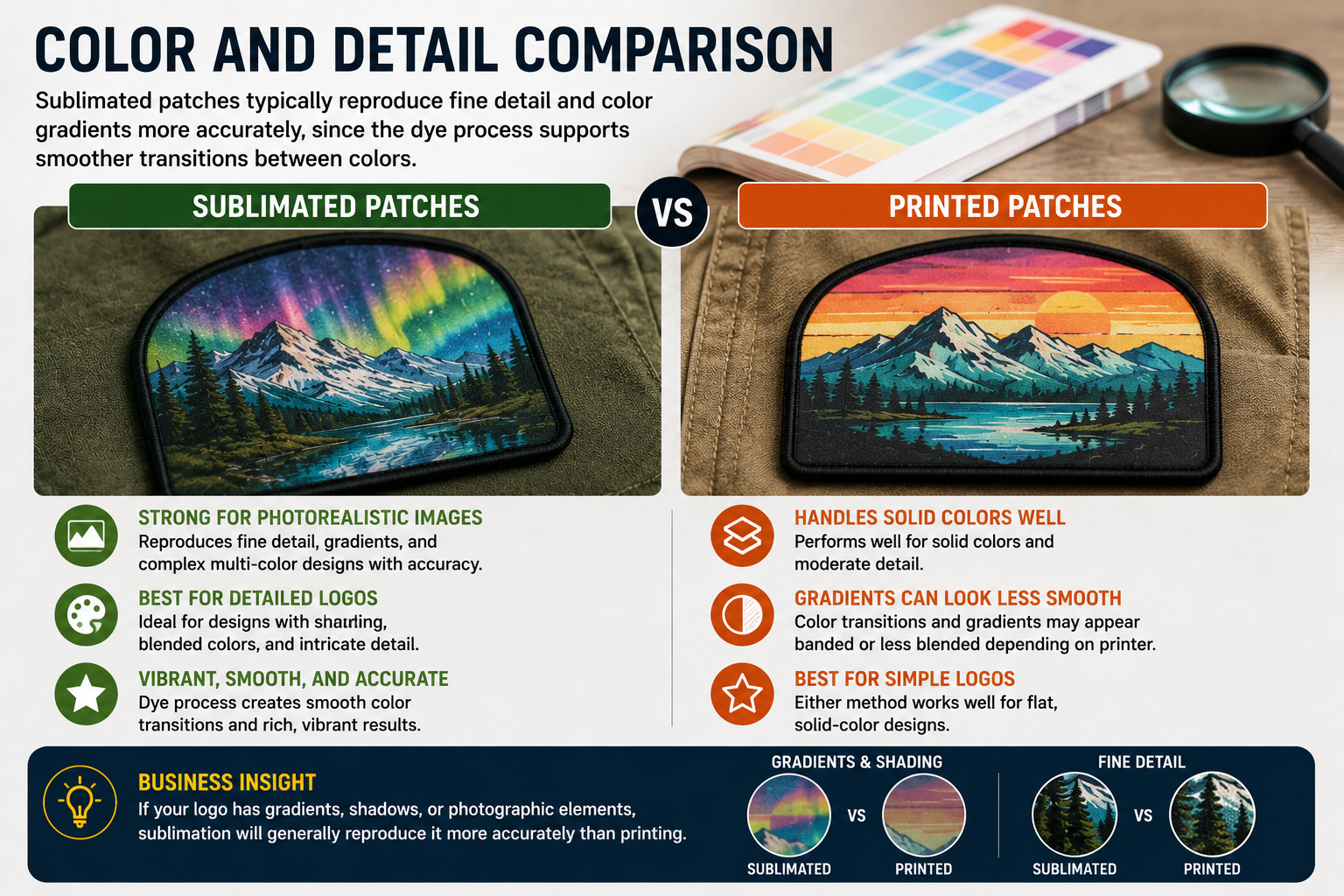
Sublimated patches typically reproduce fine detail and color gradients more accurately, since the dye process supports smoother transitions between colors.
- Sublimated patches: Strong for photorealistic images, gradients, and complex multi-color designs
- Printed patches: Handle solid colors and moderate detail well, though gradients can look less smooth depending on the printer
- Best for detailed logos: Sublimation, especially for designs with shading or blended colors
- Best for simple logos: Either method works well for flat, solid-color designs
Business Insight: If your logo has gradients, shadows, or photographic elements, sublimation will generally reproduce it more accurately than printing.
Cost Comparison
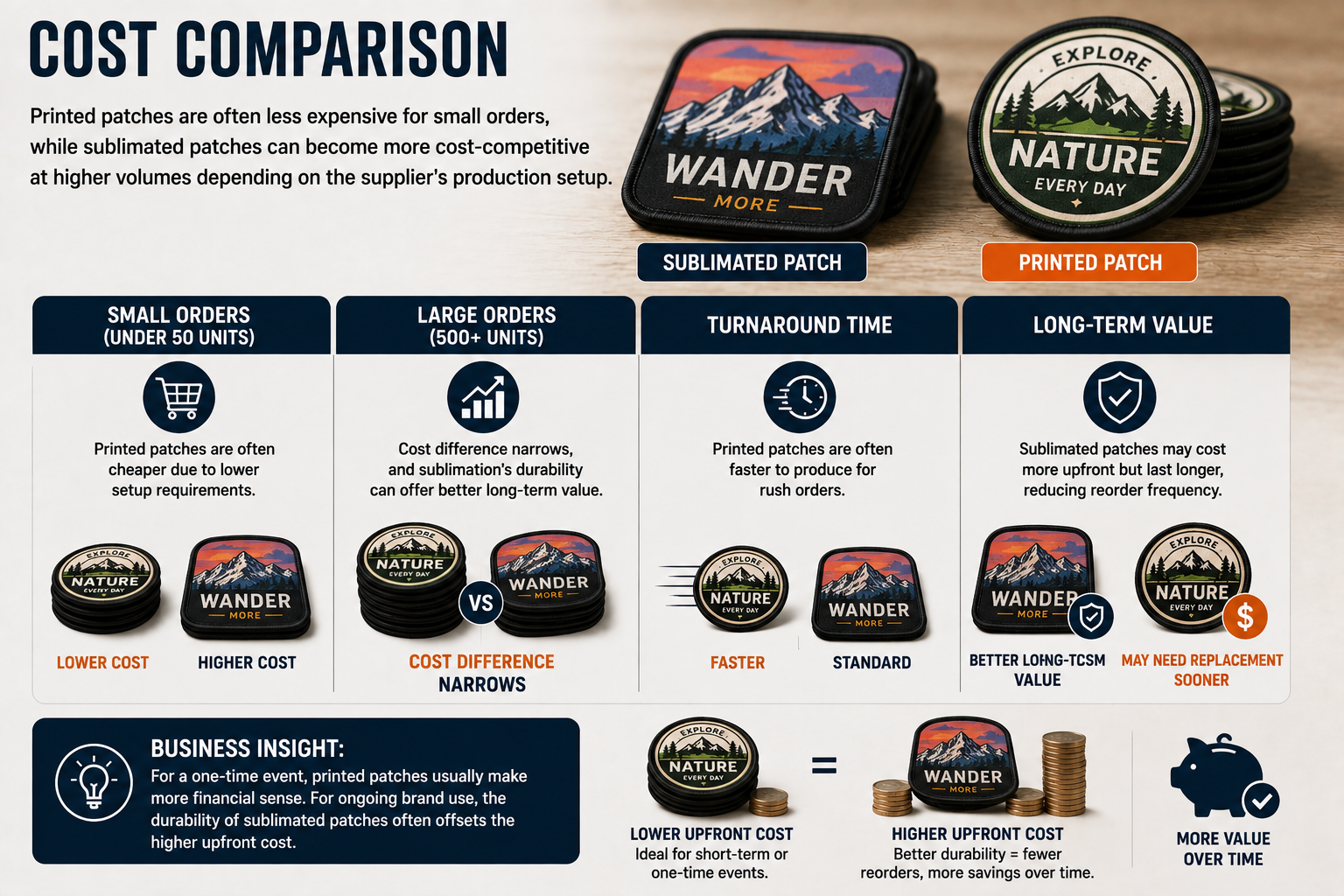
Printed patches are often less expensive for small orders, while sublimated patches can become more cost-competitive at higher volumes depending on the supplier’s production setup.
- Small orders (under 50 units): Printed patches are often cheaper due to lower setup requirements
- Large orders (500+ units): Cost difference narrows, and sublimation’s durability can offer better long-term value
- Turnaround time: Printed patches are often faster to produce for rush orders
- Long-term value: Sublimated patches may cost more upfront but last longer, reducing reorder frequency
Business Insight: For a one-time event, printed patches usually make more financial sense. For ongoing brand use, the durability of sublimated patches often offsets the higher upfront cost.
Comparison Table: Sublimated vs Printed Patches
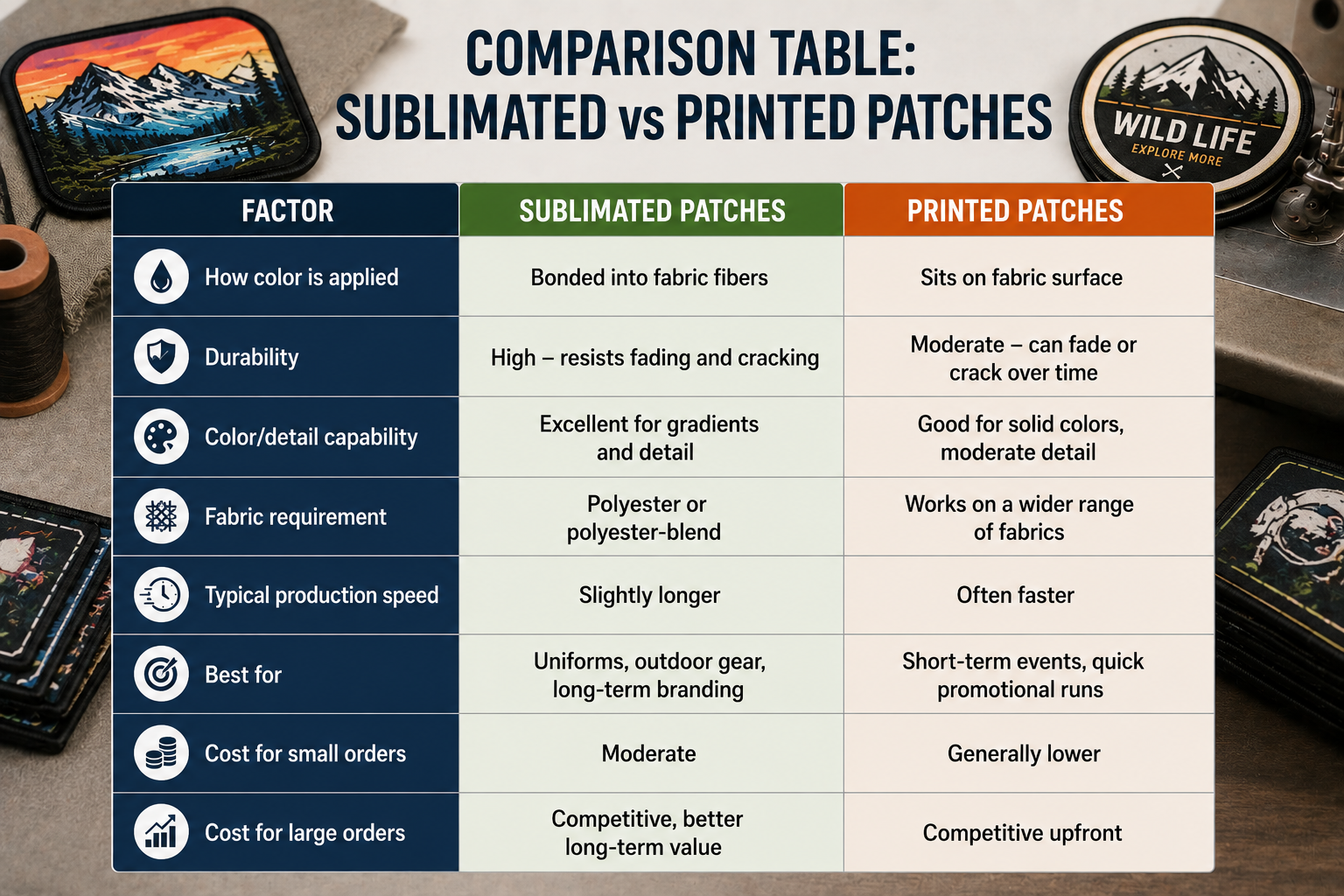
| Factor | Sublimated Patches | Printed Patches |
|---|---|---|
| How color is applied | Bonded into fabric fibers | Sits on fabric surface |
| Durability | High resists fading and cracking | Moderate — can fade or crack over time |
| Color/detail capability | Excellent for gradients and detail | Good for solid colors, moderate detail |
| Fabric requirement | Polyester or polyester-blend | Works on a wider range of fabrics |
| Typical production speed | Slightly longer | Often faster |
| Best for | Uniforms, outdoor gear, long-term branding | Short-term events, quick promotional runs |
| Cost for small orders | Moderate | Generally lower |
| Cost for large orders | Competitive, better long-term value | Competitive upfront |
Industry Applications and Use Cases
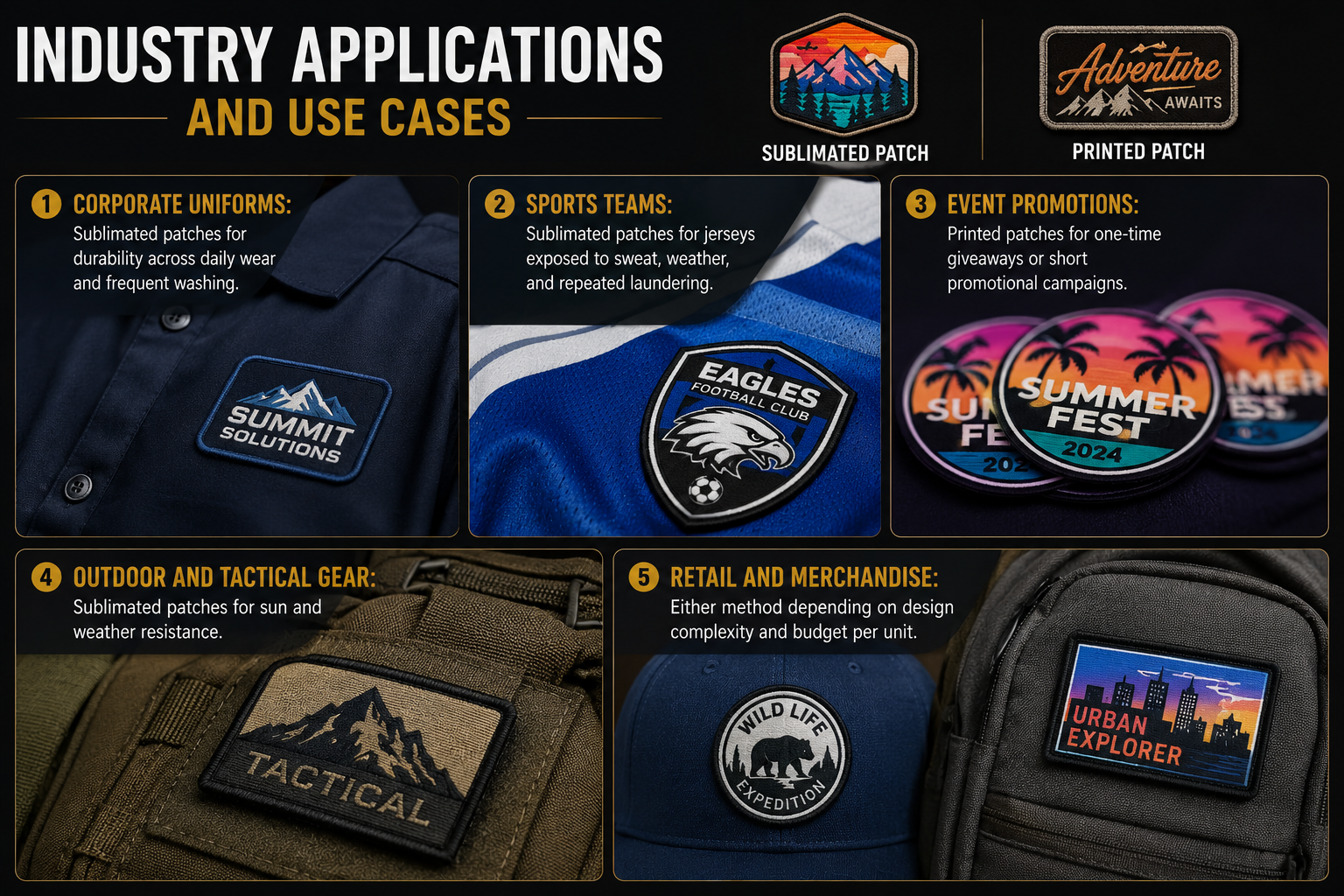
- Corporate uniforms: Sublimated patches for durability across daily wear and frequent washing
- Sports teams: Sublimated patches for jerseys exposed to sweat, weather, and repeated laundering
- Event promotions: Printed patches for one-time giveaways or short promotional campaigns
- Outdoor and tactical gear: Sublimated patches for sun and weather resistance
- Retail and merchandise: Either method depending on design complexity and budget per unit
Buying Guide: Which One Should You Choose
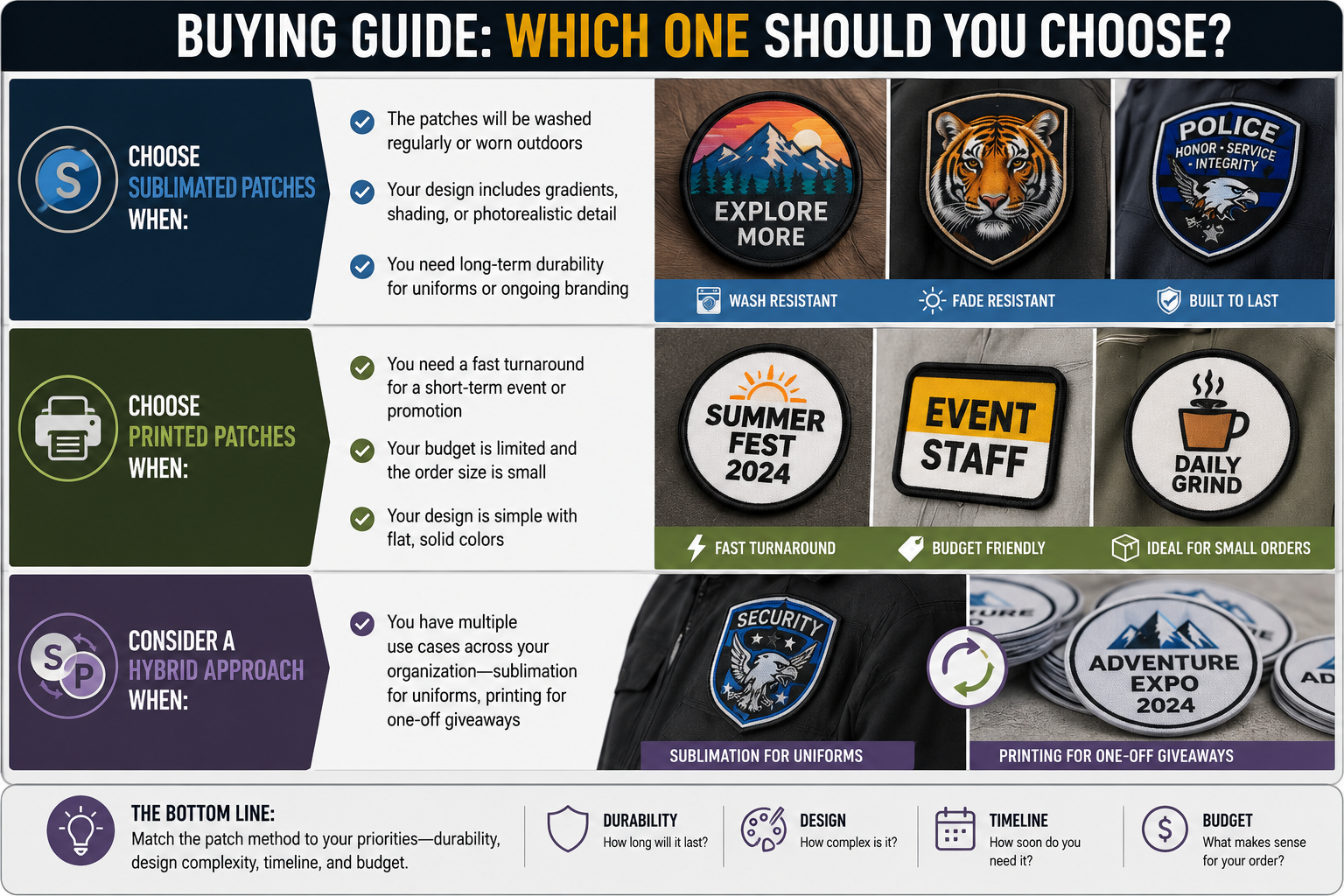
Choose sublimated patches when:
- The patches will be washed regularly or worn outdoors
- Your design includes gradients, shading, or photorealistic detail
- You need long-term durability for uniforms or ongoing branding
Choose printed patches when:
- You need a fast turnaround for a short-term event or promotion
- Your budget is limited and the order size is small
- Your design is simple with flat, solid colors
Consider a hybrid approach when:
- You have multiple use cases across your organization sublimation for uniforms, printing for one-off giveaways
Common Mistakes When Ordering Patches
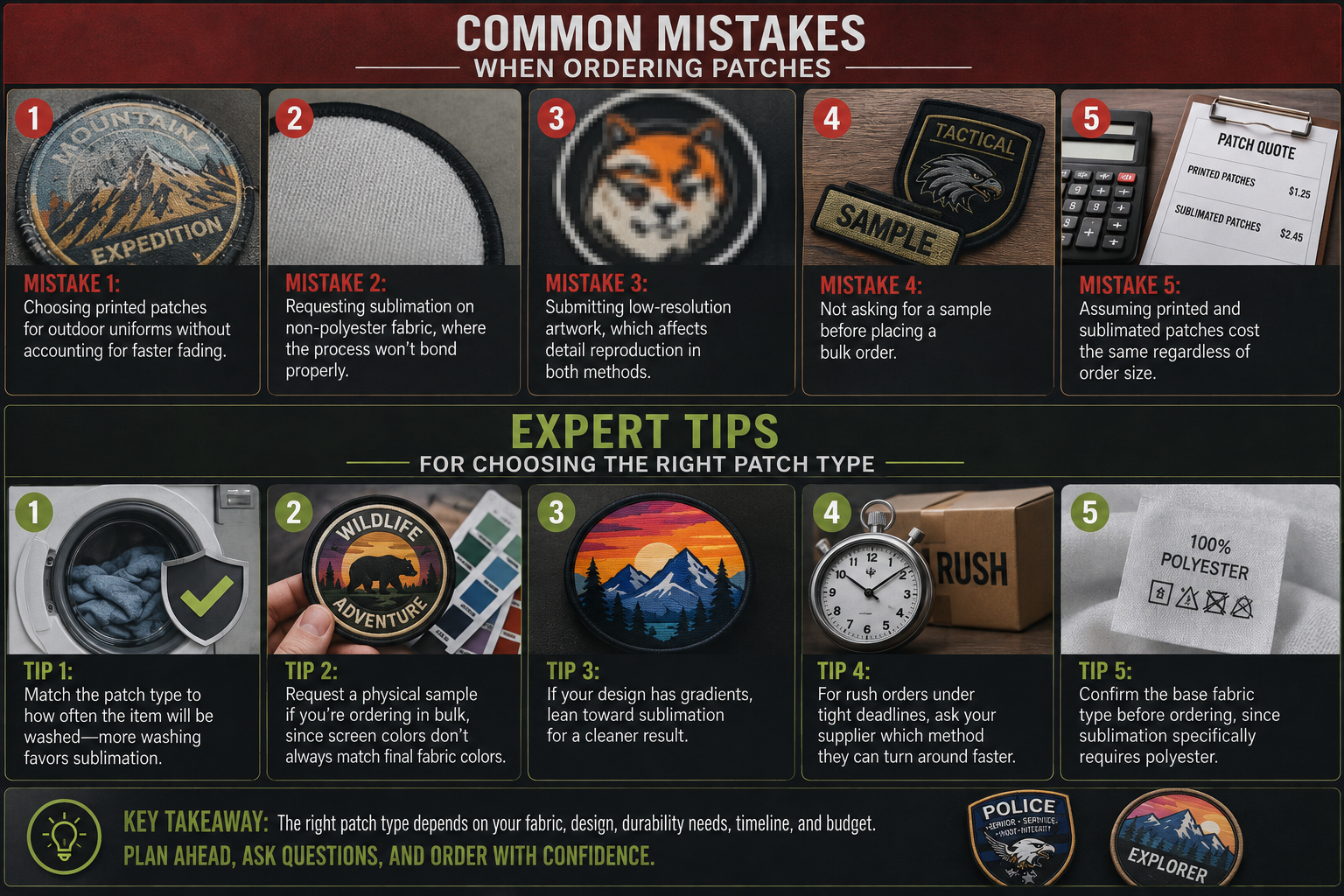
- Mistake 1: Choosing printed patches for outdoor uniforms without accounting for faster fading
- Mistake 2: Requesting sublimation on non-polyester fabric, where the process won’t bond properly
- Mistake 3: Submitting low-resolution artwork, which affects detail reproduction in both methods
- Mistake 4: Not asking for a sample before placing a bulk order
- Mistake 5: Assuming printed and sublimated patches cost the same regardless of order size
Expert Tips for Choosing the Right Patch Type
- Tip 1: Match the patch type to how often the item will be washed more washing favors sublimation
- Tip 2: Request a physical sample if you’re ordering in bulk, since screen colors don’t always match final fabric colors
- Tip 3: If your design has gradients, lean toward sublimation for a cleaner result
- Tip 4: For rush orders under tight deadlines, ask your supplier which method they can turn around faster
- Tip 5: Confirm the base fabric type before ordering, since sublimation specifically requires polyester
Customization Options
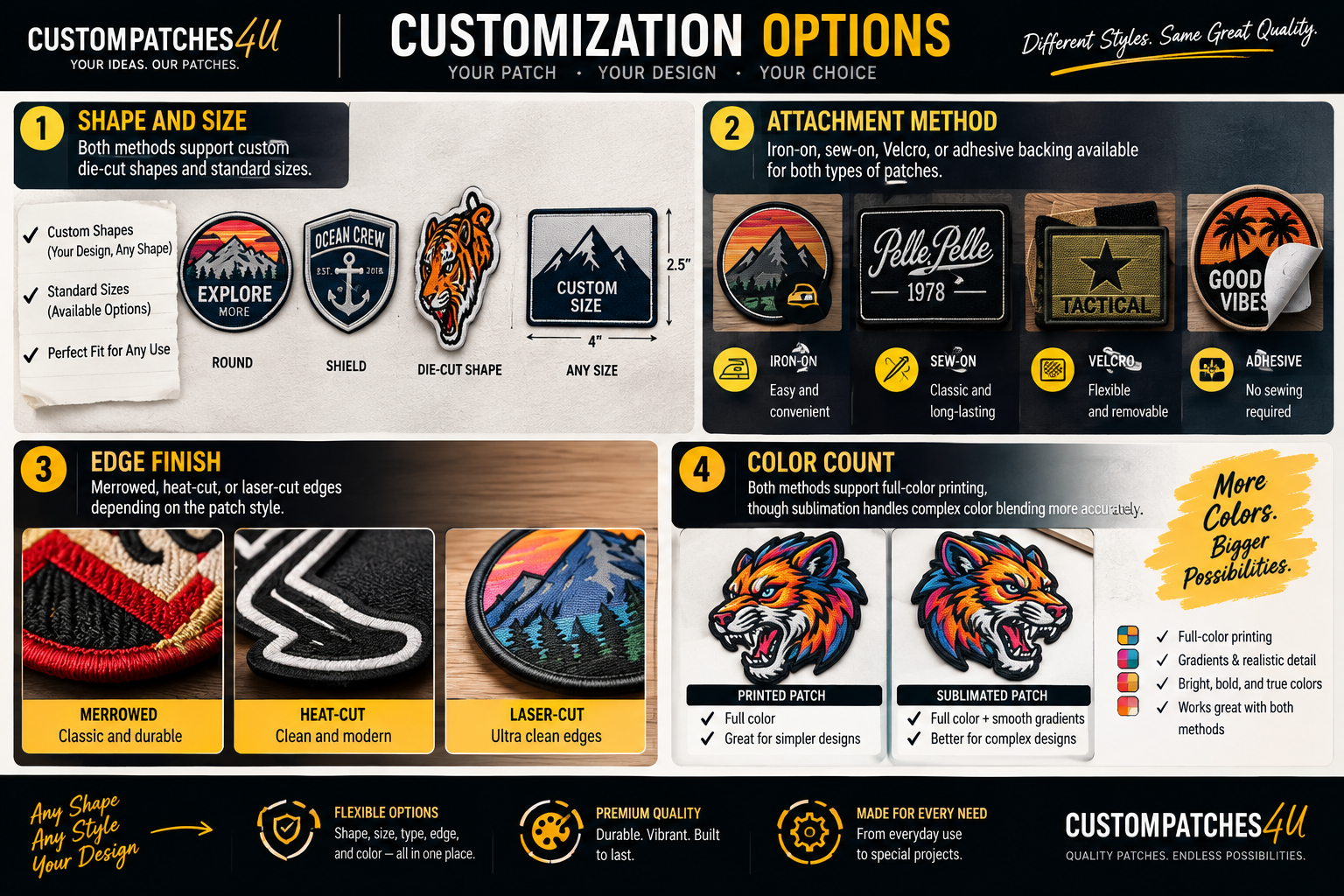
- Shape and size: Both methods support custom die-cut shapes and standard sizes
- Attachment method: Iron-on, sew-on, Velcro, or adhesive backing available for both types
- Edge finish: Merrowed, heat-cut, or laser-cut edges depending on the patch style
- Color count: Both support full-color printing, though sublimation handles complex color blending more accurately
Pricing Factors
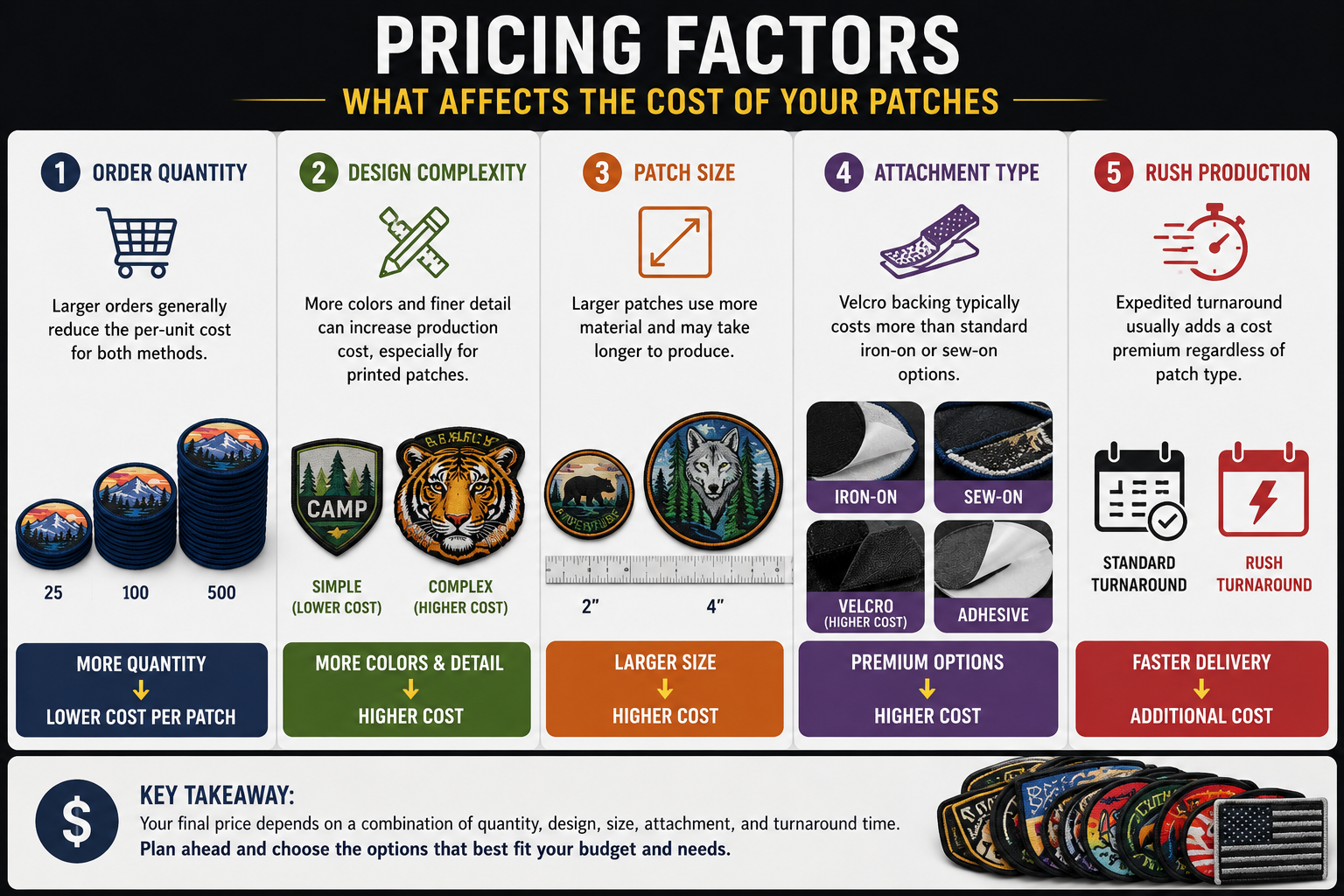
- Order quantity: Larger orders generally reduce the per-unit cost for both methods
- Design complexity: More colors and finer detail can increase production cost, especially for printed patches
- Patch size: Larger patches use more material and may take longer to produce
- Attachment type: Velcro backing typically costs more than standard iron-on or sew-on options
- Rush production: Expedited turnaround usually adds a cost premium regardless of patch type
Why Choose Custom Patches 4U
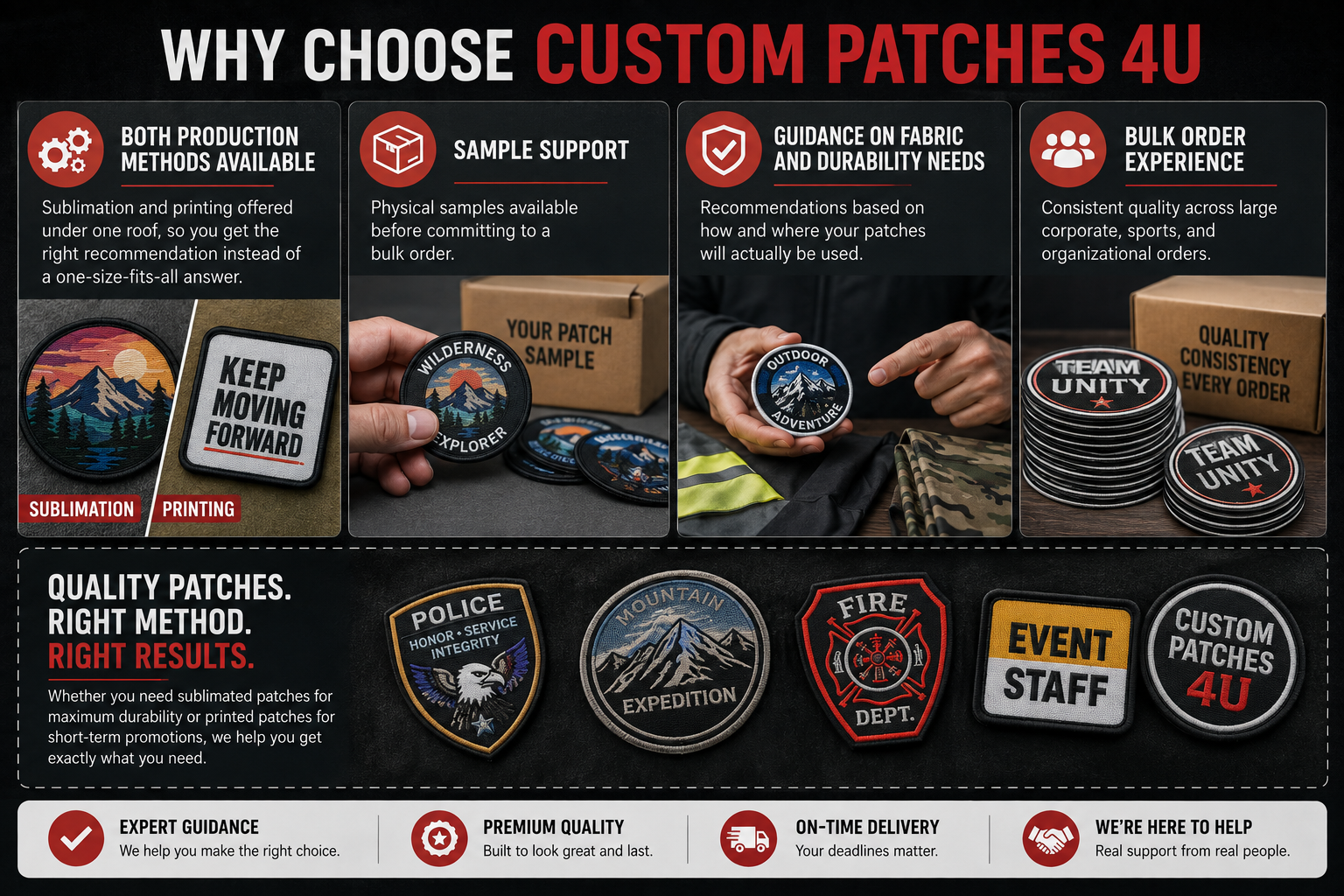
- Both production methods available: Sublimation and printing offered under one roof, so you get the right recommendation instead of a one-size-fits-all answer
- Sample support: Physical samples available before committing to a bulk order
- Guidance on fabric and durability needs: Recommendations based on how and where your patches will actually be used
- Bulk order experience: Consistent quality across large corporate, sports, and organizational orders
FAQs
What is a sublimated patch?
A sublimated patch is made by using heat to bond dye directly into polyester fabric fibers, producing a flat finish with strong color retention.
What is a printed patch?
A printed patch is made by applying ink onto the fabric surface, either through direct printing or heat transfer, without the ink bonding into the fibers.
Which lasts longer, sublimated or printed patches?
Sublimated patches generally last longer because the dye is embedded in the fabric rather than sitting on the surface, making them more resistant to fading and cracking.
Are sublimated patches more expensive than printed patches?
For small orders, printed patches are often cheaper. For larger orders, the cost gap narrows and sublimation’s durability can offer better long-term value.
Can sublimation be used on any fabric?
No, sublimation requires polyester or a polyester-blend fabric to bond properly; it does not work well on cotton or other natural fibers.
Which patch type is better for detailed logos?
Sublimated patches generally reproduce gradients, shading, and photorealistic detail more accurately than printed patches.
Are printed patches good for one-time events?
Yes, printed patches are often a practical choice for short-term events or promotions due to faster turnaround and lower cost for small quantities.
Do sublimated patches feel different from printed patches?
Yes, sublimated patches have a smooth, flat finish since the dye is part of the fabric, while printed patches can have a slightly raised texture depending on the method.
How do I know which patch type is right for my order?
Consider how often the item will be washed or exposed to weather, your design’s color complexity, and your budget and timeline each factor points toward one method over the other.
Can I order a sample before committing to a bulk order?
Yes, most suppliers, including Custom Patches 4U, offer sample patches so you can confirm color accuracy and quality before a full production run.
Get a Custom Patch Quote
If you're deciding between sublimated and printed patches, share your design, fabric type, and order size for a tailored recommendation and quote. Request a sample, ask about bulk pricing, or get guidance on which method fits your project before you place your order.